B.9 RAID 6 Arrays
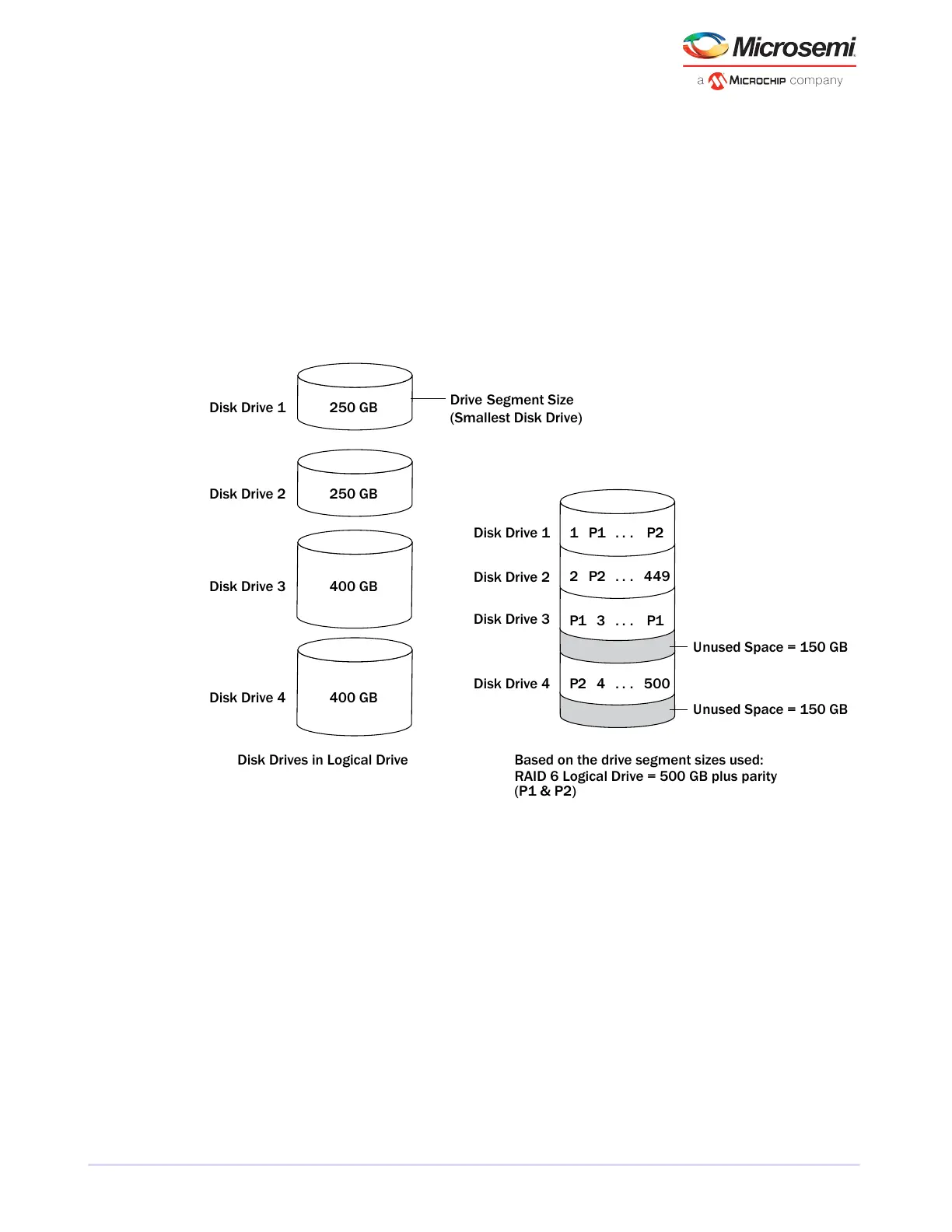
A RAID 6 array—also known as dual drive failure protection—is similar to a RAID 5 array because it uses
data striping and parity data to provide redundancy. However, RAID 6 arrays include two independent sets
of parity data instead of one. Both sets of parity data are striped separately across all disk drives in the
array.
RAID 6 arrays provide extra protection for your data because they can recover from two simultaneous disk
drive failures. However, the extra parity calculation slows performance (compared to RAID 5 arrays).
RAID 6 arrays must be built from at least four disk drives. Maximum stripe size depends on the number of
disk drives in the array.
Unused Space = 150 GB
Disk Drive 1
Disk Drive 2
Disk Drive 3
Disk Drive 4
250 GB
250 GB
400 GB
400 GB
Drive Segment Size
(Smallest Disk Drive)
Disk Drive 2
Disk Drive 3
Disk Drive 4
Disk Drive 1
Unused Space = 150 GB
Disk Drives in Logical Drive
Based on the drive segment sizes used:
(P1 & P2)
RAID 6 Logical Drive = 500 GB plus parity
P21 P1 . . .
4492 P2 . . .
P1P1 3 . . .
500P2 4 . . .
B.10 RAID 60 Arrays
Similar to a RAID 50 array (see RAID 50 ArraysRAID RAID 50arrays RAID 50), a RAID 60 array—also known
as dual drive failure protection—is built from eight disk drives congured as two or more RAID 6 arrays,
and stripes stored data and two sets of parity data across all disk drives in both RAID 6 arrays.
Two sets of parity data provide enhanced data protection, and striping improves performance. RAID 60
arrays also provide high data transfer speeds.
55
Microsemi Proprietary and Condential. Installation and User's Guide Revision 5
Understanding RAID



 To Next Page