EasyManua.ls Logo

Milltronics MultiRanger Plus - User Manual

Milltronics MultiRanger Plus
114 pages
Print Icon
To Next Page IconTo Next Page
Loading...
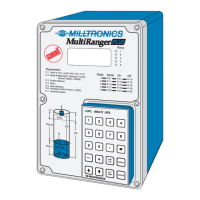
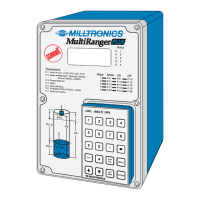
MULTIRANGER
PLUS
PROGRAMMABLE
LEVEL SYSTEM
Instruction Manual
PL-443
June 1995
33454430
PRR 1.1

Questions and Answers

  • M
    martinjesseAug 2, 2025
    What to do if my Milltronics Measuring Instruments has loss of echo?
    • A
      Amanda MurphyAug 2, 2025
      If your Milltronics Measuring Instruments is experiencing a loss of echo, there are several potential causes and solutions. It could be due to an open circuit or short circuit in the defective transducer or circuit board. Check the transducer wiring and the maximum temperature against the transducer rating, and try a substitute transducer. Alternatively, the level or target might be out of range. In this case, verify the transducer specifications, recalibrate parameters, re-aim the transducer, and consider using a polyethylene foam-faced transducer for dusty applications. Avoid using it on wet applications. You may also try using a longer-range transducer, increase the fail-safe timer, clean or move the transducer to a better location, or mount it in a standpipe.
  • A
    Amanda McfarlandAug 9, 2025
    What to do if the screen is blank and neon L1 is not flashing on my Milltronics MultiRanger Plus?
    • C
      Christopher ThomasAug 9, 2025
      If the screen on your Milltronics Measuring Instruments is blank and the neon L1 light is not flashing, the cause is likely a loss of power. To resolve this, check the power wiring, jumpers, and fuse.
  • G
    gsaundersAug 14, 2025
    Why does the reading not change on my Milltronics Measuring Instruments, but the level does?
    • Y
      ycarterAug 14, 2025
      If the reading on your Milltronics Measuring Instruments does not change even when the level does, it could be that the MultiRanger Plus is processing the wrong echo. This might be due to echoes from the vessel wall, a structural member, a stationary agitator, material hang-up, rat-tailing, or transducer ringing causing a high-level reading. To fix this, try re-aiming the transducer, and check the echoes with an oscilloscope. Ensure the transducer isn't in contact with metal and that the mounting is only hand-tight. You can also increase the blanking and raise the short measurement confidence threshold.
  • R
    robertkellyAug 20, 2025
    How to improve transducer location or aiming for Milltronics Measuring Instruments?
    • E
      Erin MyersAug 20, 2025
      To improve the transducer location or aiming for your Milltronics Measuring Instruments, relocate or re-aim the transducer to achieve maximum echo confidence. Also, inspect and use a foam deflector or stilling well.
  • B
    Bobby RodgersAug 27, 2025
    Why does the reading error progressively worsen with distance on my Milltronics MultiRanger Plus Measuring Instruments?
    • G
      Gregory CarlsonAug 27, 2025
      If the reading error on your Milltronics Measuring Instruments progressively worsens with distance, the issue may be related to temperature compensation or sound velocity compensation. Ensure that ‘J2’ is properly set.

Summary

General Information

Important Manual Information

Emphasizes reading and understanding the manual before installation and startup.

The MultiRanger Plus System

Describes the system's components and basic operational principle.

System Specifications

MultiRanger Plus Unit Specs

Details the technical specifications of the MultiRanger Plus unit.

Associated Component Specifications

Details specs for programmer, transducer, isolator, and cabling.

Installation Procedures

Mounting and Enclosure Details

Provides dimensions and mounting details for the unit.

Electrical Connections and Wiring

Details interconnection, transducer wiring, and power connections.

Programmer and Synchronization Setup

Explains programmer usage and synchronizing multiple units.

System Start Up and Operation

Initial Power Up and Modes

Covers the initial power-up and operation modes (Run/Program).

Programmer Keypad Functions

Explains the functions of keys in Run and Program modes.

Parameter Entry and Display Messages

Explains parameter entry and common display messages.

Functional Operation

Transceiver and Signal Processing

Explains transceiver operation, damping, and process rate control.

Temperature, Sound Velocity, and Blanking

Details temperature compensation, sound velocity calibration, and blanking.

Agitator Discrimination and Relays

Explains agitator discrimination and details relay modes and functions.

Pump Control and Analog Output

Details pump control functions and analog output configuration.

Analog Output Configuration

Analog Output Setup and Response

Explains programming analog output and its response to measurements.

Application Guides

Level, Pump, and Volume Applications

Covers parameters for simple level, pump control, and volume applications.

Differential Level and OCM Applications

Covers parameters for differential level and open channel measurements.

Flume;Weir Types and Standpipe Notes

Details flume/weir types for OCM and standpipe mounting considerations.

Parameter Configuration Details

General & Mode Parameters (P-1 to P-7)

Covers units, mode, distance, span, blanking, mA output, and decimal point.

Relay and Pump Control Parameters (P-8 to P-33)

Details relay functions, setpoints, pump logs, and control logic.

Volume, OCM, and Calibration Parameters (P-34 to P-67)

Covers tank shapes, volume conversion, OCM, and calibration.

Stabilization and Test Parameters (P-68 to P-99)

Covers damping, fail-safe, tests, and master reset.

Troubleshooting Guide

General Troubleshooting & Oscilloscope Use

Discusses common issues, echo processing, and oscilloscope use.

Symptom-Cause-Action Table

Lists common symptoms, their causes, and recommended actions.

Maintenance and Care

Periodic Checks and Cleaning

Recommends periodic checks and cleaning of the unit and transducer.

Sound Velocities Reference

Gas and Vapour Sound Velocities

Provides a table of sound velocities for various gases and vapours.

Glossary of Technical Terms

Glossary Definitions

Defines technical terms used in the manual.

Alphabetical Parameter Listing

Parameter Cross-Reference Index

Lists parameters alphabetically with their corresponding numbers.

Milltronics MultiRanger Plus Specifications

General IconGeneral
Measurement PrincipleUltrasonic
Output Signal4-20 mA
Enclosure RatingType 4X/IP66
Number of Transducers1
OutputsRelays
DisplayLCD
Measurement Range0.3 to 15 m (1 to 49 ft) depending on transducer
ApplicationLevel measurement of liquids, slurries, and solids in a wide range of industries

Related product manuals