EasyManua.ls Logo

Minolta IIIF - Page 26

Minolta IIIF
32 pages
Print Icon
To Next Page IconTo Next Page
To Previous Page IconTo Previous Page
Loading...
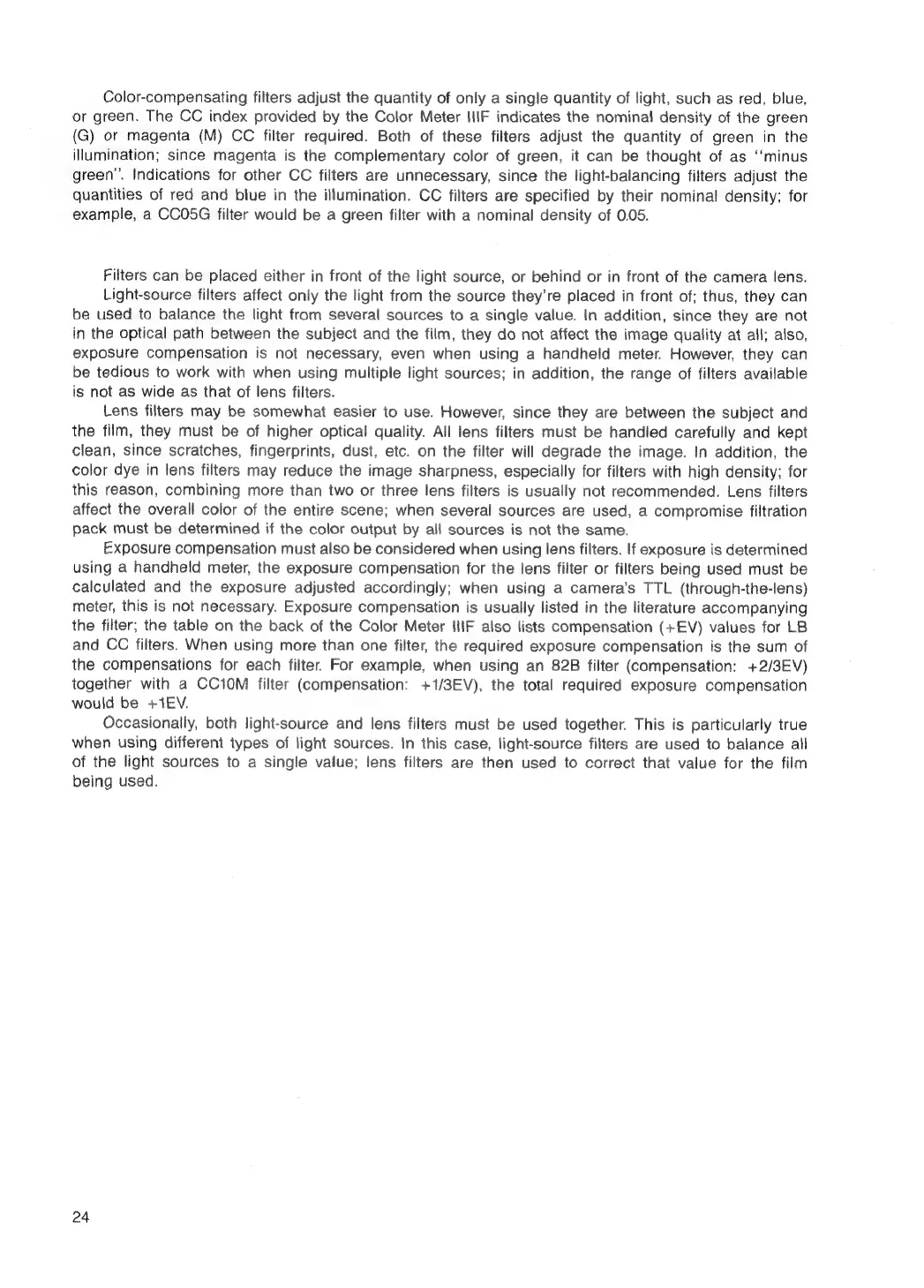
Color-compensating
filters
adjust
the
quantity
of
only
a
single
quantity
of
light,
such
as
red,
blue,
or
green.
The
CC
index
provided
by
the
Color
Meter
IIIF
indicates
the
nominal
density
of
the
green
(G)
or
magenta
(M)
CC
filter
required.
Both
of
these
filters
adjust
the
quantity
of
green
in
the
illumination;
since
magenta
is
the
complementary
color
of
green,
it
can
be
thought
of
as
“minus
green’.
Indications
for
other
CC
filters
are
unnecessary,
since
the
light-balancing
filters
adjust
the
quantities
of
red
and
blue
in
the
illumination.
CC
filters
are
specified
by
their
nominal
density;
for
example,
a
CCO5G
filter
would
be
a
green
filter
with
a
nominal
density
of
0.05.
Filters
can
be
placed
either
in
front
of
the
light
source,
or
behind
or
in
front
of
the
camera
lens.
Light-source
filters
affect
only
the
light
from
the
source
they’re
placed
in
front
of;
thus,
they
can
be
used
to
balance
the
light
from
several
sources
to
a
single
value.
in
addition,
since
they
are
not
in
the
optical
path
between
the
subject
and
the
film,
they
do
not
affect
the
image
quality
at
all;
also,
exposure
compensation
is
not
necessary,
even
when
using
a
handheld
meter.
However,
they
can
be
tedious
to
work
with
when
using
multiple
light
sources;
in
addition,
the
range
of
filters
available
is
not
as
wide
as
that
of
lens
filters.
Lens
filters
may
be
somewhat
easier
to
use.
However,
since
they
are
between
the
subject
and
the
film,
they
must
be
of
higher
optical
quality.
All
lens
filters
must
be
handled
carefully
and
kept
clean,
since
scratches,
fingerprints,
dust,
etc.
on
the
filter
will
degrade
the
image.
In
addition,
the
color
dye
in
lens
filters
may
reduce
the
image
sharpness,
especially
for
filters
with
high
density;
for
this
reason,
combining
more
than
two
or
three
lens
filters
is
usually
not
recommended.
Lens
filters
affect
the
overall
color
of
the
entire
scene;
when
several
sources
are
used,
a
compromise
filtration
pack
must
be
determined
if
the
color
output
by
all
sources
is
not
the
same.
Exposure
compensation
must
also
be
considered
when
using
lens
filters.
If
exposure
is
determined
using
a
handheld
meter,
the
exposure
compensation
for
the
lens
filter
or
filters
being
used must
be
calculated
and
the
exposure
adjusted
accordingly;
when
using
a
camera’s
TTL
(through-the-lens)
meter,
this
is
not
necessary.
Exposure
compensation
is
usually
listed
in
the
literature
accompanying
the
filter;
the
table
on
the
back
of
the
Color
Meter
IF
also
lists
compensation
(+EV)
values
for
LB
and
CC
filters.
When
using
more
than
one
filter,
the
required
exposure
compensation
is
the
sum
of
the
compensations
for
each
filter.
For
example,
when
using
an
82B
filter
(compensation:
+2/3EV)
together
with
a
CC10M
filter
(compensation:
+1/3EV),
the
total
required
exposure
compensation
would
be
+1EV.
Occasionally,
both
light-source
and
lens
filters
must
be
used
together.
This
is
particularly
true
when
using
different
types
of
light
sources.
In
this
case,
light-source
filters
are
used
to
balance
all
of
the
light
sources
to
a
single
value;
lens
filters
are
then
used
to
correct
that
value
for
the
film
being
used.
24