EasyManua.ls Logo

Minolta IIIF - Page 27

Minolta IIIF
32 pages
Print Icon
To Next Page IconTo Next Page
To Previous Page IconTo Previous Page
Loading...
Photographic
Color
Temperature
The
Color
Meter
UE
determines
the
photographic
color
temperature
according
to
the
ratio
between
the
intensity
of
light
in
the
blue
region
and
that
in
the
red
region
of
the
spectrum;
the
resulting
value
is
referred
to
as
‘‘photographic
color
temperature”,
since
it
is
determined
based
on
the
characteristics
of
color
film.
Higher
B/R
ratios
result
in
higher
photographic
color
temperatures.
However,
this
method
assumes
that
the
spectral
power
distribution
of
the
light
source
is
continuous
with
no
sharp
peaks,
such
as
those
of
sunlight
and
many
tungsten
lamps.
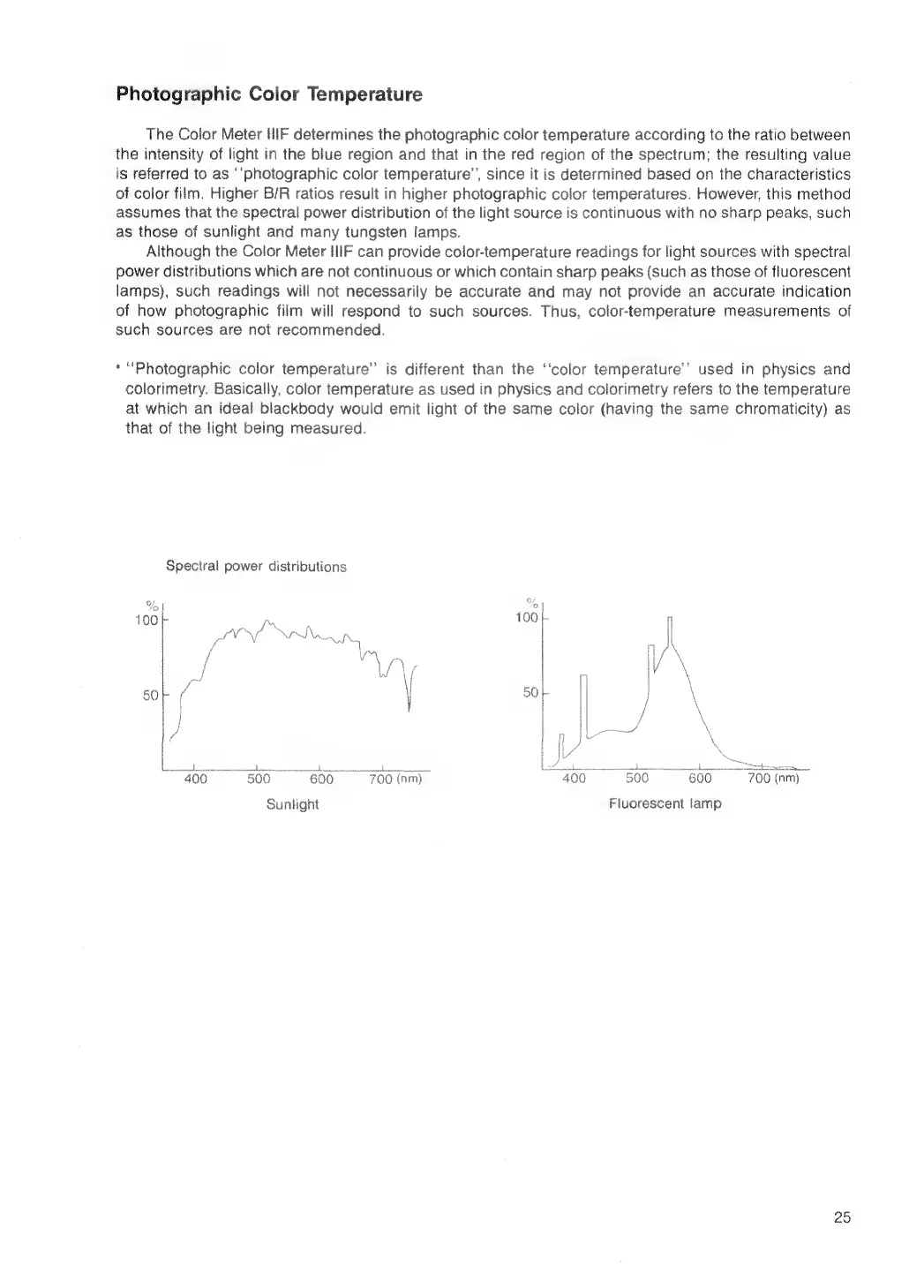
Although
the
Color
Meter
IHF
can
provide
color-temperature
readings
for
light
sources
with
spectral
power
distributions
which
are
not
continuous
or
which
contain
sharp
peaks
(such
as
those
of
fluorescent
lamps),
such
readings
will
not
necessarily
be
accurate
and
may
not
provide
an
accurate
indication
of
how
photographic
film
will
respond
to
such
sources.
Thus,
color-temperature
measurements
of
such
sources
are
not
recommended.
*
“Photographic
color
temperature”
is
different
than
the
“color
temperature’
used
in
physics
and
colorimetry.
Basically,
color
temperature
as
used
in
physics
and
colorimetry
refers
to
the
temperature
at
which
an
ideal
blackbody
would
emit
light
of
the
same
color
(having
the
same
chromaticity)
as
that
of
the
light
being
measured.
Spectral
power
distributions
400!
100
!-
50!
50+
anes
400
500 600
700
(nm)
i>
ch
L
£
400
500
600
700
(nm)
Sunlight
Fluorescent
lamp
25