Need help?
Do you have a question about the MIR MIR250 Shelf Carrier and is the answer not in the manual?
Guides on operating MiR robots, accessories, and software, including quick starts and reference guides.
Details previous versions of the document, including release dates and descriptions of changes.
Highlights key features like autonomous driving, route planning, and user-friendly interface.
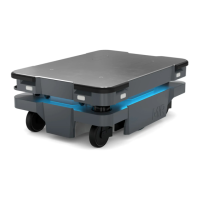
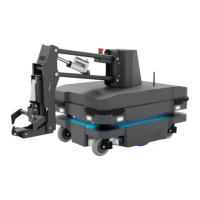
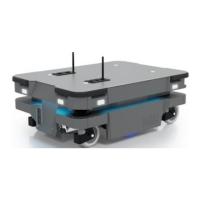
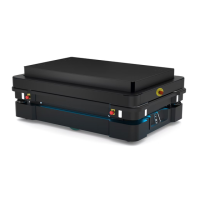
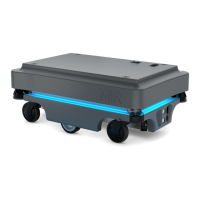
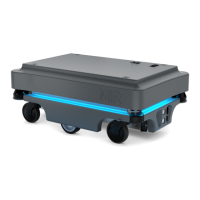
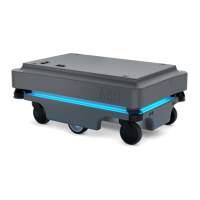
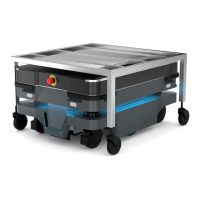
Identifies and describes the external components of the MiR250 Shelf Carrier robot.
Describes the control panel, its buttons, and operating modes for robot control.
Details the internal compartments of the robot and how to access them safely.
Explains the mechanism of picking up and placing shelves using carrier pins.
Explains the different types of safety messages used in the document (Warning, Caution, Notice).
Outlines general safety precautions to prevent injury or damage when operating the robot.
Specifies intended use and lists uses considered misuse of the MiR250 Shelf Carrier.
Defines intended user types (commissioners, operators, direct users) and their responsibilities.
Describes the warning label prohibiting riding and identifies potential hazards.
Step-by-step guide to opening and accessing the front compartment of the robot.
Step-by-step guide to opening and accessing the rear compartment of the robot.
Step-by-step guide to opening and accessing the side compartments of the robot.
Instructions on removing the top plate to access internal parts of the MiR Shelf Carrier.
Lists the contents of the robot's packaging and provides unpacking instructions.
Step-by-step guides for connecting the battery and powering on the robot.
Steps to connect to the robot's web interface via WiFi for configuration and control.
Instructions on operating the robot manually and moving it by hand.
Procedure to check hardware status and instructions for mounting the nameplate.
Steps to enable MiR250 Shelf Carrier features and test the top module functionality.
Step-by-step instructions for safely shutting down the MiR250 Shelf Carrier robot.
Detailed guide on how to charge the MiR250 Shelf Carrier using a MiR cable charger.
Procedure for disconnecting the battery and enabling fast swap functionality.
Guidelines for proper battery storage to preserve service life and disposal instructions.
Guidance on controlling access to the robot by managing user accounts and passwords.
Information on how MiR provides and installs software security patches to enhance system security.
Overview of navigation system processes and required user inputs for autonomous navigation.
Explains the roles of global and local planners in determining robot paths and avoiding obstacles.
Explains how sensors (laser scanners, cameras, proximity sensors) detect obstacles.
Explains how the robot determines its position on the map using sensor data and filtering.
Explains motor control for movement and the robot's braking systems.
Overview of the safety system and the different robot stop states.
Explains Protective and Emergency stop states and how to resume robot operation.
Describes Manual stop and key safety functions like personnel detection.
Details personnel detection safety function and protective field sets based on speed.
Explains overspeed avoidance, stability monitoring, and emergency stop buttons.
Details safety functions specific to MiR Shelf Carrier, including shelf-specific fields.
Explains safety contactors and the processes for initiating a safety stop.
Describes status lights, signal lights, and speaker functions for robot communication.
Factors to consider in the work environment for safe and proper robot functioning, including surfaces.
Process for assessing installation risks, covering robot, stations, and environment.
Design requirements for shelves and their dimensions for safe robot interaction.
Guide on creating and configuring maps, including zones, for reliable robot navigation.
Defines markers and positions on maps for accurate robot docking and travel.
Best practices for creating missions by combining actions like move, logic, and docking.
Setting robot footprints and configuring operating hazard zones for safe operation.
Procedures for brake testing and creating user groups and accounts.
Creating dashboards, updating software, and managing backups.
Creating backups and configuring system settings, including planner and safety.
Steps to create markers and positions on a map for robot navigation and docking.
Defining marker types for shelves to ensure correct docking and shelf pick-up.
Creating missions that prompt user input or handle mission errors with Try/Catch.
Creating missions for variable docking and navigating narrow doorways.
Creating missions for picking up/placing shelves and precise placement using VL-markers.
Procedure for testing created missions to ensure correct execution and smooth operation.
Tasks to be performed weekly for robot maintenance, including cleaning and checks.
Schedule for regular checks and replacement of parts like PLC, hardware, covers, and sensors.
Guidelines for cleaning and maintaining the robot's battery.
Lists original packaging materials and provides steps for packing the robot.
Transport regulations and safety precautions for lithium-ion batteries.
Diagrams showing payload center of mass limits at 1.2 m/s from the side.
Diagrams showing payload center of mass limits at 1.2 m/s from the front.
Diagrams showing payload center of mass limits at 1.2 m/s from the top.
Details the emergency stop interface on the left side of the robot.
Describes GPIO A and B interfaces on the right side for general purpose communication.
Details the auxiliary safety function interfaces for supporting safety features and emergency stops.
Guidance on preventing and resolving software errors like failed localization or reach destination.
Steps to troubleshoot and resolve hardware faults, including physical checks and resets.

 To Next Page
 General