Need help?
Do you have a question about the MIR MiR250 HooK and is the answer not in the manual?
Guides on finding documentation, courses, and resources from MiR.
Details about revisions, dates, and changes made to the manual.
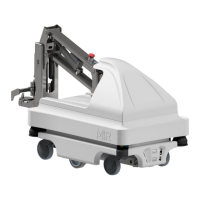
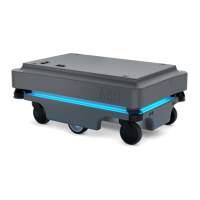
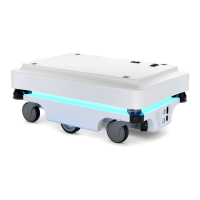
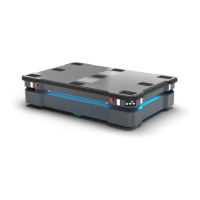
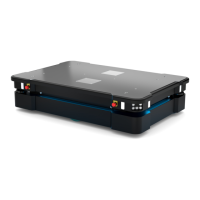
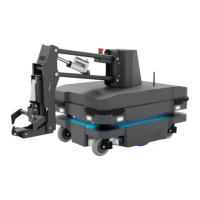
Identification and description of the MiR250 Hook's external components.
Details on internal components in various compartments of the robot.
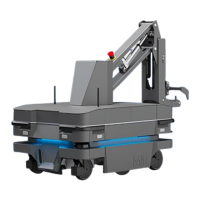
Explanation of the autonomous pick, transport, and place functionality of the hook.
Information on how lights and speaker communicate robot actions.
Responsibilities of the system manufacturer regarding safety and compliance.
Defines the meaning of WARNING, CAUTION, NOTICE, and information symbols used.
Essential safety guidelines for operating the MiR250 Hook robot safely.
Defines proper operating environments and applications for the MiR250 Hook.
Lists uses of the robot that are considered misuse and therefore prohibited.
Identifies potential hazards and precautions for integrators and personnel.
Lists the contents included in the MiR250 Hook packaging.
Step-by-step instructions for safely removing the robot from its packaging.
Procedure for connecting the robot's battery after unpacking.
Steps to safely turn on the MiR250 Hook robot and prepare it for operation.
Procedure for safely turning off the MiR250 Hook robot.
Instructions for establishing a connection to the robot's internal network.
Guide on connecting the robot wirelessly to a Wi-Fi network.
Enabling advanced configurations for maneuverability in tight spaces.
Steps to prepare the robot and its battery for extended periods of storage.
Instructions for enabling the fast battery swap option for easier battery removal.
Procedure for safely disconnecting the robot's battery for maintenance or transport.
Essential requirements for the operating environment, including surfaces and lighting.
Details on the different operating modes: Manual, Autonomous, and Locked.
Explanation of the different robot stop states: Operational, Protective, Emergency, and Manual.
Requirements and dimensions for carts that the MiR250 Hook can tow.
Information on using QR codes or AprilTags for cart identification and pick-up.
Procedure for calibrating the robot's hook to a specific cart for accurate docking.
Steps to define custom cart types and their parameters in the robot interface.
Overview of integrated safety functions like emergency stops and overspeed avoidance.
Details on the location and function of the robot's emergency stop button.
How the robot prevents overspeed conditions to maintain safety.
Explanation of how laser scanners detect obstacles and personnel for safety stops.
Procedure to access internal components by removing covers and the top module.
Step-by-step guide on how to safely remove the MiR Hook 250 top module from the robot.
Description of electrical interfaces on the left side of the robot.
Description of electrical interfaces on the right side of the robot.
Technical details of the MiR250 Hook robot, including speed, capacity, and dimensions.
Specifications related to the robot's battery model, type, weight, and dimensions.
Environmental requirements for optimal robot performance, including temperature and lighting.
Safety precautions to take before starting any maintenance tasks on the robot.
Instructions on how to open the robot's compartments to access internal components.
Regular checks and maintenance tasks to ensure the robot's optimal performance and longevity.
Procedures and considerations for updating the robot's software to the latest version.
Guidance on creating backups of robot settings, missions, and reports.
Troubleshooting common software errors related to localization and mission execution.
Steps to diagnose and resolve hardware-related issues affecting the robot's functionality.
A list of common error codes and their corresponding solutions for the robot.
Instructions for safely lifting the MiR250 Hook robot using appropriate lifting devices.
Steps for properly packing the robot using original materials for safe transport.
Guidelines for safely transporting the lithium-ion battery according to regulations.
 General
| Battery Life/Uptime | 10 hours |
|---|---|
| Charging Time | 1.5 hours |
| Connectivity | Wi-Fi, Ethernet |
| Load Capacity/Payload | 250 kg |
| Speed | 2 m/s |
| Battery | Li-ion |
| Safety Standards | EN ISO 3691-4 |

 To Next Page