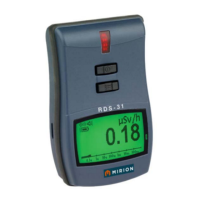
The Mirion RDS-30 Survey Meter is a digital handheld dose rate meter designed for personnel who may be exposed to gamma and/or X-ray radiation. It is microprocessor-controlled and features a user-friendly interface with a single push button and an LCD display. The device provides sequential alarms for fixed dose rate values and can store dose rate events in its histogram memory.
Function Description:
The RDS-30 measures gamma and X-ray radiation within a range of 48 keV to 1.3 MeV. It utilizes an energy-compensated GM tube, with energy response according to ambient dose equivalent H*(10). The measurement range for dose rate is 0.01 – 100,000 µSv/h or 0.001 – 10,000 mrem/h, and for cumulative dose, it's 0.01 – 1,000,000 µSv or 0.001 – 100,000 mrem. The device offers adjustable alarm levels for both dose rate and accumulated dose. Different alarm situations are indicated by a combination of audio-visual effects on the LCD and a buzzer, covering dose rate alarms, low battery warnings, device defects, and dose rate overflow. The histogram function records 480 dose rate values with a configurable time interval (10 to 14,400 seconds) and operates on a FIFO principle, replacing the oldest value with the newest once full. A ring counter tracks memory overflows.
Important Technical Specifications:
- Radiation Detected: Gamma and X-rays, 48 keV to 1.3 MeV.
- Detector: Energy-compensated GM tube, with energy response according to ambient dose equivalent H*(10).
- Measurement Range:
- Dose Rate: 0.01 – 100,000 µSv/h or 0.001 – 10,000 mrem/h.
- Dose: 0.01 – 1,000,000 µSv or 0.001 – 100,000 mrem.
- Calibration Accuracy: ± 5% of the reading in 137Cs exposure, at 3 mSv/h (300 mrem), +20°C (68°F).
- Dose Rate Linearity: ±10% ± 1 digit in the range of 0.0001 - 100 mSv/h.
- Response to Radiation Energy: ±30% over the range of 48 keV - 1.3 MeV.
- Response to Angle of Radiation Incidence: ±25% within ± 45° from the calibration direction with 48 keV energy.
- Power Supply: 2 x alkaline cell IEC LR6/AA.
- Battery Life: At least 2000 hours at normal background with alkaline cells.
- Battery Alarm: Two-step alarm for low battery voltage.
- Case: Rugged plastic case.
- Dimensions: 78 x 126 x 32 mm.
- Weight: 170 g without batteries, 220 g with batteries.
- Temperature Range:
- Operational: -25°C to +55°C (-13°F to 131°F).
- Storage: -40°C to +70°C (-40°F to 158°F).
- Connection: IrDA link to PC.
- Document Number: 2096 5600, Version 1.13, Issue Date 24.4.2014.
- Order Numbers: RDS-30 µSv/h: 1233-244, RDS-30 mrem/h: 1233-250.
- Configuration Software Order Number: 1233-246.
Usage Features:
The RDS-30 is operated via a single push button. A short press produces a beep, while a long press (until a second beep) completes an action. The six-digit display shows dose rate and various messages.
- Switch On: Press the push button briefly. The meter performs a self-test (all segments lit, buzzer activated, backlight on, battery test, HV-generator test, IrDA-link activated for 3 seconds). The dose rate is displayed within 10 seconds.
- Display Illumination: A single short press activates the backlight for 10 seconds. Configurable options allow for timeout mode (10 seconds), user-defined mode (on until pressed again), or permanently on.
- Menu Navigation: A long press (approx. 3 seconds) activates the menu, displaying "oFF". Short presses scroll through menu items. A long press on a desired menu item activates it. If no button is pressed for 7 seconds, the display returns to dose rate.
- Switch Off: From the menu, select "oFF" and long-press the button.
- Cumulative Dose (doSE): Displays and can be reset (configurable).
- Chirp Function (cHirP): Can be activated/deactivated and set to high or low sensitivity (configurable). High sensitivity chirps for every GM-tube pulse; low sensitivity divides the pulse rate by 16.
- Dose Rate Alarm Level (drAL): Configurable for single or multilevel alarm. Users can select from 8 predefined levels (disabled, 10, 50, 100, 500, 1000, 5000, 10000, 50000 µSv/h or mrem/h), which can be customized via CSW. Multilevel alarm activates sequentially.
- Dose Alarm Level (doSEAL/doAL.ti): Configurable for single or multilevel alarm. Similar to dose rate alarm, with 8 predefined levels (disabled, 100, 500, 1000, 5000, 10000, 50000, 100000, 500000 µSv or mrem), customizable via CSW.
- Time to Dose Display: Double-click the push button to show the time required to reach the current dose alarm level (hhHmm format, max 99H59). This feature is configurable.
- Diagnostics (diAG): Shows battery capacity (e.g., cAP67), firmware version, and performs a battery/display test. "LobAt" indicates weak batteries.
- IrDA Communication (irdA): Activates the infrared port for 7 seconds for communication with CSW software to change configuration or download histogram data. No dose rate measurement is performed when IrDA is active.
- Histogram Interval (HiSto): Displays the current logging interval (in seconds) or "diSAbL" if disabled. Configurable to store instant, average, or maximum dose rate values.
- Indication Unit: Selectable between µSv/h and mrem/h.
Maintenance Features:
- General Maintenance: No specific maintenance is required apart from periodic calibration checks.
- Cleaning and Decontamination: Can be performed using solutions suitable for ABS polymer and polycarbonate materials.
- Battery Replacement: Open the battery compartment cover, remove old batteries, and insert two new IEC LR6/AA alkaline batteries, observing correct polarity. After replacement, it is recommended to perform the functional test (diAG). If "LobAt" appears, refit the batteries.
- Error Handling: The device displays "dEF" (defective) and "Err+number" (e.g., Err3 for detector error) with a continuous audible alarm if a critical error occurs. Non-critical errors may show "Err+number" alternating with dose rate, providing a visual alarm without an audible one. Users should note the error number and contact the manufacturer for servicing.
- Configuration Software (CSW): Used for advanced configuration, including disabling menu items, customizing alarm levels, and managing histogram settings. The CSW allows downloading histogram data and setting a time stamp for accurate time scale.

 Need help?
 General




 To Next Page