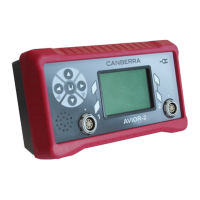
The Mirion Technologies AVIOR-2/AVIOR-2 I/O and MIP-2/MIP-2 I/O are multi-function portable polyradiameters designed for radiation protection measurements. These devices are ALARA (As Low As Reasonably Achievable) platforms, capable of measuring dose equivalent flow rates and contaminations. They support a wide range of probes, with the AVIOR-2/AVIOR-2 I/O supporting two CSP probes, and the MIP-2/MIP-2 I/O supporting one CSP type probe and one Nardeux type probe. The "I/O" versions (AVIOR-2 I/O and MIP-2 I/O) offer additional functionalities such as digital alarms and measurement data via RS485, a 24 VDC power supply, and an audio output jack.
Physical Description and Ergonomics:
The devices feature a rugged and decontaminable housing, enclosing the processing electronics and a bright liquid crystal display. Elastomer protection is provided at the front and rear. The design allows for versatile use: on a table with a retractable foot, on a stand support (for Hand/Foot option), hanging on a wall bracket, or portable with grip zones for easy handling, even with gloves.
Key Usage Features:
The devices offer four main measurement modes:
- Direct Measurement: The default mode at startup, used for body or object contamination measurements. It determines fixed surface contamination and can be influenced by internal radiation or the environment. The unit of measurement displayed is specific to the probe and can be set based on the user level. Measurements are automatically recorded at a rate of one per minute, and manual recording is also possible.
- Counting Scale Mode: Accessible from the "Technician" user level, this mode integrates the counting rate to achieve significant measurements and/or reduce uncertainty. Measurements can be stopped based on an integration time or a target uncertainty (alpha and/or beta).
- Screening Mode: Accessible to all user levels, this mode provides a simple indication of whether an object is "clean" or "contaminated" based on low and high alarm thresholds. It also indicates "high contamination" or "saturated" for excessive activity.
- Hand/Foot Mode: Accessible from the "Technician" user level, this mode requires optional Hand/Hand or Hand/Foot stands equipped with presence detectors. It allows for contamination measurement using one or two probes (alpha and/or beta hand/foot probes). The device differentiates between background noise and actual measurements.
User Interface:
The front panel features a keyboard with five keys for navigation and function control, an LCD display, a loud speaker, and LEDs for interfaces 1 and 2.
- Keyboard Functions: Keys allow for stopping/starting measurements, entering/exiting the main menu, validation, forced stop (long press), navigation (left, right, down, up arrows), recording measurements, toggling simulated sound, and controlling backlight.
- Charging Indicator: LEDs (green or red) indicate battery charge status when connected to an external power source (AC, USB, or 24 VDC). A battery status symbol is always displayed on the top banner.
- Interface LEDs: Two multi-color LEDs (Red, Green, Blue, Orange, Purple) are associated with Interface 1 and Interface 2, indicating alarms and malfunctions. These LEDs cannot be disabled.
- Loud Speaker Audio Output: Emits modulated sounds for count rate indication (simulated sound, adjustable volume), low/high threshold alarms, saturation alarms, and alert messages (e.g., "Low battery," "CPC expired"). The "I/O" versions include an audio output jack for stereo headphones.
Technical Specifications:
- Dimensions (W x H x L): 184 mm x 105 mm x 105 mm
- Weight: 950 g (including battery)
- Power Supply: 100-240V 50/60 Hz, 300 mA (Mains via CEE 7/7 Plug and IEC 320 C13 socket).
- External Power Supply (AVIOR-2 I/O & MIP-2 I/O): 24VDC, 500 mA.
- Battery: Lithium-ion, 3.7V/5.3 Ah, 19.6W, max current 5A. Charging time is less than 4 hours. Battery performance is 70% of original capacity after 850 discharge cycles at 100%.
- Autonomy (1 µGy/h ambient dose, 30 min sound/visual alarm, no backlight): SBM-2D Probe CSP type = 67 hours; SBM-2D Probe Nardeux type = 48 hours (MIP-2 only).
- Autonomy (permanent sound/visual alarm, no backlight): SBM-2D Probe CSP type = 15 hours; SBM-2D Probe Nardeux type = 14 hours (MIP-2 only).
- Environmental Characteristics: Audible alarm > 85 dB(A) at 30 cm, Operating temperature -20°C to +50°C, Storage temperature -25°C to +60°C, Protection class IP54, Vibration and shock compliant with IEEE N42.17A and NF EN 60068-2-75 standards, Max operating altitude 2000 m.
- Measurement Units: Bq, c/s, Bq/cm², Sv/h (according to probe).
- Display Range: 0.01 Bq to 99.9 GBq, 0.01 c/s to 99.9 kc/s, 0.01 Bq/cm² to 99.9 GBq/cm², 0.01 nSv/h to 99.9 MSv/h.
- Display: 3 digits, floating point with 2 significant digits.
- Response Time: Instantaneous measurement: 0.25 s, Smoothed measurement: 1s.
- Connectivity: USB mini plug, 8-pin connector for measurement interfaces (16-pin for Nardeux probe type on interface 1 of MIP-2).
- Inputs/Outputs (AVIOR-2 I/O & MIP-2 I/O): 5 relay outputs (NO, NC, 125 VAC, 60 VDC, 1A contacts), 2 opto-coupled inputs (control voltage 5VDC-24VDC), RS485 link (2-wire MOD BUS), +5V output (150 mA), +24V input (500 mA), 3.5mm audio jack (3-contacts headphones, 320 Ohm impedance, 100mW max power).
Configuration and Parameters:
- User Levels: Administrator, Technician, and Operator, with varying access to functions. Password protection is available.
- Probe Configuration: Allows setting low/high alarm thresholds and units. For CSP probes, 10 predefined threshold values are stored. For Nardeux probes, thresholds can be modified.
- Intermediate Periodic Control (IPC) of CSP Probes: Verifies measured activity against a source. An expiry date can block probe use if exceeded.
- Periodic Calibration Control (CPC): Checks characteristic values against the calibration certificate. An expiry date can block probe use. Calibration coefficients for CSP probes are set with Canberra Smart Probe Software (CSPS), while Nardeux probe coefficients are generic and stored in the MIP-2.
- Background Noise Settings: Configures subtraction measurement, dynamic measurement mode, excessive BKG alerts, acquisition time, validity period, false alarm factor (Ka), variation coefficient (K), screen factor, minimum/maximum integration time, and measurement time.
- Hand/Foot Settings: Configures double-sided hand measurements, auto integration time, and audible alarm activation.
- Display and Sound Settings: Adjusts backlight level and simulated sound volume.
- Date and Time: Sets the device's date and time, accessible at the Administrator level.
- Software Version Display: Shows the bootloader and application versions.
- Language Setting: Allows selection of the device language.
Data Management:
- Saving Data (Log Files): The device can store over 100 days of data at a rate of one point per minute. Older records are erased if memory is full. Alarm and alert events are timestamped. Data is saved automatically for events and current measurements, and can also be saved on demand. Log files are stored in a "LOG" directory with subdirectories for AUTO, COUNTING_SCALE, DIRECT_MEASURE, and HAND_FOOT modes.
- USB Mode: Connects the device to a computer or USB key for file transfer and software updates. Log files can be exported, and configuration files can be imported/exported.
Maintenance Features:
- Preventive Maintenance: Includes periodic checks (every 18 months in storage, annually, or after opening the device) to verify proper functioning and battery charge.
- Troubleshooting: A table provides common symptoms and actions, such as connecting power, checking USB communication, varying speaker volume, and formatting RAM.
- Battery Replacement: Involves removing the battery cover (6 screws), disconnecting the old battery, and installing a new one. It is crucial to use only recommended rechargeable batteries.
- Decontamination and Cleaning: The devices are easily decontaminable and have an IP54 rating. Cleaning involves aspirating dust, wiping with ALCATUM-impregnated towels and SED water, and checking background noise. For fixed contamination, nitric acid diluted to 5% can be applied, left to stand, rinsed, and background noise checked. Only soft, dry, or damp cloths should be used for cleaning, avoiding strippers, waxes, or corrosive solvents.

 Need help?
 General




 To Next Page