OPERATION
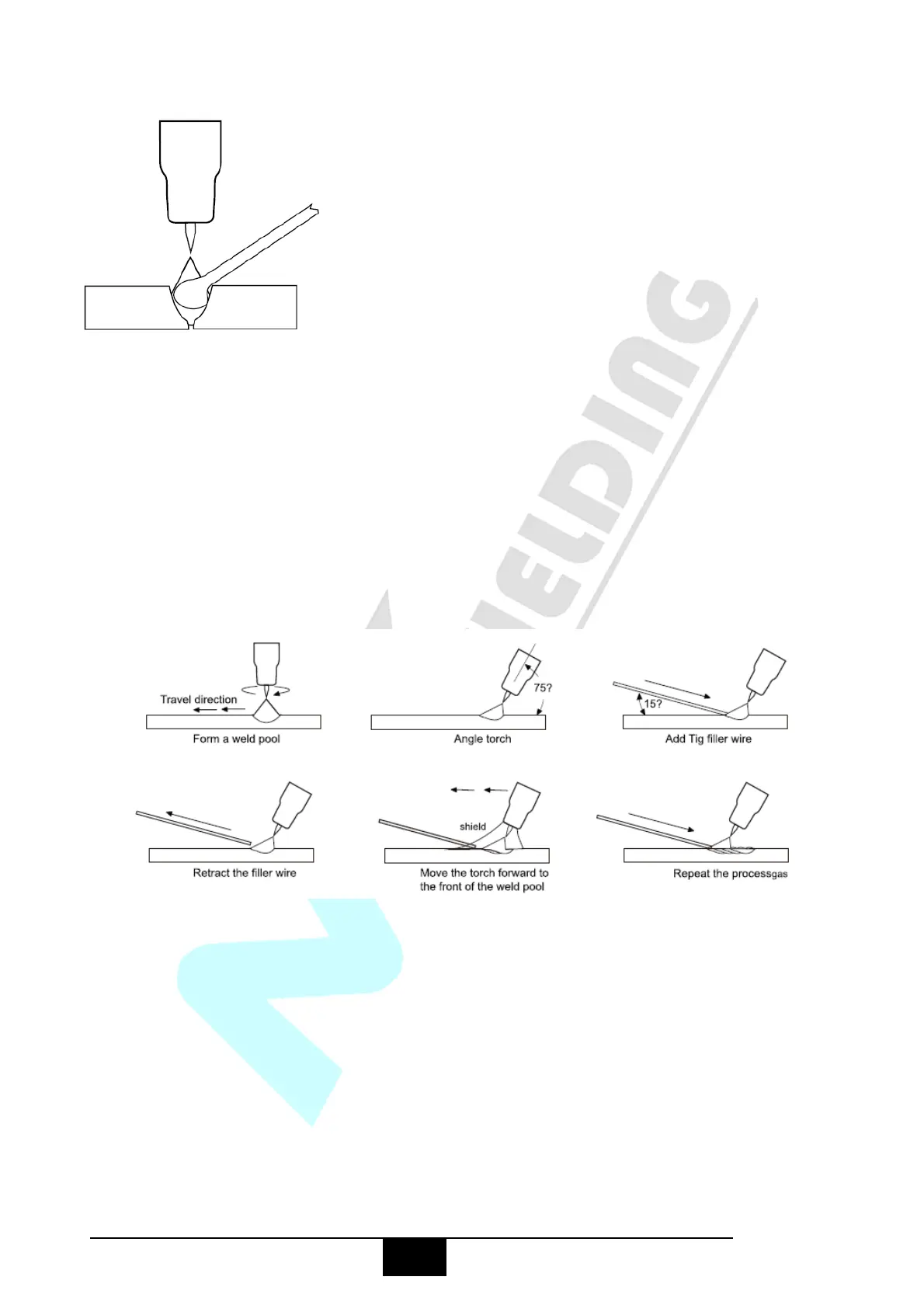
It is necessary in many situations with TIG welding to add a
filler wire into the weld pool to build up weld reinforcement
and create a strong weld. Once the arc is started the torch
tungsten is held in place until a weld pool is created, a
circular movement of the tungsten will assist is creating a
weld pool of the desired size. Once the weld pool is
established tilt the torch at about a 75° angle and move
smoothly and evenly along the joint. The filler metal is introduced to the leading edge of the
weld pool. The filler wire is usually held at about a 15° angle and fed into the leading edge
of the molten pool, the arc will melt the filler wire into the weld pool as the torch is moved
forward. Also a dabbing technique can be used to control the amount of filler wire added,
the wire is fed into the molten pool and retracted in a repeating sequence as the torch is
moved slowly and evenly forward. It is important during the welding to keep the molten end
of the filler wire inside the gas shield as this protects the end of the wire from being oxidised
and contaminating the weld pool.
§4.2.4 Tungsten Electrodes
Tungsten is a rare metallic element used for manufacturing TIG welding electrodes. The TIG
process relies on tungsten’s hardness and high-temperature resistance to carry the welding
current to the arc. Tungsten has the highest melting point of any metal, 3,410 degrees
Celsius. Tungsten electrodes are nonconsumable and come in a variety of sizes, they are
made from pure tungsten or an alloy of tungsten and other rare earth elements. Choosing
the correct tungsten depends on the material being welded, amps required and whether you



 To Next Page