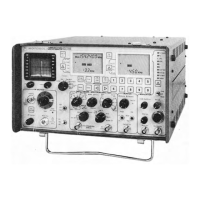
5. Return "Gen
On/Off"
switch to on. Increase the RF
Level by adjusting the step attenuator and
"RF Ver-
nier"
controls until the receiver just unsquelches.
a.
On
the LCD, read minimum squelch sensitivity
as
uV
or
dBm. This
is
the threshold squelch sen-
sitivity
of
the receiver.
b. Determine the tight squelch sensitivity
of
there-
ceiver by repeating steps 4
and
5 with the receiv-
er's squelch control set to maximum tightness.
6.
Enable the receiver's
PL/DPL
squelch circuit. Fully
open the carrier squelch control. Increase the RF
level from minimum, as in step
5,
until the receiver's
squelch
just
opens.
On
the right LCD, read the
coded squelch sensitivity in u
V or dBm.
5.5.0 AUDIO
POWER
OUTPUT TEST
1.
Referring
to
figure 5.2, set "Function" switch to
"Gen" and modulation
to
"FM". Enter the RF fre-
quency and
PL
code.
2. Adjust the step attenuator and
"RF" Vernier' con-
trols to
1000uV (-47 dBm). Adjust the
"1KHz
Lvl"
control
to
600Jo
of
the rated deviation on the KHz
scale.
Use the
"RF
In/Out"
connector for this test.
3.
Select "DVM" "AC" function.
4. Connect a suitable resistive load that can dissipate
the receiver's rated audio output, in place
of
the
speaker.
(If
the receiver
is
using a "floating" or
"bridge" output amplifier, connect a 1 : 1 isolation
transformer across the load resistor).
5.
Connect a scope probe to the service monitor's
"Vert/SINAD/Dist"
input connector
and
clip the
probe across the load resistor
or
to
the isolation
transformer.
6.
Connect "RF
In/Out"
to the receiver's antenna
port. Adjust the receiver's volume control for the
highest voltage reading on the
DVM AC scale which
does not have clipping
or
other distortion in excess
of
the radio's spec as viewed on the oscilloscope.
7.
Calculate the audio power by the following
formula:
Power
Out
(Watts)=
(AC volts)2
Load
Resistance (ohms)
8.
If
the receiver does not produce rated audio power
output, use the service monitor's oscilloscope and a
scope probe to trace through the audio stages and
locate the problem.
5.6.0 AUDIO FREQUENCY RESPONSE
1.
Use the keyboard
to
enter the frequency and
PL/DPL
code (if any)
of
the receiver under test.
2.
Set the "Function" switch
to
"Gen" and modulation
to
"FM", step attenuator
and
vernier controls
to
1000uV (-47 dBm).
3.
Select and set Tone A
to
1000Hz.
Set modulation
switch
to
"Cant".
5-3
4. Adjust the "Code Synth Lvl" control for 20%
of
rated deviation
on
the Dev scale, for example:
1 KHz in a
5KHz
system. Select "DVM" on the left
LCD and
"AC" volts.
5.
Connect the service monitor's "RF
In/Out"
port
to
the receiver's antenna port. Connect the
"Vert/
SINAD/Dist" input connector to the receiver's
speaker
output
using a scope probe.
If
the speaker
is
"floating", use an isolation transformer to avoid
shorting the output stage to ground.
6. Adjust the receiver's volume control
to
obtain a ref-
erence level reading
on
the
AC
volts scale which
is
free
of
clipping
at
any frequency within the 300 to
3000 Hz band. Return to 1 kHz and note this read-
ing as the reference level (in AC volts).
7.
Refer
to
the audio response curve in the receiver's
service manual. Change the Tone A frequency
on
the tone display LCD
to
the value for each point
on
the curve
to
be measured.
8.
Maintain FM deviation
at
20%
of
the rated devia-
tion,
as
set in step 4. Note the audio level at each
frequency. The level in dB must be calculated
as
20 X log(V
/VREF)
where VREF
is
the voltage re-
corded in step 6.
9.
EIA
RS-204C specifies the frequency response for
NBFM receivers over the range
of
300Hz to 3000
Hz as follows:
a. Audio response for receivers using loudspeakers
shall
not
vary more
than
+ 2 dB
or
-8
dB from a
standard 6 dB per octave curve, with reference
taken as
1000 Hz.
b. Audio response for receivers using headphones
or
telephone lines shall not vary more
than
+ 1
dB or -3 dB from a standard 6 dB per octave
curve, with reference taken
at
1000 Hz.
10. Plot the resulting values using 0 dB as the reference
and compare them with the 6 dB per octave curve in
your receiver's service manual
or
with the
EIA
specification as shown
on
figure 5.3.
-6
dB/OCT
1\VE
SLOPE
300Hz
1000Hz
FIGURE
5.3-RECEIVER
AUDIO
FREQUENCY RESPONSE
+9.Sd9


 To Next Page
 Loading...