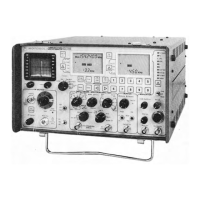
-
SECTION 5
APPLICATIONS
5.1.0 SERV.ICE SHOP SETUPS
This section
of
the
manual
guides troubleshooting,
diagnosing,
and
adjusting communications
equipment
ranging
from pocket pagers
to
repeaters. It contains in-
formation
on
how to connect
equipment
under test
to
the
R-2200/R-2400 service
moni
tor
and how to set
the
controls
and
indicators
to
obtain
the anticipated
LCD
display. Maintain a permanent written log
of
all meas-
urements
and
information
important
to
your
operation.
CAUTION: These
are
typical applications
and
are not all
inclusive.
Not
every test works with every transceiver.
Motorola
takes no responsibility for their accuracy,
ap-
plicability
or
safety. Always refer
to
your
own
trans-
ceiver's service manual for recommended test
methods
and
specifications.
The
service monitor's DVM input is unbalanced (ground
referenced).
Use
an
appropriate
interfa
ce
to
measure
balanced circuits, such as certain receiver audio
outputs
or
telephone lines.
HI
FIGURE
5.1-SPECTRUM
ANALYZER DISPLAY
5.1.1 SPECTRUM ANALYZER
The
spectrum
analyzer, figure 5
.I,
displays the
RF
spec-
trum
while center frequency
is
shown
on
the
LCD
dis-
play.
Use
the
keyboard
to
enter
the
channel center fre-
quency directly. Use
the
spectrum analyzer
to
identify
interference, trace
RF
and
IF
signals, observe transmit-
ter
harmonics, check spurious responses
and
receiver
local
oscillator radiation.
The
LCD
displays
the
ap-
propriate
frequency
and
changes
the
system operating
frequency as required.
The
CRT
displays a window
of
the
RF
spectrum
at
either
the
"Antenna"
or
"RF
In/Out"
port
in
a
range
selected
from
1
MHz
to
999.9999
MH
z
programmable
in 100
Hz
increments.
The
observed window
for
the
analyzer
can
be controlled
with
the
dispersion control.
The
spectrum analyzer has a
dynamic range
of
at
least
55
dB
with
the
step
attenuator
in
the 0
dB
position.
With
the
attenuator,
the
useable
range
can
be extended
up
to
the maximum allowable in-
put
level.
When
using
the
attenuator,
add
10
dB
per
step
attenuation
to
the actual dB reading
on
the
scope.
5-I
5.1.2 OPERATING NOTES FOR
THE
R-2400
SERVICE MONITOR WITH SI'ECTRUM
ANALYZER
In the
normal
use
of
a
spectrum
analyzer,
the
user
should keep in mind certain characteristics
common
to
this instrument.
I. Noise
Floor
(grass) - caused by
the
basic sensitivity
of
the
spectrum analyzer receiver. When
the
disper-
sion switch is set
to
it's widest sweep
(I
MH
z/
div.),
the receiver's
IF
is necessarily set
to
it's widest
band-
width (approximately
40kHz)
allowing
more
noise
through the
IF
to
be displayed. At
the
narrower
dispersions,
0.1
MHz/div.
and
.01
MHz
/ div., the
IF
bandwidth is reduced
to
15
kHz
and
6
kHz
re-
spectively, causing
the
noise floor displayed
to
vary.
2.
In
the
medium
and
narrow
dispersions,
the
shape
of
an
unmodulated
carrier displayed is due partially
to
the characteristics
of
the
IF
filters.
The
filters used
in
the
R-2400 give
the
best compromise between
shape,
atlenuation,
sweep speed,
and
RF
sweep
direction (Image switch).
3.
The
noise
that
appears
near
a
strong
signal is called
Sideband Noise
(SBN). It is a measure
of
the
im-
purity
of
tbe signals presented
to
the
spectrum
analyzer receiver, either
the
signal applied
from
an
external
RF
source (i.e. transmitter)
or
the
service
monitor's
own
lst
mixer's injection,
and
these noise
components
will
add
in the
mixer
and
could
both
be
observed
on
the
CRT.
It is
important
to
note
that
when
attempting
to
judge
the
quality
of
an
RF
car-
rier
that
the
RF
synthesizer in
the
service
monitor
could contribute
to
the
S
BN
of
the
observed signal.
4. As in any spectrum analyzer, excessively
strong
signals, even those
at
a frequency not displayed,
could
overload
the
I st mixer circuit in
the
service
monitor
and
produce
excessive SBN
or
discrete
spurious signals
that
are
not actually present in
the
applied signa
l.
Th
erefore, it is always
good
practice
to
ch
ange
the
step
attenuator
in 10 dB steps while
observing a suspected spurious signal on
the
CRT
display;
if
the signal rises (or falls)
more
than
(or
less than)
lO
dB for a
10
dB
step
of
the
attenuator,
the
mixer is
probably
being overloaded.
Th
e solu-
tion is to
add
enough
attenuation
to
insure a
dB
for
dB change
on
the
display.
lf
an
off-screen signal is
still too
strong
to
allow observation
of
the
signal
of
interest, a "suck-out" circuit (either a cavity
or
dis-
crete
component
fi
lter)
must
be
insened
to
reduce
this signal.
5. When a "spurious'' signal
appears
above
or
below
the
center frequency displayed, it could be
an
"im-
age" signal caused by
the
service monitor's mixer I
local oscillator.
To
determine
if
this spurious signal
is being generated internally, change
the
"Image"
switch
and
observe
if
the
sp
ur moves
to
the
other
side
of
the
display
or
goes
away
altogether:
if
it
does,
then
it
is
being generated internally
and
may
be ignored.


 To Next Page
 Loading...