49
Electrical
Part 1: Battery
Mudd-Ox operates on 12V of power. Ensure the battery is fully charged before diagnosis.
Signs of Battery Issues
• Certain components do not work.
• Starter cranks over very slowly, or not at all.
• Battery does not hold its charge very long, or will not charge at all.
• Sparks and/or smoke occur near the battery terminals.
Battery Inspection
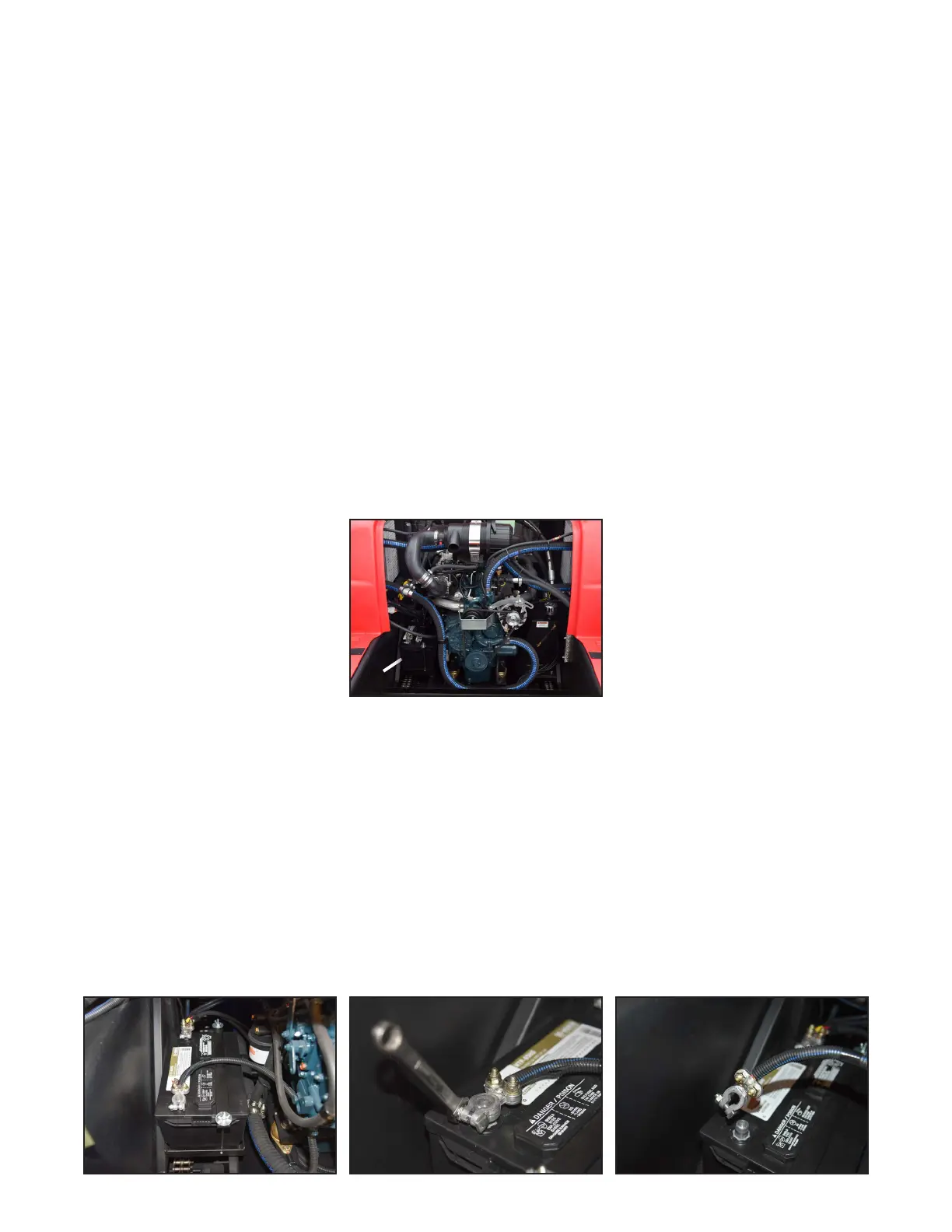
Located on the left side engine compartment is the battery (A in Figure-1). Its tie down mount should be firmly
secured to prevent movement. The battery terminals should not have any corrosion. They must be firmly secured
to the battery, as any looseness can create poor electrical connection. On the dash instrumentation is a volt meter.
A non-running engine will show approx. 12.7 Volts, while a running engine should show approx. 13.8 Volts. If engine
voltage is severely below 12.7, it may be necessary to charge the battery and immediately diagnosis if the battery or
charging system is faulty. If alternator outputs significantly over 13.8 volts, diagnose charging system immediately
to prevent over charging of battery.
Battery Removal
Before diagnosing any electrical components, fuses or relays, first the battery must be removed.
1. See Engine Cover Removal under Accessing the Mudd-Ox to remove the front lower operator seat.
2. The battery is now visible (Figure-2). There are (2) wiring terminals, a positive (+) and negative (-) which are
clearly labeled on the battery itself. Always disconnect the negative terminal first when disconnecting a battery.
Do this by loosening the battery terminal with a wrench. Note: Never allow the wrench, or any other metals
touch both terminals at the same time. This will cause dangerous battery shortage. (Figure-3).
3. Lift the wiring up to remove off the terminal, and place it away from the battery (Figure-4).
4. Next remove the positive (+) terminal, and place it away from the battery.
Figure-1
Battery Location
Figure-2
Battery
Figure-3
Ground (-) Removed
Figure-4
Lift and place away from battery
AA


 To Next Page