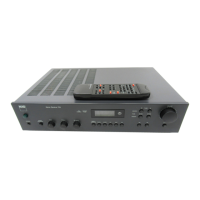
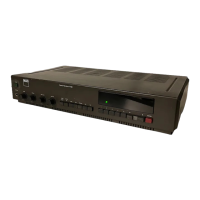
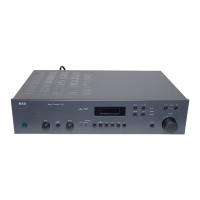
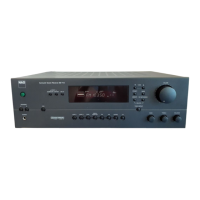
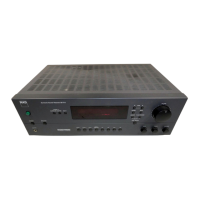
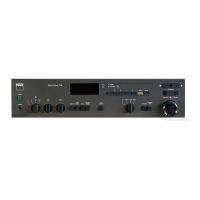
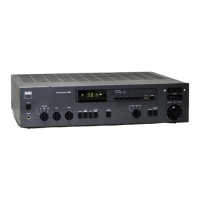
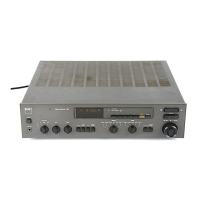
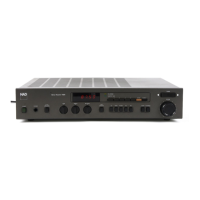
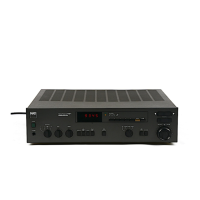
FRONT PANEL CONTROLS
1.
POWER. Depress this button to switch on the
reo
ceiver. The green LED above the tuning presets will illumi·
nate when the power is on.
To
switch the power off, depress
the
POWER button again and release it.
If you prefer, you may leave the receiver's POWER
switch permanently engaged and use an external switch
(such as a clock timer) to turn the power on and off.
2.
PHONES. Plug stereo headphones in here. The
circuit
will provide proper drive signals lor all conventional
stereo headphones regardless
01
their impedance, with just
one exception: electrostatic headphones
usually are sup·
plied with an adapter unit which must be connected directly
to the speaker terminals on the rear panel.
When a headphone plug
is
inserted into the PHONES
socket the loudspeakers are automatically shut off. If you
want to listen to speakers, you must remove any plug
Irom
the socke\.
Belore plugging conventional headphones into the
PHONES jack, turn down the VOLUME control
lor
salety.
And when you are not listening
to
the headphones it is
wise to unplug them
Irom the socket. Otherwise, when not
listening to the phones you might inadvertently turn up the
volume to a level which would feed excessively strong
signals
to
the headphones and damage them.
You
may freely use headphone extension cables. If you
want to use a headphone Y·connector to drive two headsets
simultaneously, they should be identical models. Connecting
together two headphones which differ widely in impedance
usually will produce a substantial loss of volume in the
headset having the higher impedance (or
in
both).
3.
BASS. The Bass control adjusts the relative level
01
the low frequencies in the sound. The electrical response
of the receiver is flallest when the control
is
set
in
the detent
at the
12
o'clock position. Rotation of the knob to the right
(clockwise) increases the level of low-frequency sounds,
and rotation counter-clockwise decreases their level. Adjust
it
to achieve the tonal balance that sounds most natural
to you.
You
will note that at moderate rotations away from
center the effect
01
the Bass control
is
subtle because its
action is confined to the lowest audible frequencies where
significant energy is seldom found in recordings.
Only at
large rotations away from center
is
there a sUbstantial boost
or cut
at
the mid·bass frequencies which are common
in
music.
4. TREBLE. The Treble control adjusts the relative
level of the high frequencies in the sound. The response of
the recei
ver
is lIallest when the control is set in the detent
at the
12
o'clock position. Rotation of the knob
to
the right
(clockwise) increases the level
01
high·frequency sounds,
and rotation counter·clockwise decreases their level. Adjust
it to achieve the tonal balance which sounds most natural
to you.
You
will note that boosting the Treble increases the
brilliance and clarity
01
details
in
the sound, but also makes
any noise more prominen\. Turning down the Treble makes
the sound mellower while suppressing hiss and record
surface
no
ise, but too much Treble roll-off will make the
sound dul
l.
5.
BALANCE.
The BALANCE control adjusts the rela·
tive levels of
the
left and right channels. A detent at the
12
o'clock position marks the point of equal balance. Rotation
of the knob to the right (clockwise) decreases the level
01
the left channel so that only the right channel is heard, thus
shifting the sonic image to the right. Rotation of the knob
to the left shifts the sonic image toward the left speaker.
6
Ideally the detented center position of the BALANCE
control will be the normal setting. But several common
circumstances
may
cause
unequal
balance,
requiring
a
compensatory off-center BALANCE selling to restore the
most uniform spread of stereo sound between the speakers.
These include unequal output from the two channels of the
phono cartridge, different acoustical environments around
the two loudspeakers,
or
simply a listening
pOSition
that
is
closer to one speaker than to the other.
Adjust the BALANCE control
to
produce a natural
spread of sound across the space between the speakers,
with any monophonic sound (such
as
a radio announcer's
voice) appearing as a phantom image centered midway
between them.
6.
VOLUME. This control adjusts the overall loudness
level of the sound.
It has no effect on the level of the signals
fed to the
RECORD jacks lor tape recording. The VOLUME
control is designed for accurate tracking of its two channels,
so
that the stereo balance will not shift noticeably as the
loudness of the sound is varied.
7.
LOUDNESS COMPENSATION. Pressing this
bUllon engages a "loudness compensation" circuit which, at
low·to·medium sellings of the VOLUME control, boosts the
low-bass response of the receiver
in
order to compensate
lor the human ear's diminished sensitivity to low-frequency
sounds at low loudness levels. The circuit also provides a
slight treble boost to overcome the "masking" of subtle
high·frequency details by background noise. The
loudness·
compensation
circuit
in
this
receiver
is
more
subtle
in
its
action, and thus more realistic in psycho·acoustic terms,
than
similar
circuits
in
other
receivers.
8.
BASS EQUALIZATION. This circuit boosts the
lowest bass frequencies, those below
60
Hz
.
In
virtually all
loudspeakers the useful output
rolls off at frequencies below
the wooferlcabinet resonance (which
typically occurs be-
tween 40 and 70 Hz). The BASS
EO
circuit compensates for
this
roll-off, extending the useful response
of
the speakers
significantly lower in frequency.
Of
course
very
low frequencies are not found in all
music,
nor
in all recordings, so the effect of the bass equal-
ization often won't be obvious. Sometimes you may find that
switching it in and out does not produce any noticeable
change in the sound whatsoever, simply because the
record·
ing contains no energy at very low frequencies. But if your
loudspeakers are capable of reproducing low bass, and
if
you play recordings in which low bass does have an impor·
tant role, the BASS EO will make
an
audible (and occasion-
ally dramatic) difference.
If your loudspeakers already have extended and
powerful
deep·bass response, the BASS EO will still be
useful to correct for the bass
roll-offs engineered into some
recordings.
It also works well
in
combination with the LOUD-
NESS COMPENSATION
circuit to restore subjectively Ilat
frequency response when you listen to music at low
volume levels.
CAUTION:
Be
prepared to switch off the equalization
when playing recordings (especially
digitally mastered
discs) that contain unusually potent recorded bass. The
BASS EO boosts deep bass levels
by
5 dB, i.e. by a factor
of three in power.
If this boost
is
combined with high·volume
playback levels, a
bass· heavy input signal may overdrive
the amplifier into
Clipping
and-more
important-overdrive
a small woofer beyond its safe excursion limits, causing its
voice·coil to clatter against the magnet backplate. As long
as the speaker sounds good
it
probably
is
OK; but distorted
or
unmusical
sounds
,
such
as
clattering
noises
,
are
a
sign
of distress in a woofer.
Be
alert, also, for signs of acoustic feedback (in which



 To Next Page
 Loading...