Chapter 9 Counters
© National Instruments Corporation 9-11 NI USB-621x User Manual
Method 1b—Measure Low Frequency with One
Counter (Averaged)
In this method, you measure several periods of your signal using a known
timebase. This method is good for low to medium frequency signals.
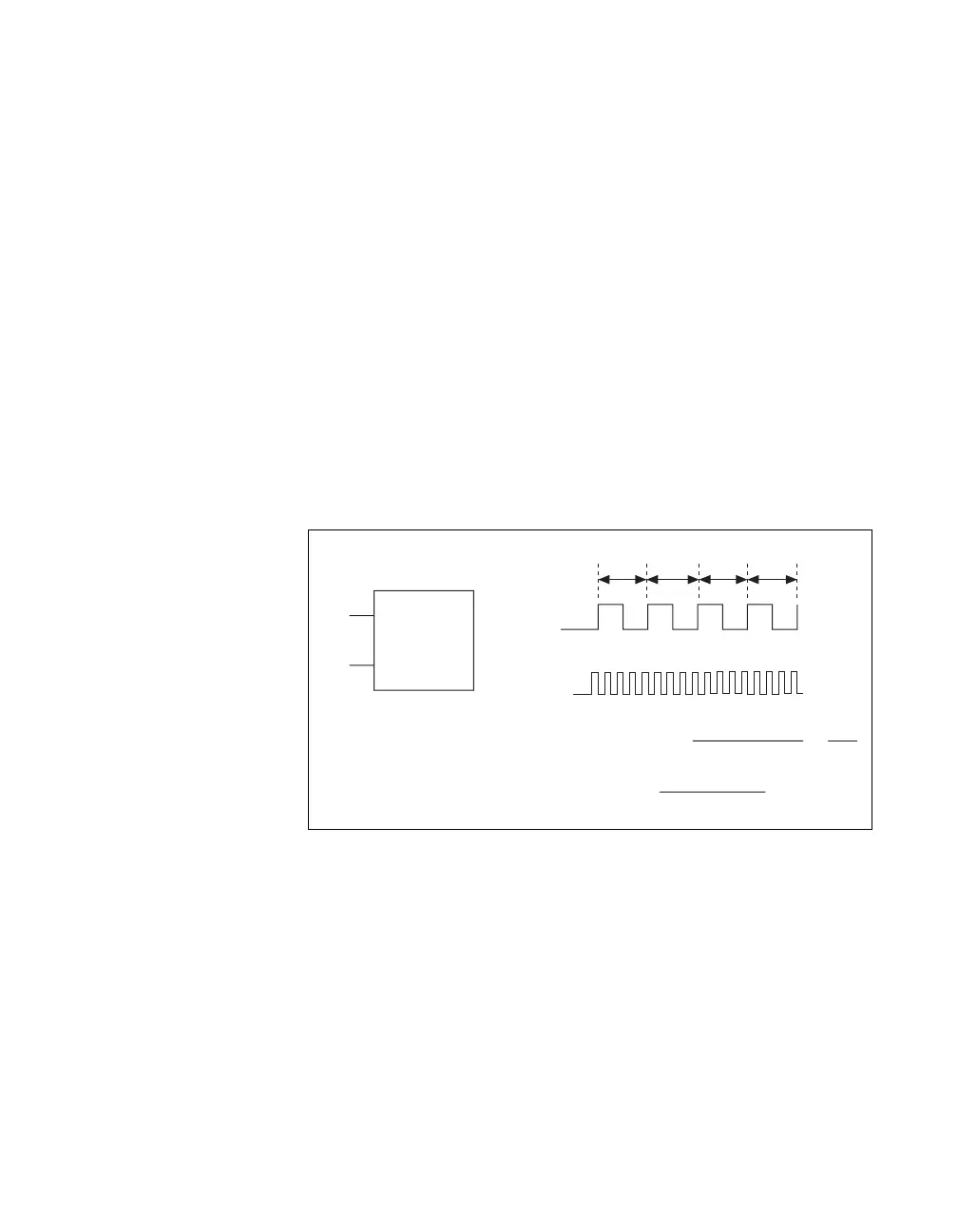
You can route the signal to measure (F1) to the Gate of a counter. You can
route a known timebase (Ft) to the Source of the counter. The known
timebase can be 80MHzTimebase. For signals that might be slower than
0.02 Hz, use a slower known timebase.
You can configure the counter to make K + 1 buffered period
measurements. Recall that the first period measurement in the buffer should
be discarded.
Average the remaining K period measurements to determine the average
period of F1. The frequency of F1 is the inverse of the average period.
Figure 9-12 illustrates this method.
Figure 9-12. Method 1b
Method 2—Measure High Frequency with Two
Counters
In this method, you measure one pulse of a known width using your signal
and derive the frequency of your signal from the result. This method is good
for high frequency signals.
In this method, you route a pulse of known duration (T) to the Gate of a
counter. You can generate the pulse using a second counter. You also can
F1
Ft
F1
Intervals Measured
Gate
Source
Buffered Period
Measurement
Average Period of F1 =
N
1
+
N
2
+ …
N
K
K
Frequency of F1 =
N
1
+
N
2
+ …
N
K
K × Ft
Ft
T
1
T
2
…T
K
1
Ft
×
1
2 ...
N
1
1... ...
N
2
… 1... ...
N
K


 To Next Page
 Loading...