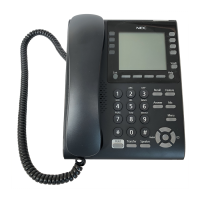
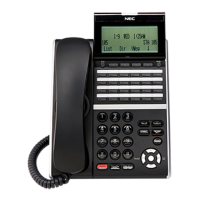
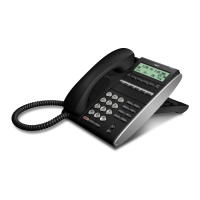
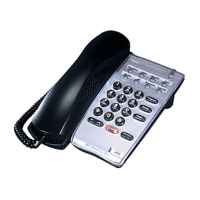
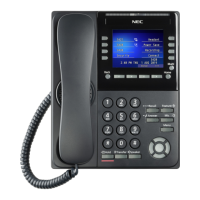
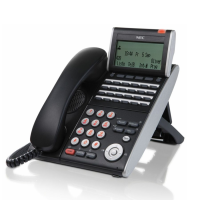
This document outlines the features and operational procedures for the DT400/DT800 series of NEC telephones, designed for business communication. The phone is equipped with a range of functionalities to manage calls, customize settings, and enhance user experience.
Device Overview and Basic Functions
The DT400/DT800 telephone features a clear LCD display, a microphone, and a call indicator lamp. The call indicator lamp (2) at the top corner of the display flashes when a call terminates to the terminal and lights steadily when a message has been left. The microphone (1) is integrated for hands-free communication.
The LCD (3) is a 24-character, 4-line display that shows call status, feature availability, and other relevant information. The top line of the LCD is dedicated to status icons.
Call Management Features
- Answering Calls (12): When the LED on the "Answer" key is lit, pressing it answers a waiting call.
- Originating Outside Calls: To make an outside call, lift the handset or press the "Speaker" key (17) to receive a dial tone. Then, dial the Central Office access code (usually 9), followed by the desired telephone number. The display will show the elapsed time, trunk type, and trunk number.
- Originating Internal Calls: For internal calls, lift the handset or press the "Speaker" key to get a dial tone, then dial the desired station number. The display will show the digits dialed.
- Multiline Appearance: This feature allows users to manage multiple lines. To originate a call using multiline appearance, press the "Multiline Appearance" feature key, lift the handset or press "Speaker," dial the Central Office access code (9), and then the desired number.
- Placing a Call on Hold (19): Pressing the "Hold" key places an active call on hold. The held line will flash. If the held line appears on other DT Series stations, the associated LED flashes red slowly. Any station with this line appearance can retrieve the call.
- Placing a Call on Exclusive Hold: Pressing the "Hold" key twice places a call on exclusive hold. The line appearance will show an interrupted wink. If the held line appears on other DT Series stations, the LED remains steadily lit red. Only the DT Series phone that set the "Exclusive Hold" option can retrieve the call.
- Retrieving Held Calls: To retrieve a held call, lift the handset or press the "Speaker" key, then press the held line.
- Transferring Calls (18): To transfer an established call, press the "Transfer" key, receive an interrupted dial tone, dial the destination station's extension, and then hang up or wait for an answer. This allows the station user to transfer calls without attendant assistance.
- Conferencing Calls: With a call in progress, ask the party to hold, press the "Transfer" key, receive an interrupted dial tone, and dial the desired number. Once the new call is answered, press the "Conf" key to establish a three-way conference. If one party hangs up, the other two remain connected.
- Call Pickup (Group): When a station within a pickup group rings, lift the handset and press the "Call Pickup" key or dial the "Call Pickup" access code (which can be stored on a one-touch speed calling key). This establishes a connection to the calling party.
- Number Redial: To recall the last number dialed, press the "Redial" key (15). The last number will be displayed. Pressing "Redial" again scrolls through the last 5 numbers dialed. Press '*' to redial the displayed number.
- Speed Calling (One-touch Speed Calling keys): To originate a call using speed calling, press the desired "Speed Calling" key, or press "Speaker" and then the "Speed Calling" key.
- Call Forwarding - All Calls: To set, press the "Speaker" key or lift the handset, receive a dial tone, press the "CF-AllCalls" key, receive a special dial tone, and dial the destination station or 9 and the outside telephone number. The "CF-AllCalls" LED will light. Press "Speaker" or hang up. To verify, leave the phone on hook and press "CF-AllCalls" key; the display will show the forwarded station number. To cancel, press "Speaker" or lift handset, then press "CF-AllCalls" key.
- Call Forwarding - Busy/No Answer: To set, press the "Speaker" key or lift the handset, receive a dial tone, press the "CF-NoAnswer" key, receive a special dial tone, and dial the destination station or 9 and the outside telephone number. The "CF-NoAnswer" LED will light. Press "Speaker" or hang up. To verify, leave the phone on hook and press "CF-NoAnswer" key; the display will show the forwarded station number. To cancel, press "Speaker" or lift handset, then press "CF-NoAnswer" key.
- Save and Repeat a Number: To save a number, press the "Speaker" key or lift the handset, dial the desired telephone number, press '>>>', then press the "S&R" key. The dialed number is now stored. To redial the programmed number, press the "Speaker" key or lift the handset, then press the "S&R" key. If the saved number is busy or no answer is received, press the "S&R" key again before hanging up to save it.
Programmable Keys and Customization
- Soft Keys (5): Any feature shown at the bottom of the LCD is available via the soft keys. The appropriate feature key is displayed on the screen based on the call handling process.
- LCD Line Keys (8): These keys are used to access appropriate line features displayed on the LCD.
- Programmable Keys: These keys can be programmed as "Speed Dial" keys. Users can assign any numbers (up to 24 digits), such as telephone numbers, to these keys. The phone provides 32 (8 keys x 4 pages) additional programmable keys.
- Registering Name on OneTouch Speed Dial Key: To register a name for a speed dial number, press the "SPD NAME" button (LCD display), then the desired "One-Touch Speed Calling" key, enter the desired name on the keypad, press the '>>>' button TWICE on the upper display, then "SET" to save the name. Uppercase alphabetic characters are available for name registration.
Navigation and Interface Elements
- Exit (4): This key allows the user to exit from the "Help" key mode.
- Scroll Key (9): This key is used to turn over pages of the 8LD display, showing the status of line keys (e.g., call termination, call hold, busy) and feature key settings as icons.
- Cursor (15): The cursor key provides 4-way scrolling (UP/DOWN/LEFT/RIGHT) for navigating menus and adjusting settings. It also functions as a "Redial" key (LEFT), "Directory" key (RIGHT), "Volume UP" key (UP), and "Volume DOWN" key (DOWN).
- Enter (16): The DT400/DT800 Series has a "Shortcut Menu" for frequently used features. Users can access this menu by pressing the "Enter" key.
- Menu (14): From this key, users can access information on missed calls.
Terminal Setup and Maintenance Features
- Help (6): Pressing this key brings up explanations of the soft keys on the LCD.
- LCD Screen (7): Any feature shown on the LCD is available. The appropriate feature is displayed on the screen according to the call handling process.
- Recall (10): Press this key to finish a call and hear the dial tone.
- Feature (11): This key is used to activate various features, such as terminal setup functions, and to program Speed Dial Keys.
- Speaker (17): This key controls the built-in speaker for hands-free dialing and monitoring. The LED on the key lights when it is active.
- Mic (13): Press this key to respond hands-free. The LED on this key must be lit for speakerphone operation.
- Adjusting Handset Receiver Volume: Press the "Up/Down" key in the off-hook status or during a call.
- Adjusting Speaker Volume: Press the "Up/Down" key during speakerphone operation or during a call.
- Adjusting Ringer Tone: Press the "Up/Down" key during ringing.
- Adjusting LCD Contrast: Press the "Up/Down" key in the on-hook status. When connected with 16LD ADM, 16 degrees of LCD contrast are available (8 degrees in the terminal side and 2 degrees in ADM itself).
- Microphone On/Off: The LED on the "Mic" key shows the status of the built-in microphone. To toggle, press the soft key associated with the "MIC Display" or press "Feature" and "1".
- Selecting Ringer Tone:
- Press the "MENU" key.
- Go to "SETTING".
- Select "[1] User Setting".
- Select "[1] Incoming Call".
- Select "[4] Ring Tone".
- Select "[1] External Call" (use the "Cursor" keys to select a ringtone).
- Press "EXIT" to exit settings.
The DT Series offers 14 kinds of ringer tones, with Tone 6 as the default.
The DT400/DT800 series provides a comprehensive set of features for efficient and flexible business communication, allowing users to manage calls, customize their phone's behavior, and access various functions with ease.

 Need help?

 To Next Page
 General