13
© by NECTA VENDING SOLUTIONS SpA 0012 Colibrì
INITIALISING
The machine was designed for different market needs.
The software is capable of managing all possible configu-
rations.
For this reason, before starting the machine, some
parameters must be set.
"Model"
Defining whether the machine is Espresso or Instant.
"Country"
Intended as type of basic doses for the different selections
(e.g. strong coffee IT = 40 cc - strong coffee FR = 60 cc).
The available "Countries" are:
It - Fr - Es- Uk
"Layout"
A number of Button/Selection combinations to choose
from is provided for each dose type model (the combina-
tions available for each layout are indicated in the dose
selection table supplied with the machine).
"Tank"
Intended as water supply from a tank. This can be enabled
or disabled (water supply from the mains):
FILLING THE WATER SYSTEM
When the machine is switched on the condition of air-
break (full or empty), pump (electrical functioning and
water flow) and boiler (pressure).
If required by the conditions, the machine will automati-
cally start an installation cycle, and namely:
- the display will show "Installation" for the entire dura-
tion of the cycle;
- the water mains solenoid valve is opened or the water
supply pump is started to fill the air-break;
- the milk solenoid valve is opened so that the air may
be bled from the boiler and 400 cc. of water filled.
N.B.: If there is no water flow during the installation cycle,
the machine will lock until the water is resumed or the
machine is switched off.
IMPORTANT NOTICE!!!
If a considerable amount of air bubbles is formed in the
water system, for example during maintenance, it is pos-
sible that an installation cycle is automatically started
when the machine is switched on.
Versions with internal tank
For models with an internal tank, when the machine is
first switched on, the installation procedure MUST BE
carried out manually (see relevant chapter).
OPERATION OF THE COFFEE UNIT
COFFEE DISPENSING CYCLE
After each time the machine is switched on, upon the first
espresso coffee based selection, the coffee unit is rotated
completely before the normal cycle, too ensure that the
device is in the correct start position.
When selecting coffee, the grinder is started and will
continue until the coffee doser chamber is full (see Fig. 15).
When the doser unit is full, the ground coffee dose is
released into the coffee unit.
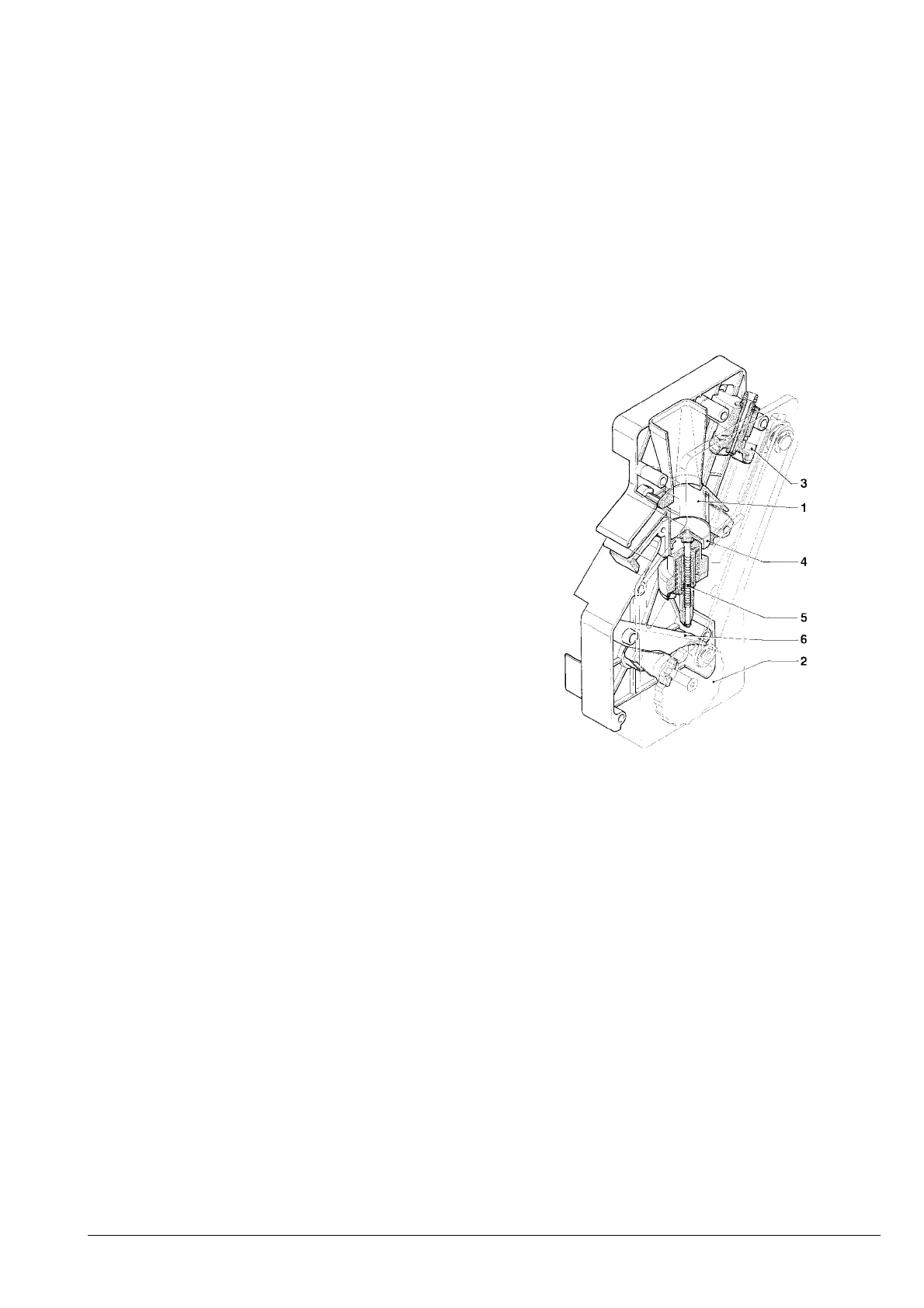
The coffee falls into the vertical brew chamber (1) (see Fig.
12).
Fig. 12
1 - Brew chamber
2 - External disk
3 - Upper piston
4 - Lower piston
5 - Pre-brewing spring
6 - Swinging lever
The ratiomotor handle engaged with the disk (2) located
outside of the unit rotates by 180°, causing the brew
chamber to swing and lowering the upper piston (3) (see
Fig. 13).
Due to the water pressure, the pre-brewing spring (5) sinks
and the lower piston (4) goes down 4 mm, thus forming a
water cushion which allows an even use of the coffee dose.
At the end of the dispensing cycle and during a pause of 3
seconds, the pre-brewing spring (5) will discharge the
water through the third way of the dispensing solenoid
valve, lightly pressing the used coffee dose.
By completing its rotation, the ratiomotor makes the swing-
ing lever (6) lift the pistons and the coffee dose.
At the same time, when the brew chamber returns to its
vertical position, the scraper on the coffee hopper stops
the used coffee dose and drops it. The lower piston now
returns to the bottom dead centre.





 To Next Page