25
© by NECTA VENDING SOLUTIONS SpA 0012 Colibrì
REGENERATING THE SOFTENER UNIT (OPTIONAL)
Only a 2-litre ion-exchange resin softener unit can be used
on these machines.
The resins should be regenerated at least once a week or
even more frequently depending on the hardness of the
water from the mains used to supply the machine (see
table below).
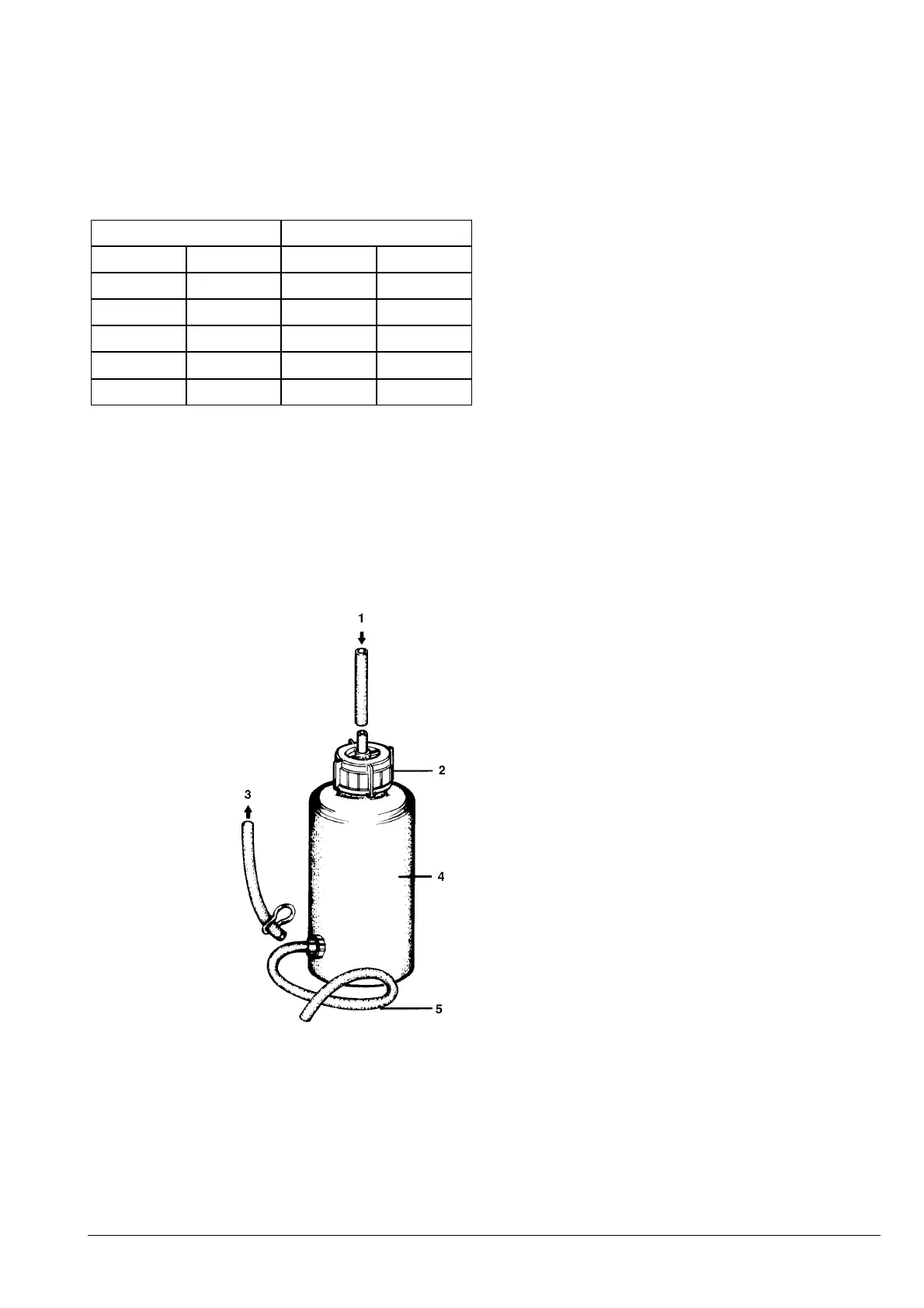
Fig.. 18
1 - From the tap
2 - Cap
3 - To the machine
4 - Softener unit
5 - To the drain
ssendrahretaWsnoitcelesforebmuN
F°G°.cc06.cc031
016,500650082
022,1100820041
038,610091009
044,220041007
050,820011055
To regenerate the resins correctly do as follows:
- remove the softener unit from the cabinet and shake it
vigorously to eliminate any preferential paths which
may have formed;
- fill 0.5 Kg. of sodium chloride (ordinary salt);
- connect the side hose union to a tap and the middle
rubber-holder to a drain point; the direction of the water
flow must be
NECESSARILY
the one shown in the figure 18
ANNUAL SANITISING
At least once a year, or more frequently according to the
use of the machine and the quality of the inlet water, the
entire foodstuff circuit system must be cleaned and
sanitised in the following way:
- all parts of the hydraulic system in contact with food,
including the hoses, must be removed from the unit
and fully disassembled;
- wash all components with detergents, ensuring that all
visible residue and product films are mechanically
removed using brushes or similar tools, if necessary;
- all components must be soaked in a sanitising solution
for at least 20 minutes;
- the unit internal surfaces are to be cleaned with the
same sanitising solution;
- Thoroughly rinse and then reinstall the parts.
Before restarting the unit, the same sanitising pro-
cedure described in section "Sanitising the food-
stuff circuits and the mixers" should be repeated
with the components reassembled.
- adjust the water flow in such a way as to completely
dissolve the salt in 10 litres water within 25 minutes;
- during the regeneration operation, ensure that the sof-
tener unit is always full of water, bleeding any air which
may have entered;
- at the end of this operation ensure that outlet water is no
longer salted; it is advisable to check the hardness of the
water by means of appropriate chemical reagents: the
outlet water hardness should be 0° F.






 To Next Page