© National Instruments Corporation 21 NI cDAQ-9178/9174 User Guide and Specifications
Using a Digital Source
To use ao/PauseTrigger, specify a source and a polarity. The source can be a PFI signal or one of several
other internal signals on the NI cDAQ-9178/9174 chassis.
You also can specify whether the samples are paused when ao/PauseTrigger is at a logic high or low
level. Refer to the Device Routing in MAX topic in the NI-DAQmx Help or the LabVIEW Help for more
information.
The NI-DAQmx Help is available after installation from Start»All Programs»National Instruments»
NI-DAQ»NI-DAQmx Help. To view the LabVIEW Help, select Help»Search the LabVIEW Help in
LabVIEW. Alternately, to download the LabVIEW Help, go to
ni.com/manuals.
Using an Analog Source
Some C Series I/O modules can generate a trigger based on an analog signal. In NI-DAQmx, this is
called the Analog Comparison Event, depending on the trigger properties.
When you use an analog trigger source, the samples are paused when the Analog Comparison Event
signal is at a high or low level, depending on the trigger properties. The analog trigger circuit must be
configured by a simultaneously running analog input task.
Analog Output Timing Signals
The NI cDAQ-9178/9174 chassis features the following AO (waveform generation) timing signals:
• AO Sample Clock
• AO Sample Clock Timebase
AO Sample Clock
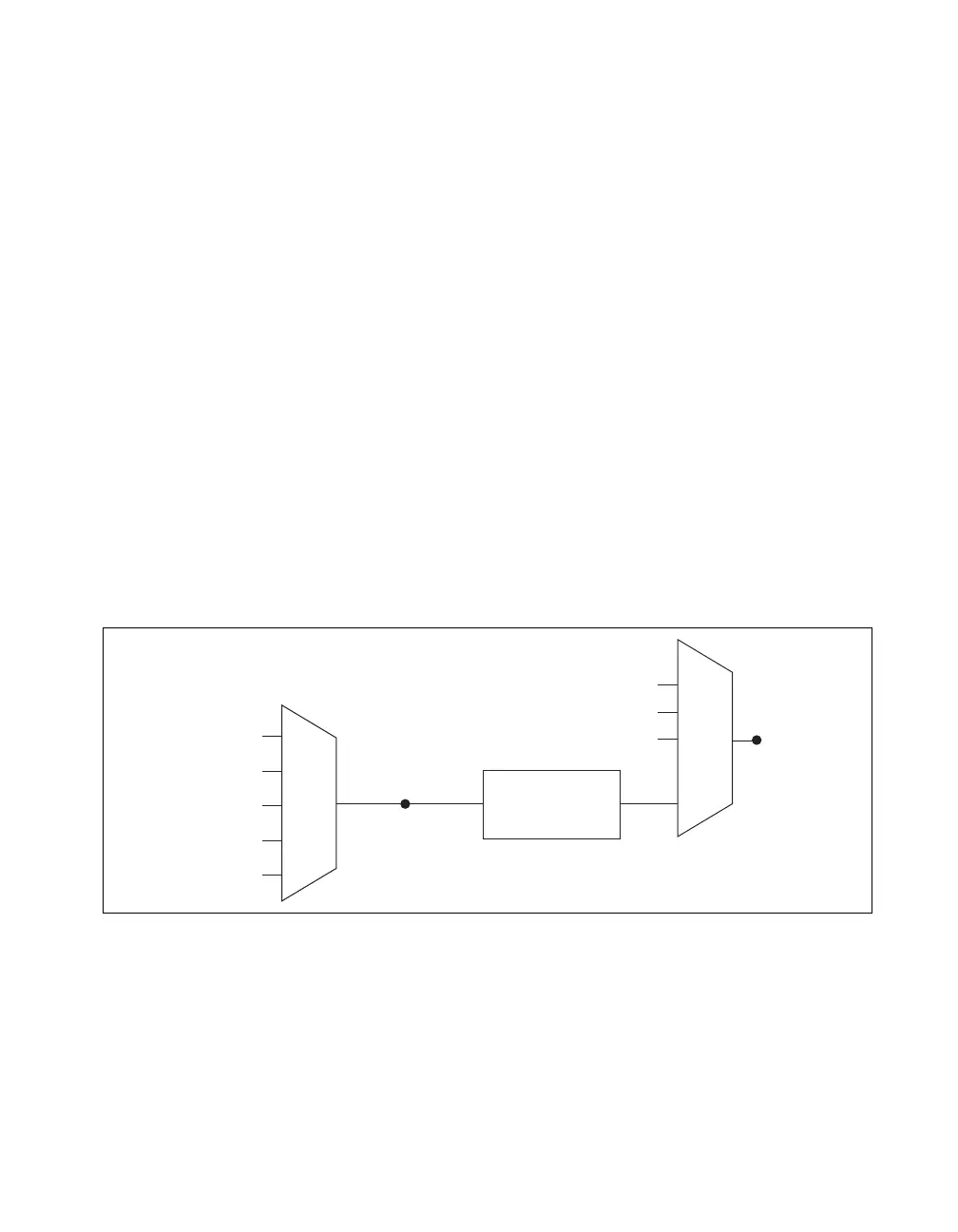
The AO sample clock (ao/SampleClock) signals when all the analog output channels in the task update.
ao/SampleClock can be generated from external or internal sources as shown in Figure 14.
Figure 14. Analog Output Timing Options
Routing AO Sample Clock to an Output Terminal
You can route ao/SampleClock to any output PFI terminal. ao/SampleClock is active high by default.
AO Sample Clock Timebase Signal
The AO Sample Clock Timebase (ao/SampleClockTimebase) signal is divided down to provide a source
for ao/SampleClock. ao/SampleClockTimebase can be generated from external or internal sources, and
is not available as an output from the chassis.
Programmable
Clock
Divider
ao/SampleClock
Timebase
PFI
Analog Comparison Event
Ctr
n
Internal Output
ao/SampleClock
Analog Comparison
Event
20 MHz Timebase
80 MHz Timebase
PFI
100 kHz Timebase


 To Next Page