DIAGNOSTICS - cont’d.
Diagnostic Symptom Chart
Problem Possible Cause Action to Take
Not cooling, not
turning on.
■ Faulty thermostat.
■ No power to control module.
■ Faulty wire from control module to
compressor.
■ Faulty control module.
■ Faulty Compressor.
Perform Test F
Refrigerator gets too
cold.
■ Bad capillary tube position.
■ Faulty thermostat.
■ Faulty control module.
Perform Test G
Refrigerator builds
frost inside.
■ Door not closed.
■ Damaged door gasket.
■ Air leak at foam plug.
Perform Test H
Runs but does not
cool properly.
■ High ambient temperatures .
■ Blocked air ventilation.
■ Frost build up.
■ Condenser coil restricted.
■ Faulty condenser fan.
■ Faulty cooling unit.
Perform Test I
Will not run on DC
power.
■ Blown fuse in DC circuit.
■ Undersized wiring to refrigerator,
minimum #12 gauge wire required.
Refer to Owner's Manual for
recommend wire size.
■ Partially discharged battery, volt-
age below 11.3 VDC at compres-
sor module.
■ High resistance (voltage drop) in
supply circuit.
Perform Test J
Voltage within range
but refrigerator cuts
out.
Parts can cause a + / - 10 VDC which
can cause refrigerator voltage to
register within specification, but cutout
because of part variance.
Perform Test K
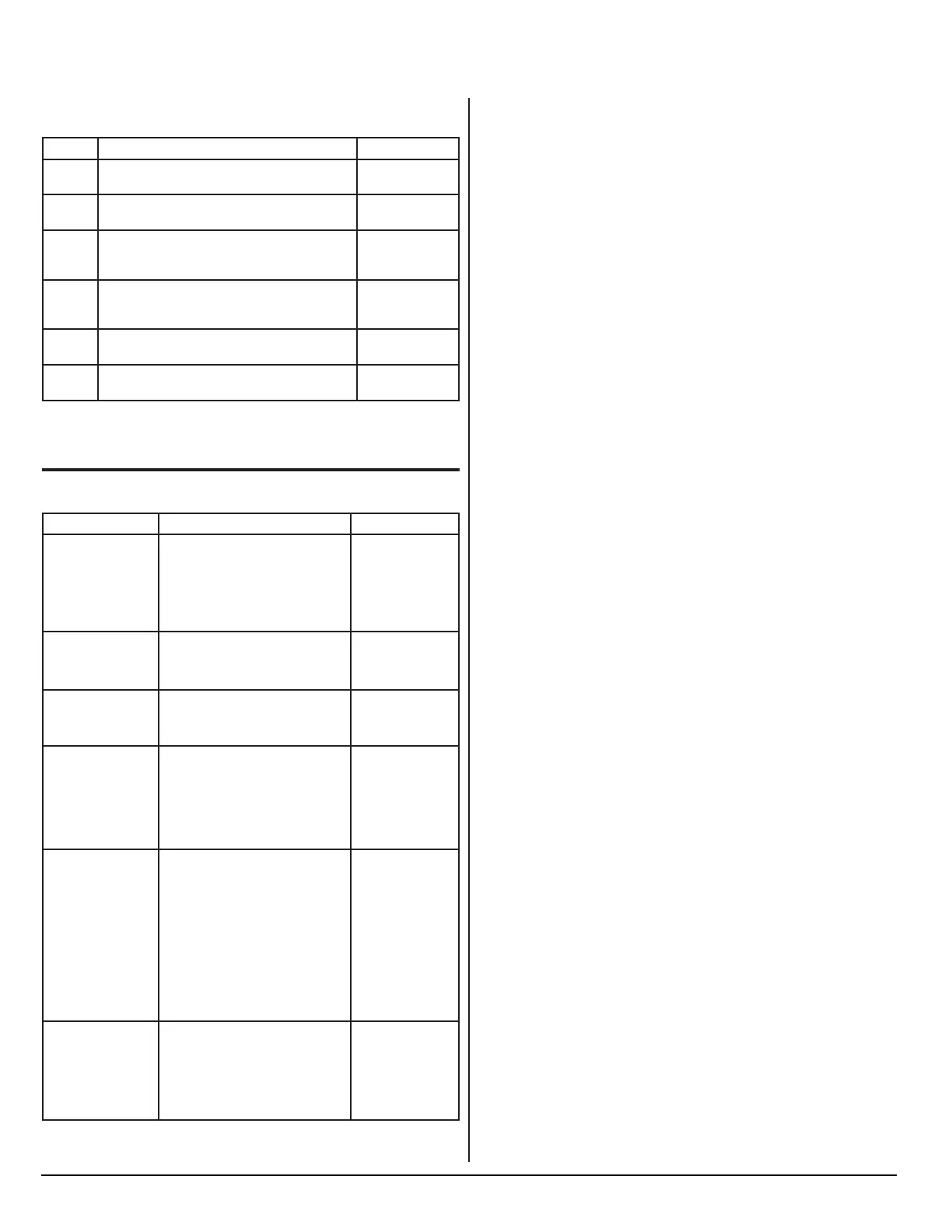
Self-Test Diagnostic Chart
Flashes Description Action
1 Battery Protection Cut-Out.
The voltage is outside the cut out setting.
Perform Test A.
2 Fan Over current Cut-Out.
The fan electrical load is more than 1.0 amp.
Perform Test B.
3 Motor Start Error.
The rotor is blocked or the differential pressure in the
refrigeration system is too high ( >5 bar).
Perform Test C.
4 Minimum Motor Speed Error.
The motor can not maintain minimum speed (1850
rpm).
Perform Test D.
5 Thermal Cutout of Electronic Unit.
The electronic unit is running too hot.
Perform Test E.
6 Controller Hardware Failure
Controller detects abnormal parameters
Perform Test K.
10
www.norcold.com
N1152



 To Next Page