31
TEO-5 User’s Guide
Low Frequency Oscillators
Low Frequency Oscillators
LFOs are special-purpose oscillators that produce a frequency that is
typically below the range of human hearing (although these can actu-
ally extend into the audio range if set to their maximum frequency). The
LFOs are used for periodic modulation such as vibrato (periodic pitch
modulation) and tremolo (periodic amplitude modulation). They can also
be used as modulation sources for any of the many modulatable param-
eters in the TEO-5.
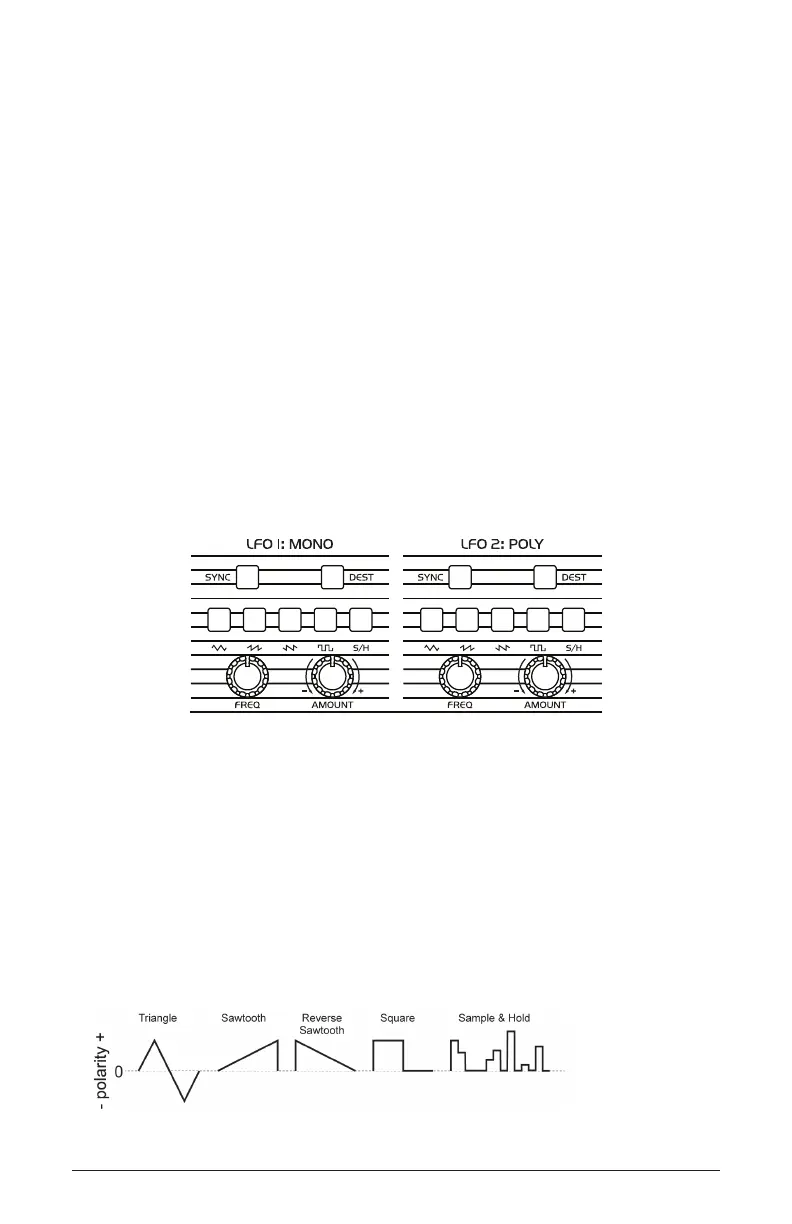
The LFOs produce a variety of waveshapes, including triangle, sawtooth,
reverse sawtooth, square, and S&H (sample & hold/random). Though
most often used for low-frequency modulation, the TEO-5 LFOs can actu-
ally function at speeds that extend into the audible range for extreme effects.
The LFOs can be free-running or synced to the Arpeggiator, Sequencer, or
MIDI clock for tempo-synced effects such as lter sweeps, tremolo, and so on.
The Low Frequency Oscillators
The triangle wave is bipolar. That is, its waveshape is positive for half of its
cycle and negative for the other half. This makes it possible to generate a
vibrato that goes alternately sharp and at in equal amounts on either side of
a center frequency.
The square, sawtooth, reverse sawtooth, and sample & hold waves
generate only positive values. In the case of the square wave, this makes it
possible to generate trills.
LFO waveshapes


 To Next Page