EasyManua.ls Logo

Olympus CH30 - User Manual

Olympus CH30
28 pages
Print Icon
To Next Page IconTo Next Page
Loading...
OLYMPUS
INSTRUCTIONS
CH30/CH40
BIOLOGICAL
MICROSCOPE
Question and Answer IconNeed help?

Do you have a question about the Olympus CH30 and is the answer not in the manual?

Summary

Safety and Precautions

General Safety Precautions

Essential safety guidelines and warnings for operating the microscope, including electrical and handling safety.

Microscope Safety Symbols Explained

Explanation of symbols used on the microscope to indicate potential hazards and operational requirements.

Getting Started and Maintenance

Initial Setup and Handling

Instructions for initial setup, handling precautions, and environmental considerations for the microscope.

Microscope Maintenance and Storage

Guidance on cleaning optical components, general maintenance, and proper storage of the microscope.

Understanding Warning Labels

Information on the location and meaning of warning labels affixed to the microscope.

General Operational Caution

Advisory on operating the microscope only as specified in the manual to prevent damage or injury.

Microscope Nomenclature and Parts

Microscope Assembly Guide

Microscope Assembly Diagram

Visual guide illustrating the order and components for assembling the microscope.

Detailed Assembly Procedures

Bulb and Observation Tube Mounting

Step-by-step instructions for mounting the halogen bulb and the observation tube.

Component Mounting Procedures

Mounting Eyepieces and Objectives

Procedures for mounting eyepieces and objectives onto the revolving nosepiece.

Mounting the Condenser

Instructions for mounting and positioning the microscope condenser.

Filter and Cord Connections

Mounting Filters and Diaphragms

Steps for mounting the blue filter, filter holder, and field iris diaphragm attachment.

Connecting the Power Cord

Guidance on safely connecting the power cord to the microscope and power outlet.

Optional Cord Rest Installation

Microscope Controls Overview

Observation Procedures

Using the Microscope Controls

Base Controls and Illumination

Instructions for turning on the bulb and adjusting illumination intensity.

Stage and Specimen Handling

Guidance on specimen placement and securing slides on the microscope stage.

Observation Tube Adjustments

Interpupillary and Diopter Adjustment

Procedures for adjusting interpupillary distance and diopter for comfortable binocular viewing.

Condenser Adjustments

Field Iris and Aperture Iris Diaphragms

Instructions for adjusting field and aperture iris diaphragms for optimal illumination and contrast.

Focusing and Immersion Objectives

Focusing Adjustment Knobs and Lever

Details on adjusting coarse/fine focus knob tension and using the pre-focusing lever.

Using Immersion Objectives

Guidelines for using immersion oil objectives, including application and removal of oil.

Photomicrography Setup

Selecting Light Paths for Photography

Instructions for selecting light paths using the trinocular observation tube for photomicrography.

Photomicrography Components

Mounting Camera Unit and Focus Adjustment

Steps for mounting the camera unit and performing focus adjustments for photography.

Color Temperature Compensation

Guidance on using filters for color temperature compensation when taking photographs.

Phase Contrast Attachments

Mounting and Using Phase Contrast

Instructions for mounting and using phase contrast attachments for specialized microscopy.

Microscope Specifications

Optical Characteristics and Glossary

Troubleshooting Guide

Optional Units and Attachments

Power Supply Cord Selection Guide

Overview

This document is an instruction manual for the Olympus CH30/CH40 Biological Microscope, a precision instrument designed for detailed observation of specimens.

Function Description

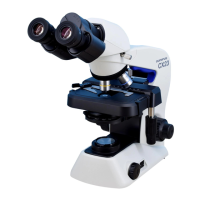
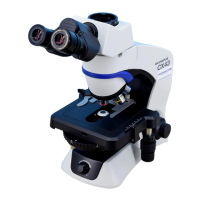
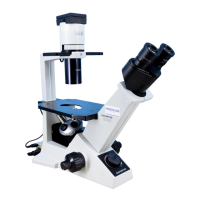
The Olympus CH30/CH40 is a biological microscope used for observing specimens at various magnifications. It features a built-in illuminator, a revolving nosepiece for objective selection, and a mechanical stage for precise specimen movement. The microscope allows for both visual observation through eyepieces and can be adapted for photomicrography using optional camera systems. It supports brightfield observation and can be equipped with phase contrast attachments for enhanced viewing of transparent or low-contrast specimens.

Usage Features

The microscope is designed for ease of use, with several features to optimize observation and ensure user comfort and safety:

  • Illumination Control: The microscope is equipped with a main switch to turn the bulb on/off and a light intensity knob to adjust brightness. A voltage selector switch on the base ensures compatibility with local mains voltage.
  • Objective Selection: A revolving nosepiece allows users to easily switch between different objectives (4X, 10X, 40X, 100X oil immersion) to change magnification. Objectives should be mounted in increasing order of magnification.
  • Focusing: Coarse and fine focus adjustment knobs are provided for bringing specimens into sharp focus. The coarse adjustment knob tension can be adjusted using a tension adjustment ring. A pre-focusing lever helps prevent the objective from contacting the specimen and simplifies refocusing.
  • Stage and Specimen Placement: The mechanical stage allows for precise movement of the specimen along the X and Y axes using dedicated knobs. A specimen holder secures single or multiple slides.
  • Observation Tube: The observation tube (binocular or monocular) can be clamped onto the microscope frame.
  • Eyepieces: Eyepieces are inserted into the observation tube. For binocular tubes, interpupillary distance can be adjusted to match the user's eyes, and a diopter adjustment ring on the left eyepiece allows for individual focus correction. Optional micrometer discs can be inserted into the NCWHK10X eyepieces for measurement.
  • Condenser: The condenser, with its height adjustment knob, focuses light onto the specimen. An aperture iris diaphragm knob controls the numerical aperture of the illumination system, which affects image resolution and contrast.
  • Field Iris Diaphragm (CH40 only): The CH40 model features a field iris diaphragm dial to adjust the diameter of the field iris, which helps exclude extraneous light and improve image contrast. For the CH30, an optional field iris diaphragm attachment can be mounted.
  • Filters: A blue filter can be used to convert tungsten illumination to daylight color temperature for natural specimen viewing. For photomicrography with daylight film, a light balancing filter (45LBD-2N) is recommended.
  • Immersion Objectives: For 100X observation, immersion oil is applied to the specimen, and an oil immersion objective is used. Instructions are provided for checking and removing bubbles in the oil to ensure clear images.
  • Photomicrography (Optional): The microscope can be adapted for photomicrography using various Olympus camera systems (PM-10M, PM-20, PM-30, PM-10AK) with a trinocular observation tube (CH3-TR45). A light path selector knob allows switching between binocular observation and photomicrography. A heat absorbing filter (45HA) is recommended for photomicrography.
  • Phase Contrast (Optional): Phase contrast attachments (phase annuli, phase contrast objectives, centering telescope) can be mounted for observing transparent specimens. The centering telescope is used to align the light annulus in the condenser with the phase annulus in the objective.

Maintenance Features

The manual provides clear guidelines for maintaining the microscope to ensure its longevity and optimal performance:

  • Handling: The microscope is a precision instrument and should be handled with care, avoiding sudden impacts, direct sunlight, high temperature, humidity, dust, or vibrations. When moving, it should be carried with one hand under the base and the other holding the recessed handle on the arm.
  • Cleaning:
    • Glass Components: Clean with gauze, or with gauze slightly moistened with a mixture of ether (70%) and alcohol (30%) for fingerprints or oil smudges. Note that the lower lens of the NCWHK10X eyepiece should only be cleaned with a dry cloth or by blowing off dust, as solvents can cloud it.
    • Non-Optical Components: Clean with a lint-free, soft cloth lightly moistened with a diluted neutral detergent.
    • Immersion Oil: After use, remove immersion oil from the objective front lens by wiping with gauze slightly moistened with an ether/alcohol mixture or EE-6310.
  • Bulb Replacement: Always switch off the main switch and disconnect the power cord before replacing the bulb. Allow the lamp housing and bulb to cool. Only use the designated bulb type to prevent fire. Avoid touching the bulb with bare hands; if touched, wipe with alcohol.
  • Storage: When not in use, the microscope should be covered with the provided dust cover.
  • Warning Labels: Users are instructed to heed warning labels affixed to the microscope, especially regarding hot surfaces and proper handling.
  • Cord Rest (Optional): An optional cord rest can be attached to the rear panel of the microscope frame for convenient storage of the power cord.
  • Troubleshooting Guide: A comprehensive troubleshooting guide is included to help users identify and resolve common issues related to the optical system, focusing adjustment, observation tube, stage, objective change, and electrical system.

Olympus CH30 Specifications

General IconGeneral
TypeBiological microscope
Magnification40x - 1000x
Objective Lenses4x, 10x, 40x, 100x
FocusingCoaxial coarse and fine focusing knobs
ObjectivesPlan Achromat
CondenserAbbe condenser NA 1.25
Illumination6V 30W halogen bulb
Eyepiece10x
StageMechanical stage
Power SupplyAC 100-240V, 50/60Hz

Related product manuals