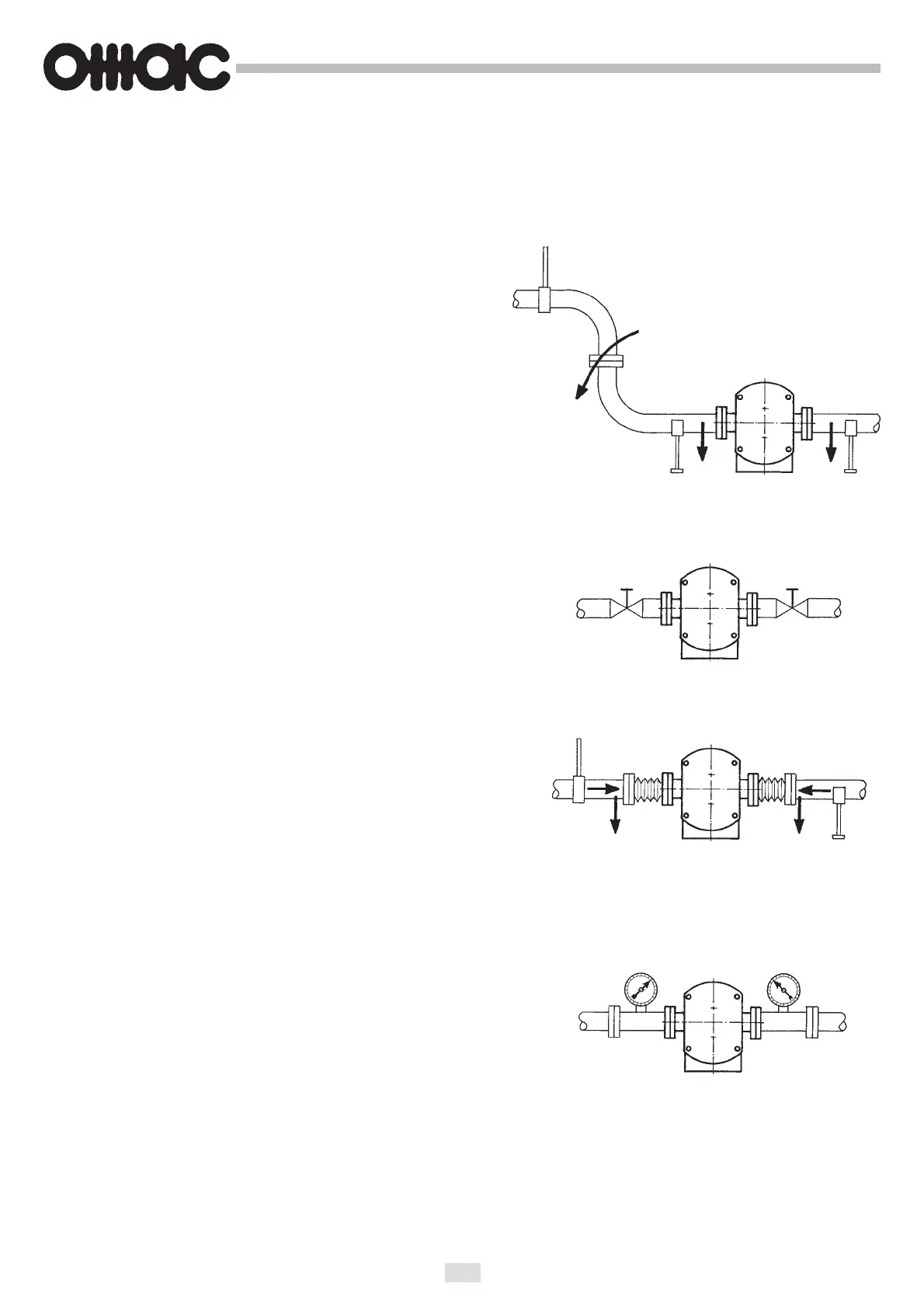
4 -The pump should be installed near the source, from which it sucks.
5 -Reduce at min. bends and necks along the whole line.
6 -Use large radius bends, avoiding Tees and needless runs.
7 -Check the perfect inlet connection seal not to reduce the pump suction power.
8 - The piping weight must not load on pump body and the
connection must be carried out without forcing in order to
avoid overloads and distortion of the rotor case.
9 - Especially in case of very long piping system isolation
valves on both inlet and outlet side to permit pump
maintenance and removal without total draining of the piping
system.
10 - Where possible arrange a flexible expansion joint to
reduce vibration and to avoid forcing, due to thermal
expansion of piping.
11 - We advise to arrange gauges and vacuum gauges near
the pump. They are usefull to check the pump working
conditions and diagnose possible trouble such as:
– pressure overload
– flow absence
– instability in duty conditions
– cavitation
12 - Where necessary arrange on inlet a filter, whose suction area must not be smaller than 4-5 time the suction pipe
to minimize the friction losses.
13 - During the pump unit installation it's necessary to leave a usefull room for maintenance and possible removal.
14 - If the pump is not flooded, arrange on inlet side a "foot" valve or a check valve to keep the priming.
6
Fig. 5
Fig. 4
Fig. 3
Fig. 2



 To Next Page