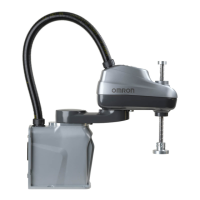
The Omron i4L robot is a selective compliance assembly robot arm (SCARA) designed for automated motion control in factory environments, particularly for material handling operations. It is capable of high-speed, high-precision motion for payloads up to 5 kg, featuring a compact design and flexible programmability.
Function Description:
The i4L robot is an integrated system that operates with EtherCAT communications, allowing seamless integration with other networked devices, safety devices, vision systems, motion equipment, and discrete I/O. It is controlled by an NJ501 Robot Integrated CPU Unit, which provides both PLC functionality and robot control. The robot can be mounted on a horizontal (table mount) or vertical (wall mount) surface without additional adapters. It features a multi-colored LED light dome for status indication, with an integrated brake release button. Mounting points are available for external equipment like cameras and solenoid valves. Pass-through electrical and pneumatic ports extend from the robot base to the outer link for end-of-arm tooling. The Primary Interface Panel centralizes cable connections, while a Secondary Interface Panel on the outer link provides connections for end-of-arm tooling. Built-in, optically isolated I/O offers 17 inputs and 12 outputs, expandable with optional IO Blox units. Work envelope limits can be adjusted with configurable hard-stop points for joints 1, 2, and 3.
Important Technical Specifications:
- Payload: 2 kg rated, 5 kg maximum.
- Reach: Available in 350 mm (i4-350L), 450 mm (i4-450L), and 550 mm (i4-550L) configurations.
- Z-axis Stroke: 180 mm for i4-350L, i4-450L, and i4-550L; also available in 350 mm for i4-550L (350 mm Z).
- Cycle Time: 0.57 s (i4-350L), 0.54 s (i4-450L, i4-550L) for continuous path with straight-line motion cycle (25 mm up, 305 mm over, 25 mm down, and back along the same path, 2 kg payload, 20°C ambient temperature, no joint 4 rotation).
- Downward Push Force (burst with no load): 150 N.
- Repeatability at 100% speed: X, Y: 0.01 mm; Joint 3: 0.01 mm; Joint 4: 0.01°.
- Joint Speeds (maximum): Joint 1: 456 degrees/s; Joint 2: 456 degrees/s; Joint 3: 800 mm/s; Joint 4: 6000 degrees/s.
- Joint Ranges: Joint 1: ±136°; Joint 2: ±136° (i4-350L), ±148° (i4-450L, i4-550L); Joint 3: 180 mm (i4-350L, i4-450L, i4-550L), 350 mm (i4-550L 350 mm Z); Joint 4: ±360°.
- Electrical Specifications:
- Control Power: 24 VDC ±10%, 5 A / 120 W maximum, user-supplied 5 A in-line fuse, 0.75 mm² to 2.5 mm² wire size.
- High Power: 48 VDC ±10%, 15 A / 720 W rated (20 A / 960 W maximum), 2.5 mm² wire size.
- XIO Connector I/O: 12 inputs (sinking/sourcing, 0-30 VDC operational range, 2.5-6 mA ON state current), 8 outputs (sourcing, 24 VDC ±10%, 0.7 A per channel max).
- TIO Connector I/O: 5 inputs, 4 outputs (similar electrical characteristics to XIO).
- Belt Encoder: Line driver pulse input (A, B, Z signals), 2-5 VDC ON voltage, 100 µA input current, 5 VDC ±10% output rating (1 A max).
- Environmental Specifications:
- Ambient Operating Temperature: 5 to 40°C.
- Storage Temperature: –25 to 55°C.
- Humidity: 5 to 90%, non-condensing.
- Altitude: 2000 m maximum.
- Pollution Degree: 2.
- Protection Class: IP20 / NEMA Type 1.
- EtherCAT Communication: 100BASE-TX, 100 Mbits/s, line, daisy chain, and branching topology, 100 m max transmission distance between nodes, 2 ms or 4 ms communication cycle.
- Mounting Hardware Torque: Socket Head Cap Screw (M8 x 1.25 mm, Class 10.9 or 12.9): 30-32 N-m.
Usage Features:
- Control Modes: Supports Manual mode (for commissioning, teaching, setup, speed limited to 250 mm/sec) and Automatic mode (for normal operation at maximum speed).
- High Power Operations: Robot motion is enabled by supplying 48 VDC High Power, which can be controlled via the Front Panel, connected PC (Sysmac Studio), user program (V+ keyword POWER), or T20 pendant. High Power is automatically disabled if safety circuits are not satisfied or a fault occurs.
- Brake Operation: Joints 3 and 4 have mechanical brakes. Brakes are released by supplying 24 VDC Control Power and pressing the built-in brake release button or a remote brake release signal via the XIO connector. Joints 1 and 2 do not have brakes.
- Jogging: Manual jogging is performed during setup or teaching, with reduced speed and acceleration limits. Can be executed in world, tool, or joint modes using software or a T20 pendant.
- Robot Positioning: Includes Joint Zero Position (inner and outer links fully extended, quill retracted) and Ready Position (programmable via READY keyword).
- Arm Configurations: Supports both Left Arm and Right Arm configurations, selectable via RIGHTY/LEFTY keywords, to optimize for the work area.
- Collision Avoidance: Obstacles can be defined in software to prevent collisions with the robot base, flyover assembly, cables, connectors, walls, or other objects.
- EtherCAT Node ID Setting: Configurable via hardware switches on the robot interface panel or through Sysmac Studio software.
Maintenance Features:
- Periodic Maintenance:
- Safety Functions: Check E-Stop, enable and key switches, and barrier interlocks every 6 months.
- Fastener Torques: Check mounting screws (30-32 N-m), external equipment fasteners (2.5 N-m for M4, 4.5 N-m for M5), and hardstop screws (17 N-m for Joint 1 & 2, 4.5 N-m for Joint 3 clamp collar) every 3 months. Initial check after 72 hours of operation, then every 3 months.
- Safety and Warning Labels: Check weekly.
- High Power Indicator: Check operation weekly.
- Oil Leaks: Inspect around robot joints every 3 months.
- Joint 3 Lubrication: Lubricate quill every 3 months or 150 km of travel using THK AFF Grease (part number 20950-000). Requires removal of tool flange and outer link cover.
- Encoder Backup Batteries: Replace every 2 to 4 years, or when a low battery alarm is present. Requires 24 VDC Control Power to be present during replacement to maintain joint position data.
- Cleaning: Clean exterior of the robot as needed, especially around robot joints. Avoid organic solvents.
- Bellows Inspection: Check weekly for cracks, wear, or damage.
- Non-periodic Maintenance:
- Tool Flange Replacement: Procedure involves removing the old flange, aligning the new one with the z-axis quill, applying thread lock, and tightening screws to specified torques (1.1 N-m for setscrew, 2.5 N-m for socket-head screws).
- Troubleshooting: Fault detection via V+ programs, LED indicator, or Sysmac Studio. Emergency Stop troubleshooting using jumper plugs (XFP, XUSR, XMCP) to bypass and isolate safety devices. Error messages are provided with explanations and corrective actions.

 Need help?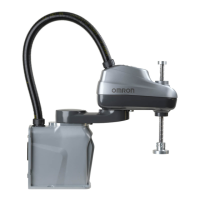

 To Next Page
 General