
 Need help?
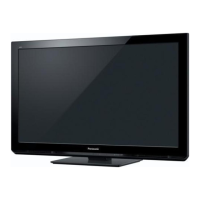
Do you have a question about the Panasonic TX-P42VT20E and is the answer not in the manual?
General guidelines for conducting repairs and servicing without modifying equipment or wiring.
Procedure for measuring touch currents between exposed metallic parts and earth ground.
Techniques to reduce component damage from static electricity when handling sensitive devices.
Diagram showing PCB layout with component names and screw locations.
Details TV power, display panel, sound, and PC signal specifications.
Lists supported TV receiving systems and band names.
Details connection terminals like AV, Component, and HDMI with their specifications.
Explains KEY data generation for CI Plus, DTCP-IP, and One-to-One features.
General information on recording digital TV programs using a USB HDD.
Procedure to enter the service mode using the remote control.
Explains the key commands used for navigating the service mode menu.
Lists adjustable parameters in service mode, their values, and remarks.
Instructions on how to exit the service mode.
How to use the mirror option for picture reversal (left/right, up/down).
Steps to access the service tool mode from the service mode menu.
How to display SOS History information (LED blinking indications).
How to display power on time and on/off switching count.
Detailed explanation of each item within the hotel mode setup menu.
Purpose of data copy for board replacement and hotel installation.
Steps to prepare the SD card with the startup file (pwd file).
Procedure for copying TV data to an SD card using a password.
Procedure for copying data from an SD card to the TV set using a password.
How to access and interpret the self-check indication for IIC bus lines.
Procedures for self-check indication only or with factory reset.
Points to confirm if 'NG' was displayed in the self-check.
Purpose and usage of the SC jig for testing SC or SM boards.
Steps for removing rear cover, AC inlet, P-board, and side covers.
Steps for removing XS-Board, Tuner unit, and A-Board.
Instructions for removing speakers, woofer, fan unit, and SM-Board.
Steps for removing SC-Board, SS2-Board, and SS-Board.
Steps to remove hanger metals and the one leg bracket.
Steps to remove cabinet mount metals.
Steps for removing the D-Board and C1-Board.
Steps for removing C2-Board and the plasma panel section.
Steps for removing K-Board, V-Board, and contact metals.
Caution and steps for replacing the plasma panel, handling it carefully.
Procedure for setting Vsus to LOW or HIGH after replacing the plasma panel or A-board.
Steps for sub-contrast adjustment via RF system, AV system, and HD system.
Procedure for THX white balance adjustment using a color analyzer.
Overall block diagram of the TV system, showing major components and interconnections.
Detailed block diagram (part 1 of 5) illustrating system signal flow.
Detailed block diagram (part 2 of 5) showing system signal flow.
Detailed block diagram (part 3 of 5) illustrating signal flow.
Detailed block diagram (part 4 of 5) showing system signal flow.
Detailed block diagram (part 5 of 5) illustrating system signal flow.
Caution statement regarding correct assembly and locking of flexible cables in connectors.
Wiring diagram showing connections for fans and power supply.
Wiring diagram illustrating connections for woofer and speakers.
Wiring diagram showing connections for various boards and terminals.
Wiring diagram illustrating cable connections.
Wiring diagram showing lead wire dressing and connections.
Notes explaining resistor, capacitor, voltage measurement, and signal flow conventions.
Schematic diagram of the P-Board (part 1 of 4), showing power supply circuits.
Schematic diagram of the A-Board (part 1 of 26), showing IIC communication lines.
Schematic diagrams for XS, D, C1, C2, SC, and SS boards.
Foil side view of the P-Board with reference grid.
Location of ICs, transistors, and test points on the P-Board foil side.
Location of ICs, transistors, and test points on the P-Board component side.
Foil and component side views of the K-Board with part numbers.
Foil and component side views of the V-Board with part numbers.
Foil and component side views of the SS2-Board with part numbers.
Foil side view of the A-Board, showing component placement.
Foil side view of the XS-Board.
Component side view of the XS-Board.
Foil side view of the D-Board.
Component side view of the D-Board.
Foil side view of the C1-Board.
Component side view of the C1-Board.
Foil side view of the C2-Board.
Component side view of the C2-Board.
Foil side view of the SC-Board.
Component side view of the SC-Board.
Foil side view of the SS-Board.
Component side view of the SS-Board.
Exploded view of the TV assembly showing outer mechanical parts.
Exploded view 2 of the TV assembly, showing internal mechanical parts.
Instructions for packing the TV and accessories.
Notes regarding the supply source of mechanical parts.
Notes regarding retention time limitations for certain parts.
Comprehensive list of electrical replacement parts with detailed specifications.
 General
| Screen Size | 42 inches |
|---|---|
| Resolution | 1920 x 1080 pixels |
| Panel Type | Plasma |
| HDMI Ports | 4 |
| USB Ports | 2 |
| Ethernet | Yes |
| 3D Support | Yes |
| Weight | 26 kg |
| Response Time | 0.001 ms |
| Wi-Fi | No |
| Integrated Speakers | Yes |
| Digital Tuner | Yes |
| Refresh Rate | 600 Hz |
| Contrast Ratio | 5, 000, 000:1 |


 To Next Page