5: BASIC Stamp Command Reference – OWIN
BASIC Stamp Programming Manual 2.0c • www.parallaxinc.com • Page 201
The 1-wire protocol has a well-defined standard for transaction sequences.
Every transaction sequence consists of four parts: 1) Initialization, 2) ROM
Function Command, 3) Memory Function Command, and 4)
Transaction/Data. Additionally, the ROM Function Command and
Memory Function Command are always 8 bits wide (1 byte in size) and is
sent least-significant-bit (LSB) first.
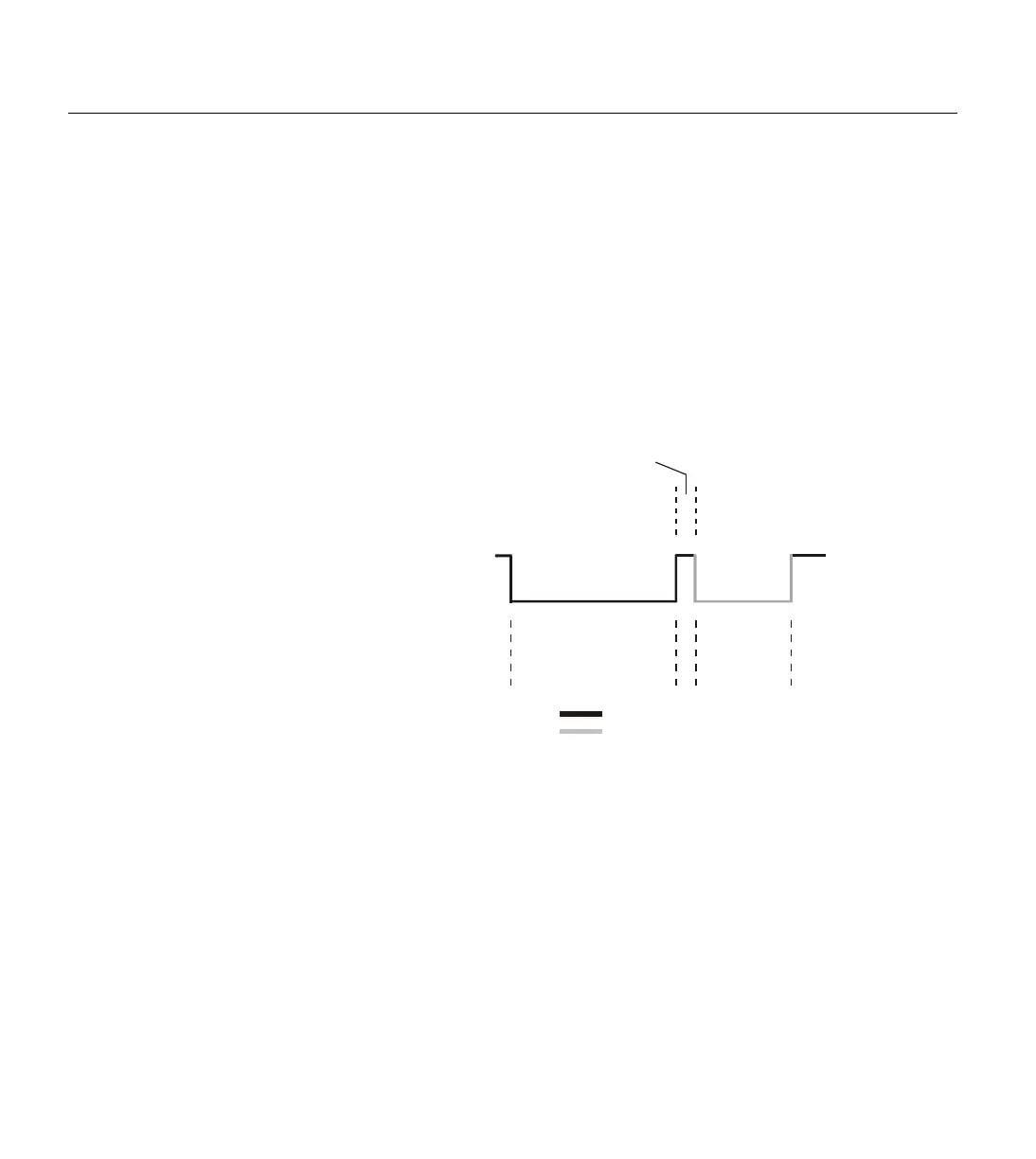
The Initialization part consists of a reset pulse (generated by the master)
and will be followed by a presence pulse (generated by all slave devices).
Figure 5.18 details the reset pulse generated by the BASIC Stamp and a
typical presence pulse generated by a 1-wire slave, in response.
This reset pulse is controlled by the lowest two bits of the Mode argument
in the OWIN command. It can be made to appear before the ROM
Function Command (ex: Mode = 1), after the Transaction/Data portion (ex:
Mode = 2), before and after the entire transaction (ex: Mode = 3) or not at all
(ex: Mode = 0). See the section on Mode, above, for more information.
Following the Initialization part is the ROM Function Command. The
ROM Function Command is used to address the desired 1-wire device.
Table 5.47 shows common ROM Function Commands. If only a single
1-wire device is connected, the Match ROM command can be used to
address it. If more than one 1-wire device is attached, the BASIC Stamp
will ultimately have to address them individually using the Match ROM
command.
THE 1-WIRE PROTOCOL FORMAT.
BASIC Stamp’s
Reset Pulse
Apx. 564 s
µ
Device’s
Presence
Pulse
60 - 240 s
µ
15 - 60 sµ
driven by BASIC Stamp
driven by 1-wire device
+5 (vdd)
0 (vss)
Figure 5.18: OWIN Reset and
Presence Pulse.



 To Next Page