2018-04
80
HART Multiplexer System KFD*-HM*-16
Appendix
9Appendix
9.1 Supported HART Commands
The following tables show the HART commands supported by the HART multiplexer system.
The HART commands are divided into 3 groups:
• Universal commands
• Common practice commands
• Device-specific commands
9.1.1 Universal Commands
Note!
The universal commands and common practice commands are described in detail in /1/,
see chapter 9.3. At this point, only the functions are explained, not the underlying
data structures of the HART protocol.
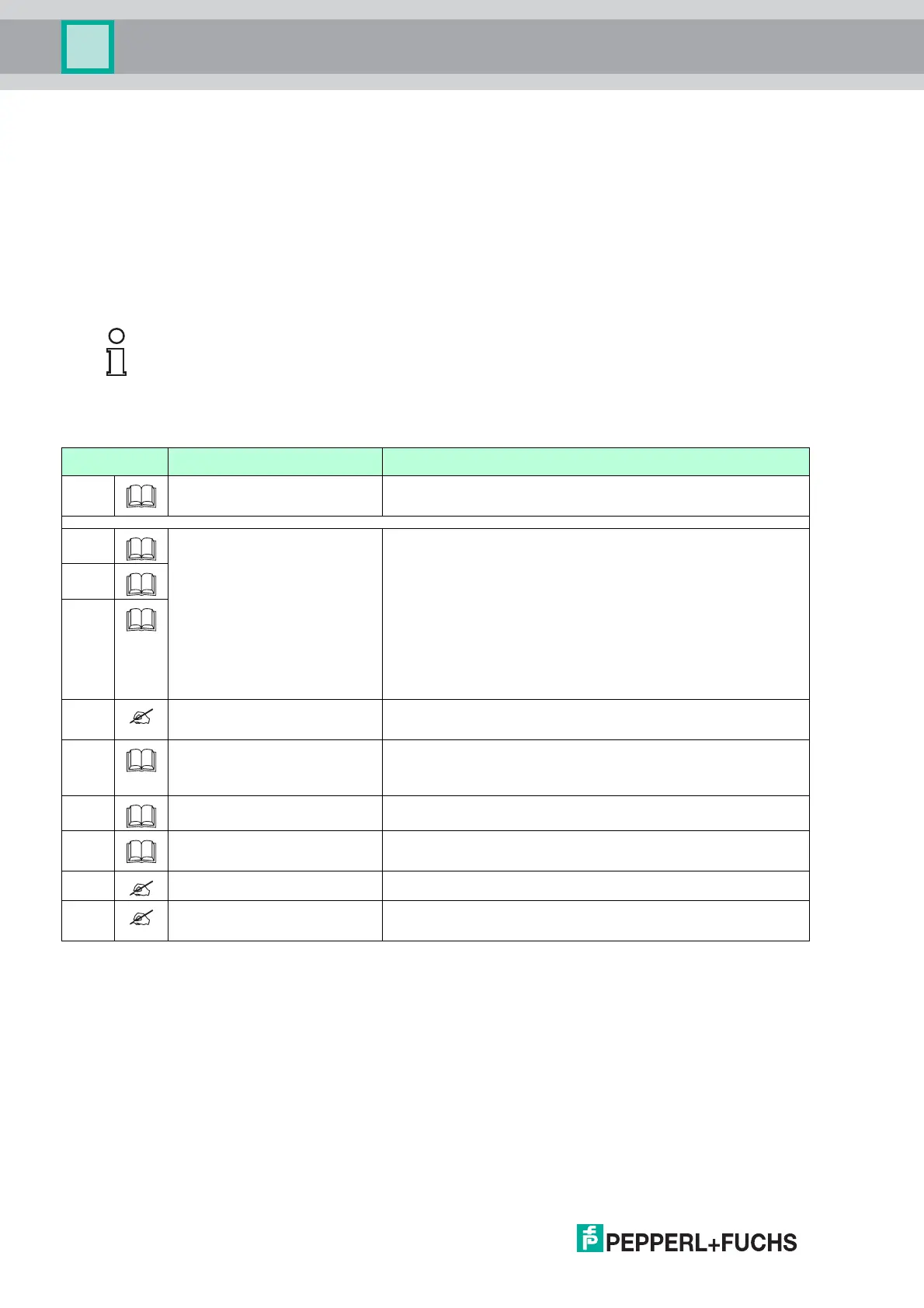
Command Action Meaning
0 Read unique device
identification.
A 12 byte device identification is given in response.
1 Read HART variables (data). Commands are only supported by the
HART multiplexer system for compatibility purposes and
have no significance. However, in the field devices
(e. g., scan function) they have the following meanings:
• 1: Read primary variable.
• 2: Read primary variable as a current (mA) and
percentage of the measuring range.
• 3: Read primary variable as a current (mA) and four
(pre-defined) dynamic variables.
2
3
6 Set polling address. This command will not be accepted and the messages
Access restricted or Busy will be returned.
11 Read unique device
identification using the tags.
A 12 byte device identification is given in response if the
specified tag corresponds to the tag stored in the
HART multiplexer system.
12 Read message. The 32-digit message is read, see also command 17.
13 Read the tag, description,
and date.
Read the 8-digit tag, the 16-digit description, and the date.
17 Save message. The 32-digit message is written, see also command 12.
18 Save the tag, description,
and date.
Save an 8-digit tag, a 16-digit description, and a date.
Table 9.1



 To Next Page