KENR9126 7
Troubleshooting Section
(1) E lectronic unit injectors
(2) Electronic Control Module (ECM)
(3) Electronic Service Tool (EST)
(4) D iagnostic co nnector
(5) SMM S relay
(6) Starting motor
(7) CAN bus terminator
(8) P ositive glow plug relay
(9) Glow plugs
(10) Negative glow plug relay
(11) Alternator cha rging relay input
(12) Coolant level sensor (if equipped)
(13) Exhaust gas temp erature sensor (if
equipped)
(14) Customer interface connector
(15) Electronic display
(16) 12V or 24V pow er supply
(17) Primary t hrottle
(18) Secondary throttle
(19) Warning lamp
(20) Diagnostic lamp
(21) Maintenance lamp
(22) Low coolant level lamp
(23) Low oil pressure lamp
(24) High coolant temperature lamp
(25) Water in fuel lamp
(26) Ignition switch
(27) Remote s hutdown switch
(28) Troll mode switch
(29) Slow vessel mode switch
(30) Throttle synchronize 1 switch
(31) Throttle synchronize 2 switch
(32) Maintenance clear switch
(33) Trip clear switch
(34) Water in fue l sensor
(35) Fue l supply pressure sensor (if
equipped)
(36) Transmission oil pressure sensor (if
equipped)
(37) Transmission oil temperature sensor (if
equipped)
(38) Fuel level sensor (if equipped)
(39) Fuel temperature sensor (if equipped)
(40) Fuel rail pressure se nsor
(41) Intake manifold air pressure sensor
(42) Intake manifold air temperature sensor
(43) Coolant temperature sensor
(44) Oil pressure sensor
(45) Primary sp eed/timing sens or
(46) Secondary speed/timing sensor
(47) Wastegate regulator (if equipped)
(48) Solenoid for th e fuel rail pump
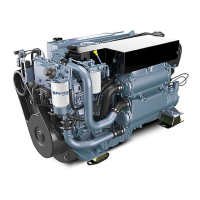
The engine is designed for electronic control. The
engine has an Electronic Control Module (ECM),
afuelrail
pump and electronic unit injectors. All of
these items are electronically controlled. There are
also a number of engine sensors. Turbocharged
engines c
an be equipped with an electronically
controlled wastegate for the turbocharger. The
ECM controls the engine operating parameters
through t
he software within the ECM and the inputs
from the various sensors. The software contains
parameters that control the engine operation. The
paramet
ers include all of the operating maps and
customer-selected parameters.
The elec
tronic system consists of the ECM, the
engine sensors, and inputs from the application. The
ECM is the computer. The flash file is the software
for the
computer. The flash file defines the following
characteristics of the engine:
•
Engin
epower
•
Torque curves
•
Engine speed (rpm)
•
Engin
eNoise
•
Smoke and Emissions
The ECM determines the injection timing, the amount
of fuel that is delivered to the cylinders and the intake
mani
fold pressure if an electronically controlled
wastegate is installed on the turbocharger. These
decisions are based on the actual conditions and the
des
ired conditions at any given time.
Engine Speed Governor
The govern
or has software that compares the desired
engine speed to the actual engine speed. The actual
engine speed is determined through the primary
speed/ti
ming sensor and the secondary speed/timing
sensor. If the desired engine speed is greater than
the actual engine speed, the governor injects more
fuel in or
der to increase engine speed. If the actual
engine speed is greater than the desired engine
speed, the governor limits the amount of fuel that is
supplie
d to the electronic unit injectors in order to
reduce engine speed.
Timing C
onsiderations
Fuel injection timing is determined by the ECM after
consid
ering input from the following components:
•
Engine coolant temperature sensor
•
The sensor for the intake manifold air temperature
•
The se
nsor for the intake manifold pressure
•
Speed/timing sensors
•
Throttle position sensor
At en
gine start-up, the ECM determines the top
center position of the number 1 cylinder from the
speed/timing sensors. The ECM determines when
fuel
injection should occur relative to the top center
position. The ECM optimizes engine performance
by control of each of the electronic unit injectors so
tha
t the required amount of fuel is injected at the
precise point of the engine's cycle. The electronic unit
injectors are supplied with high-pressure fuel from
th
e fuel rail. The ECM also provides the signal to the
solenoid in the fuel rail pump. The solenoid in the fuel
rail pump controls a valve in the fuel rail pump. This
va
lve controls the pressure in the fuel rail. Fuel that is
not required for the engine is diverted away from the
fuel rail pump back to the fuel tank.



 To Next Page