EasyManua.ls Logo

Philips PM3350A - Page 47

Philips PM3350A
109 pages
Print Icon
To Next Page IconTo Next Page
To Previous Page IconTo Previous Page
Loading...
4
-
14
4
APPLICATIONS
-
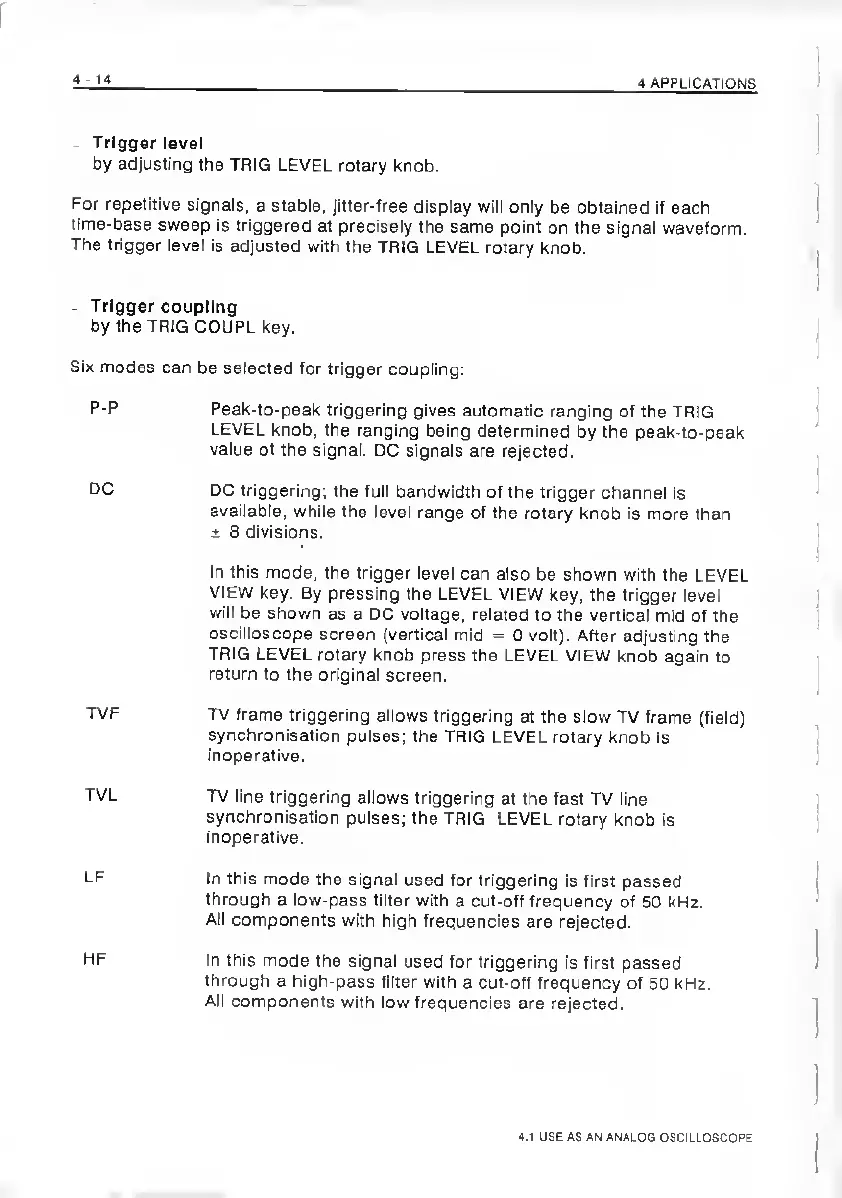
Trigger
level
by
adjusting
the
TRIG
LEVEL
rotary
knob.
For
repetitive
signals,
a
stable,
Jitter-free
display
will
only
be
obtained
if
each
time-base
sweep
Is
triggered
at
precisely
the
same
point
on
the
signal
waveform.
The
trigger
level
is
adjusted
with
the
TRIG
LEVEL
rotary
knob.
-
Trigger
coupling
by
the
trig
COUPL
key.
Six
modes
can
be
selected
for
trigger
coupling:
P-P
Peak-to-peak
triggering
gives
automatic
ranging
of
the
TRIG
LEVEL
knob,
the
ranging
being
determined
by
the
peak-to-peak
value
of
the
signal.
DC
signals
are
rejected.
DC
DC
triggering;
the
full
bandwidth
of
the
trigger
channel
is
available,
while
the
level
range
of
the
rotary
knob
is
more
than
±
3
divisions.
In
this
mode,
the
trigger
level
can
also
be
shown
with
the
LEVEL
VIEW
key.
By
pressing
the
LEVEL
VIEW
key,
the
trigger
level
will
be
shown
as
a
DC
voltage,
related
to
the
vertical
mid
of
the
oscilloscope
screen
(vertical
mid
=
0
volt).
After
adjusting
the
TRIG
LEVEL
rotary
knob
press
the
LEVEL
VIEW
knob
again
to
return
to
the
original
screen.
TVF
tv
frame
triggering
allows
triggering
at
the
slow
TV
frame
(field)
synchronisation
pulses;
the
TRIG
LEVEL
rotary
knob
is
inoperative.
TVL
tv
line
triggering
allows
triggering
at
the
fast
TV
line
synchronisation
pulses;
the
TRIG
LEVEL
rotary
knob
is
inoperative.
LF
In
this
mode
the
signal
used
for
triggering
is
first
passed
through
a
low-pass
filter
with
a
cut-off
frequency
of
50
kHz.
All
components
with
high
frequencies
are
rejected.
HF
In
this
mode
the
signal
used
for
triggering
is
first
passed
through
a
high-pass
filter
with
a
cut-off
frequency
of
50
kHz.
All
components
with
low
frequencies
are
rejected.
4.1
USE
AS
AN
ANALOG
OSCILLOSCOPE

Related product manuals