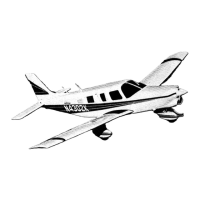
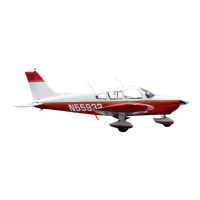
TWIN COMANCHE C/R
II
1
i
a
4
,
d-
1
1. Electric fuel pumps - off.
(Unless above 15,000 feet)
2. Power - set.
3. Mixture - lean in accordance with engine manufacturer manual.
4. Cowl flaps - set.
(Position to maintain allowable cylinder head temperature)
5. Fuel valves (main or auxiliary) - on.
6. Trim-set.
7. Engines gauges - check and monitor.
Since a fuel injected engine such as is used on the Twin Comanche takes an appreciable length of time
to start after fuel starvation, it is recommended that you avoid emptying a fuel cell to depletion. If the
engine should stop because a fuel cell is depleted of fuel be prepared to wait a while for the engine to start
after changing to a fuel cell with fuel in it. If it is necessary to use all the fuel in a fuel cell, carefully
monitor the fuel flow meter and quickly change the fuel valve position at the first indication of a decrease
in fuel flow. This will enable you to keep the engine operating while using all of the fuel in the fuel cell. _
During flight, keep account of time and fuel used in connection with power settings to determine how
the fuel flow and fuel quantity gauging systems are operating. If the fuel flow indication is considerably
higher than the fuel actually being consumed or an asymmetric flow gauge indication is observed, you may
have a clogged fuel nozzle which should be cleaned.
APPROACH AND LANDING
Prior to extending the landing gear for landing, retard both throttle controls to check that the landing
gear warning horn is operating. Flying the airplane with the horn inoperative is not permitted. It can lead to
a gear up landing as it is easy to forget the landing gear when approaching for a single engine landing when
other equipment is inoperative or when attention is drawn to events outside of the cockpit. Therefore it is
especially important to check that the landing gear is down when there is any distraction in the landing
situation.
Lower the gear at speeds below 150 miles per hour and the flaps at speeds below 125 miles per hour
for reduce wing flap operating loads.
d
CAUTION
Maintain sufficient speed during turns in the traffic pattern. It is a
good practice to trim the aircraft to establish a speed of at least
115 miles per hour on the downwind leg and 110 miles an hour on
the base leg. Hold 110 miles per hour until the turn onto final
approach has been completed. Then reduce to a final approach
speed at 95 miles per hour. _
Set the propeller at a high cruising RPM of a least 2400 RPM for
ample power if a go-around is necessary. Mixture control should
be in the full rich position unless density altitude or conditions of
high temperature and humidity dictate otherwise.
Avoid steep turns at low airspeeds or at low altitudes, particularly
during the turn from base leg to final approach.
Ascertain the landing gear is down and locked on base leg or fmal approach by checking the green
indicator light on the instrument panel and the external mirror to make sure the nose landing gear is
extended.
OPERATlNGINSTRiJCTIONS '
ISSUED: June 1,197O
-
‘PAGE 9


 To Next Page
 Loading...