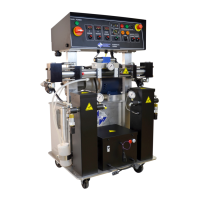
PH-20/PHX-20 Manual
35
b) Determine what material is NOT exiting the Mixing Chamber.
c) Read the Pressure Gauge on the problem side and interpret the
reading.
d) In this example a lack of Iso (A) with fluctuating LOW
pressure on the Iso (A) side indicates the Metering Pump
is not developing sufficient pressure or material volume;
Cavitation.
In this example a lack of Poly (R) with HIGH pressure on the Poly
(R) side indicates the Metering Pump is developing sufficient
pressure; a stoppage after the Pressure Gauge is not allowing
the material to exit the Spray Gun.
Check Spray Gun for a blockage.
6. Cavitation
Cavitation occurs when the Metering Pump [B, or C, page 9] requires a larger volume
of material than the supply system (Transfer Pump) can furnish. This creates a "void"
of material in the Metering Pump. The most common causes of cavitation are:
a) Material temperature too low causing increased material viscosity resulting in the
inability of the Transfer Pump to maintain sufficient supply to the Metering Pump.
This is most common with today's blown systems. Ensure the material
temperature in the drums is no lower than the material suppliers' recommendation.
b) Failure to vent the material drum while drawing material out with the Transfer Pump
causes a vacuum and cavitation in the Transfer Pump. Ensure the drum is vented
to the atmosphere or a Desiccated Air Dyer Kit is installed as recommended by the
material supplier.
c) Air volume insufficient for Transfer Pump or Transfer Pump Air Valve partially
closed will limit the ability of the Transfer Pump to operate at its maximum
capability.
d) Inlet Material Screen [O, page 11] obstructed (See MAINTENANCE section).
e) Metering Pump Inlet Ball does not seat properly allowing material to flow back into
the Material Delivery Hose when the Metering Pump is on the "Discharge" stroke.
This causes the volume of material on that Metering Pump to be less on the
discharge stroke resulting in intermittent off-ratio material and Pressure Gauge
fluctuation.


 To Next Page