EasyManua.ls Logo

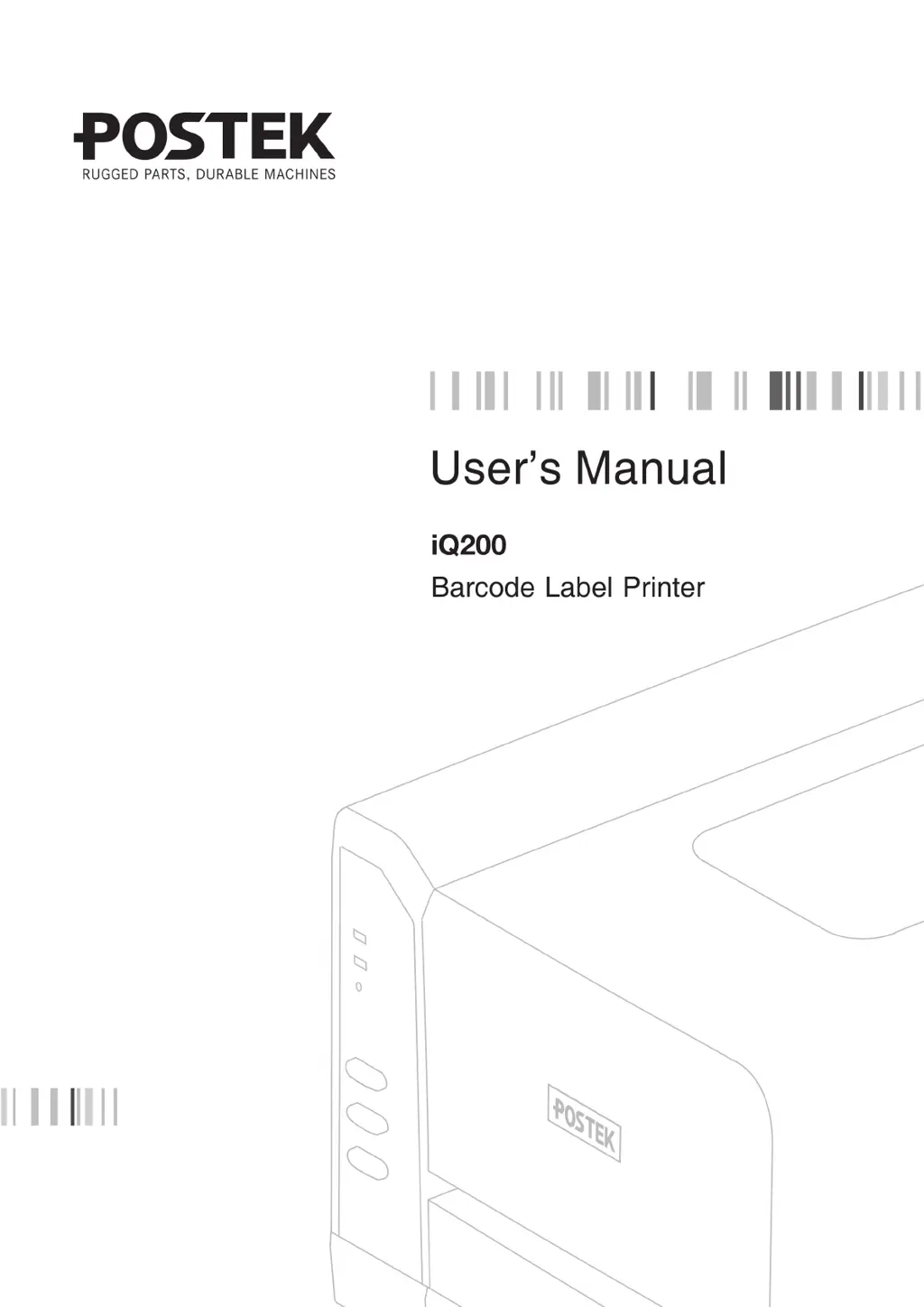
Postek iQ200 - User Manual

Postek iQ200
38 pages
Print Icon
To Next Page IconTo Next Page
Loading...

Questions and Answers

  • G
    guerraanneAug 6, 2025
    How to fix vertical blank lines appearing on Postek Label Maker?
    • S
      Stephanie GouldAug 6, 2025
      If vertical blank lines appear on your labels printed by Postek Label Maker, the printhead is likely dirty. Clean the printhead following the recommended maintenance guidelines.
  • T
    Terry DavisAug 16, 2025
    Why is my Postek iQ200 printing with poor quality?
    • R
      raymondmooreAug 16, 2025
      If your Postek Label Maker is producing poor quality prints, it could be due to several reasons. First, the printing parameters might be set inappropriately. Try adjusting the print darkness and speed settings. Another potential cause is a dirty printhead; in this case, clean the printhead following the recommended maintenance guidelines. Lastly, the issue might be due to poor quality consumables; try switching to higher-quality consumables.
  • A
    Anita KellerAug 26, 2025
    What to do if data is sent but Postek iQ200 Label Maker is not printing?
    • W
      Wayne HoffmanAug 26, 2025
      If you're sending data to your Postek Label Maker but it's not printing, there are a couple of potential causes. First, ensure that the correct driver is chosen in the label software. If the driver is correct, the issue might be due to memory overflow. In this case, try resetting the printer.

Summary

FCC Notice

Trademarks

Copyright

Disclaimer

Important Safety Instructions

Preface

Symbol Conventions

Defines symbols used in the document for warnings, cautions, and notes.

Important Notes

Printhead Care and Warnings

Guidelines for handling and cleaning the printhead to prevent damage and ensure longevity.

Cutter Safety and Maintenance

Safety rules and maintenance procedures for the optional cutter accessory.

Chapter 1: Introduction

1.1 Specifications

Detailed technical specifications including printing mode, resolution, speed, media, and interfaces.

1.2 Contents in the Box

Lists the items included in the printer package for user verification.

Chapter 2: Setup and Use

2.1 Main Parts and Structures

Overview of printer components: front, internal, and rear views with labeled parts.

2.2 Setting up the Printer

Instructions for interface connection and powering up the printer, including cable noise reduction.

2.2.3 Loading the Media

Step-by-step guide to loading media, covering Standard Mode and its variations.

2.3 Using the External Media Stand

Instructions for setting up and using the external media stand for label rolls and fanfold media.

2.4 Changing Reflective Media Sensor Position

Procedure for adjusting the reflective media sensor for accurate label detection.

Chapter 3: Operations and Settings

3.1 Basic Operations

Covers basic printer functions, including power switch operation and front panel controls (LEDs and buttons).

3.1.4 DIP Switches

Details the function and settings of the printer's DIP switches for various configurations.

3.1.5 Setting Operation Mode

Instructions for configuring the printer's operation mode: Tear-off, Peeler, and Cutter modes.

3.2 WIFI Settings

Guidance on setting up the printer's Wi-Fi connectivity.

3.3 Installing Windows Driver and Label Editing Software

Steps for installing necessary drivers and label editing software for printer operation.

Chapter 4: Maintenance

4.1 Cleaning the Printhead

Procedure for cleaning the printhead using anhydrous isopropyl alcohol to ensure print quality.

4.2 Cleaning the Platen Roller

Instructions for cleaning the platen roller to remove debris and maintain performance.

4.3 Cleaning the Printer Interior

Guidance on periodically cleaning the printer's interior to prevent dust and debris accumulation.

4.4 Cleaning the Sensors

Instructions for cleaning sensors with anhydrous isopropyl alcohol to maintain proper detection.

Chapter 5: Troubleshooting

5.1 LED Error Indications

Lists common LED error indications and their corresponding causes and solutions for the printer.

5.2 Miscellaneous Issues

Addresses other common printer problems such as blank lines, data issues, and print quality.

Appendix A: Interface Specifications

Appendix B: ASCII Table

Postek iQ200 Specifications

General IconGeneral
Print TechnologyThermal Transfer/Direct Thermal
Print Resolution203 dpi
Power Supply100-240V AC, 50/60Hz
Media Width25.4 mm to 118 mm
Media Thickness0.06 mm to 0.25 mm
ConnectivityUSB, Ethernet, RS-232
Operating System CompatibilityWindows, Linux, Mac OS
Memory128 MB RAM
Media TypeContinuous, Die-Cut, Black Mark
Processor32-bit RISC CPU
Supported Barcode TypesPDF-417, Maxicode, DataMatrix, QR code, Aztec
Supported Image FormatsBMP, PCX, GIF, PNG
Dimensions210 mm

Related product manuals