23
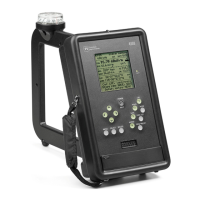
4.2.5.10 Frequency range for measurements: While the 4100's specified frequency range for
accurate measurements is 200 kHz - 5.1 MHz, it can be used outside this range. The frequency range for
which the unit is calibrated is shown on the nameplate on the bottom of the case and on the screen that
appears for three seconds when the unit is first turned on. At the low end it can be used as long as manual
self-calibration gives a CAL OK message, typically below 200 kHz, and calibration down to 200 kHz is
available. At the high end the 4100 can be used with reduced accuracy at least to 8.5 MHz, so 5th
harmonic measurements of 1.7 MHz are possible.
4.2.6 Measuring Harmonics
4.2.6.1 Measurement conditions: The PI 4100 can measure broadcast harmonics with full
accuracy for harmonic frequencies up to 5.1 MHz and with reduced accuracy to 8.5 MHz. For accurate
measurements the received signal must be large enough that the harmonic to be measured will be above
the 4100’s noise floor, but not large enough to cause significant harmonic generation within the 4100.
The range of fundamental frequency field strength values that satisfy these conditions, depending on the
target harmonic ratio it is required to equal or exceed, is as follows:
Target harmonic ratio: 60 dB: Fundamental field strength must be: 30 mV/m to 12 V/m
70 dB 100 mV/m to 6 V/m
80 dB 300 mV/m to 3V/m
If local RF noise picked up is greater than the 4100’s noise floor, the lower field strength limit needs to be
greater than stated above. Generally, greater fundamental field strength is better; the best value for
accurate harmonic ratio measurements is approximately 2 V/m.
4.2.6.2 Measurement procedure:
● Use Tx select to select the desired station.
● Position the 4100 and orient it for maximum field strength, near 2 V/m if possible.
● Press MENU and move the cursor to Harmonic.
● Move the underline cursor to the desired harmonic multiple, for example 3.
● Press MENU to return to the field strength screen.
3x now appears on the display to the left of the frequency, and the 4100 is set to receive at three times the
displayed frequency. The received field strength is displayed in dB relative to the fundamental field
strength, or dBc, so a harmonic 72 dB below the fundamental will display as -72 dBc.
4.2.7 Spectrum mode operation
The 4100 can display the spectrum of a signal as a plot of received amplitude vs. frequency
over a span of 128 kHz, which is centered on the frequency shown on the field strength screen at the time
MODE is pressed (see below). It does this by stepping its operating frequency in 1 kHz steps across the
span, producing a plot on the display in 1 dB amplitude steps. Amplitude values are held internally with
0.1 dB resolution. The measurement bandwidth, or resolution bandwidth, at each frequency is fixed at
1.0 kHz. Each amplitude value is the average of the signal received over a period of approximately 20
milliseconds. The total amplitude range available is approximately 128 dB. These parameters are at
variance with NRSC requirements for spectral occupancy measurements, which call for a 300 Hz
resolution bandwidth and peak hold without averaging.
Spectrum modes: There are three spectrum modes, designated Normal, Peak, and Abs
(meaning Absolute). From the field strength screen press MODE to go to Normal, press it again to go to
Peak, press it again to go to Abs, and press it again to return to the field strength screen.
Normal mode: This is a plot of amplitude in dBc (dB below the center frequency carrier
amplitude) with the center frequency point at the top center of the plot.


 To Next Page