9
CUTTING METHODS
OPERATING TIPS
S Check chain tension before first use
and after 1 minute of op eration. See
CHECK CHAIN TENSION in the MAINTE-
NANCE
section.
S Cut wood only. Do not cut met a l, plas-
ti cs, masonry, non-wood building mate-
rial s, etc.
S Stop the saw if the chain str ikes a for-
eign object. Inspect the saw and repair
part s as necessary.
S Keep the chain out of dir t and sand.
Even a small amount of dirt will quickly
dull a chain and increase the possibility
of kickback.
S Practice cuttin g a few small logs using
the following steps. This will help you get
the “feel ” of using your saw before you
begin a major sawing operation.
S Squeeze tri gger swit ch and allow unit
to reach full speed before cutt ing.
S Begin cutting with the saw frame
against the log.
S Keep the motor at full speed the en-
tire time you are cutting.
S Release the trigger switch as soon
as the cut is completed, allowing the
motor to stop.
S Keep the cord away from the cutti ng
are a. Posit i on cord so it will not be
caught on branches and the like dur-
ing cutting.
S To a void losing control when cut is
complete, do not p ut pressure on
saw at end of cut.
S Stop motor bef ore setting saw down.
TREE FELLING TECHNIQUES
WARNING: Che ck for broken or
dead branches which can fall while cu t-
ting causing serious injury. Do not cut
near buildings or e lectrical wires if you
do not k now the direction of tree fall, nor
cut at night s ince you will not be able to
see well, nor during bad weather s uch
as rain, snow, or strong winds, etc. If the
tree does make contact with any utility
line, the utility company should be noti-
fied immediately.
S Careful ly plan your sawing operation in
advance.
S Clear the work area. You need a clear
area all around the tr ee so you can have
secur e foot ing.
S The chain saw operator should k eep
on the uphill side of the terrain as the
tree is likely to roll or slide downhill af-
ter it is felled.
S Study the natural conditi ons that can
cause the tree to fall in a particular direc-
tion, such as:
S The wind direction and speed.
S The lean of t he tr ee . The lean of a tr e e
mi gh t not be appar e n t due to uneven
or sloping terrain. Use a plumb or level
to det ermine the dire ct ion of tre e lean.
S Weight and branches on one side.
S Surrounding trees and o bstacles.
S Look for decay and rot. If the trunk is
rotted, it can snap a nd fall toward the
operator.
S Make sure there is enough room for
the tree to fall. Maintain a distance of
2-1/2 tree lengths from the nearest per-
son or other o bjects. Noise can drown
out a warning call.
S Remove dirt, s tones, loose bark, nails,
staples, and wire from the tree where
cuts are to be made.
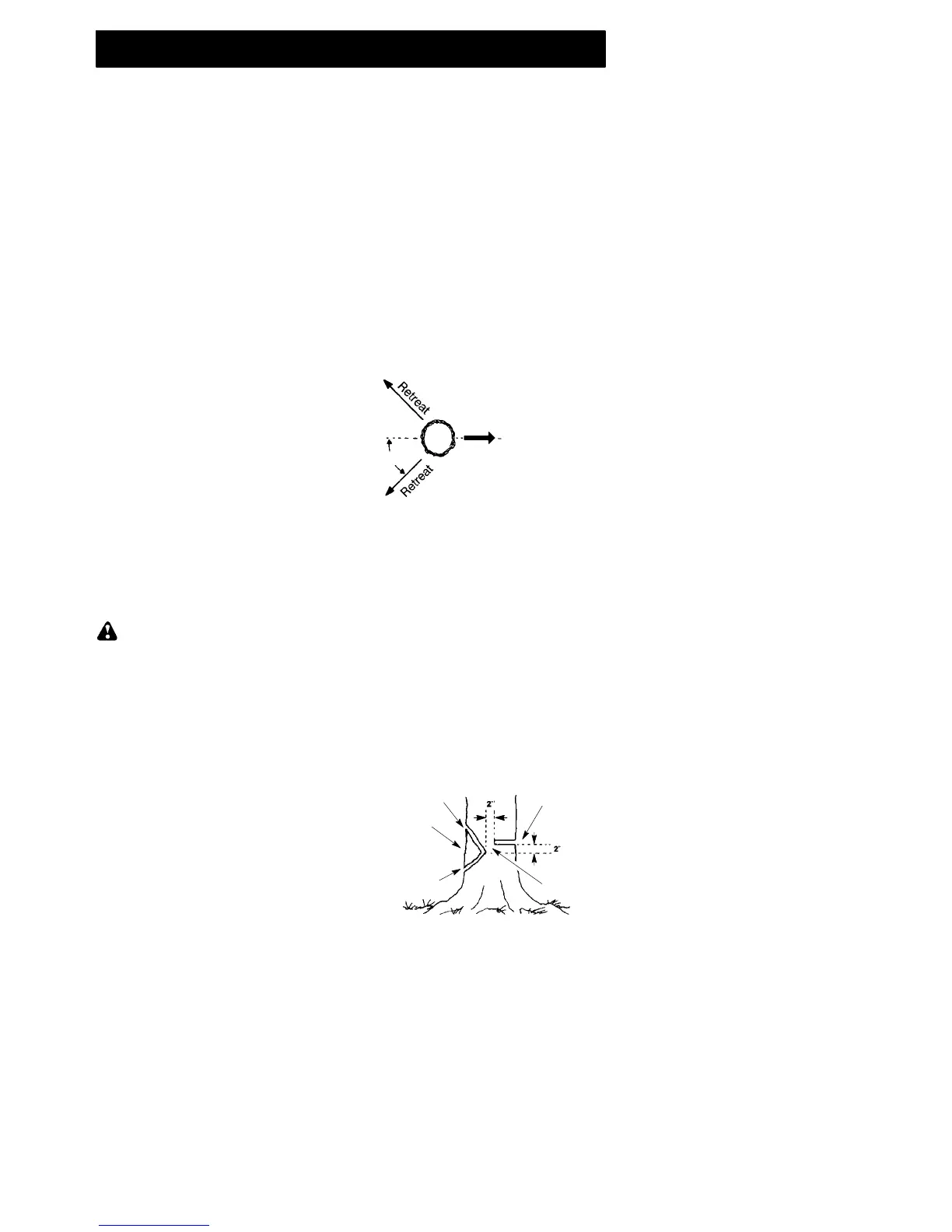
Direction of Fall
45_
Plan a clear retreat path
FELLING LARGE TREES
(6 inches in diameter or larger )
The notch method is used to fel l large
trees. A not ch is cut on the side of the tree
in the desired direction of fall. After a felling
cutismadeontheoppositesideoftree,
the tree will tend to fall in the direction of
the notch.
NOTE: If tree has large buttress roots,
remove them before making the notch. If
using saw to remove buttress roots,
keep saw c hain from c ontacting ground
to prevent dulling of the chain.
NOTCH CUT AND FELLING T REE
S Make notch cut by cutti ng the top of the
notc h fi rst . C ut thr oug h
1/3 of the
diameter of the tr ee. Next complete the
notch by cutting the bottom. See illustra-
tion. Once the notch is cut, remove the
wedgeofwoodfromtree.
Notch
First cut
Second cut
Final cut here
Hinge










 To Next Page