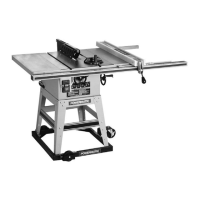
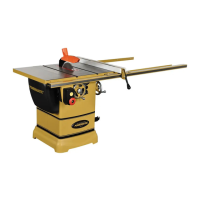
Model 72 -
12"/14"
Tilting Arbor Saw
OPERATING INSTRUCTIONS
PROPER OPERATING PROCEDURES
RIPPING:
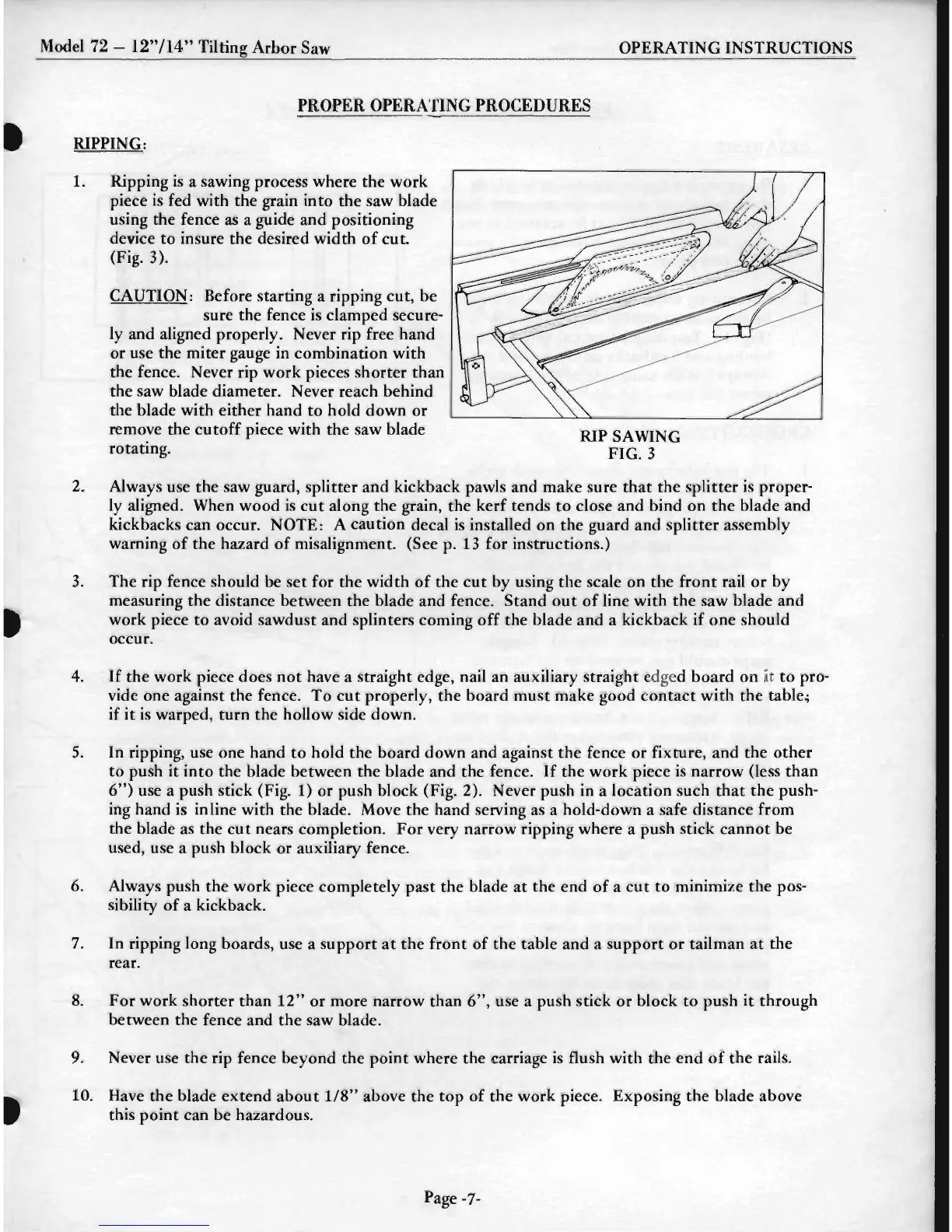
1. Ripping
is
a sawing process where the work
piece
is
fed with the grain
into
the saw blade
using the fence
as
a guide and positioning
device
to
insure the desired width
of
cut.
(Fig. 3).
CAUTION: Before starting a ripping cut, be
sure the fence
is
clamped secure-
ly and aligned properly. Never rip free hand
or
use the miter gauge in combination with
the fence. Never rip work pieces shorter than
the saw blade diameter. Never reach behind
the blade with either hand
to
hold down
or
remove the
cutoff
piece with the saw blade
rotating.
RIP SAWING
FIG. 3
2.
Always use the saw guard, splitter and kickback pawls and make sure
that
the splitter
is
proper-
ly aligned. When wood
is
cut
along the grain, the kerf tends
to
close
and
bind on
the
blade and
kickbacks can occur. NOTE: A caution decal
is
installed on the guard and splitter assembly
warning
of
the hazard
of
misalignment. (See p.
13
for instructions.)
3.
The rip fence should be
set
for the width
of
the
cut
by using the scale on the
front
rail
or
by
measuring the distance between the blade and fence. Stand
out
of
line with the saw blade and
work piece
to
avoid sawdust and splinters coming
off
the blade and a kickback
if
one should
occur.
4.
If
the work piece does
not
have a straight edge, nail an auxiliary straight edged
board
on
it
to
pro-
vide one against the fence. To
cut
properly, the board
must
make good
contact
with the table;
if
it
is
warped, turn the hollow side down.
5.
In ripping, use one hand
to
hold the board down and against the fence or fixture, and the other
to push
it
into
the blade between the blade and the fence.
If
the work piece
is
narrow (less than
6")
use a push stick (Fig. 1)
or
push block (Fig. 2). Never push in a location such
that
the
push-
ing hand is inline with the blade. Move the hand serving
as
a hold-down a safe distance from
the blade
as
the
cut
nears completion.
For
very narrow ripping where a push stick
cannot
be
used, use a push block
or
auxiliary fence.
6. Always push the work piece completely past the blade
at
the end
of
a
cut
to minimize the pos-
sibility
of
a kickback.
7.
In ripping long boards, use a
support
at
the
front
of
the
table and a
support
or
tailman
at
the
rear.
8.
For
work shorter than
12"
or
more narrow than
6",
use a push stick
or
block
to
push
it
through
between the fence and the saw blade.
9.
Never use
the
rip fence beyond the
point
where the carriage
is
flush with the
end
of
the
rails.
10. Have the blade extend
about
1/8"
above the
top
of
the work piece. Exposing
the
blade above
this
point
can be hazardous.
Page
-7-



 To Next Page