
 Need help?
Do you have a question about the ProMinent DCM3 Series and is the answer not in the manual?
Step-by-step guide for calibrating the pH sensor on the DCM3 controller.
Guide for calibrating the Free Chlorine sensor using the DPD method.
Instructions on how to change the pH set point for feeder control.
Explanation of deadband for controlling feeder overlap and chattering.
How to view detailed alarm information and clear active alarms.
Instructions for temporarily forcing a chemical feeder ON (Priming).
How to use the STOP/START key to control feed relays and their status.
The DCM3 Series Controller is a sophisticated device designed for managing water chemistry in various applications, ensuring optimal and safe operating conditions. It provides precise control over pH, Free Chlorine, and ORP (Oxidation-Reduction Potential) levels, crucial for maintaining water quality.
The primary function of the DCM3 controller is to monitor and adjust water chemistry parameters automatically. It continuously measures pH, Free Chlorine, and ORP, comparing these readings against user-defined setpoints. Based on these comparisons, the controller activates or deactivates chemical feeders (e.g., acid feed, oxidant feed) to bring the water chemistry back within the desired ranges. This automated process minimizes manual intervention, enhances safety, and ensures consistent water quality.
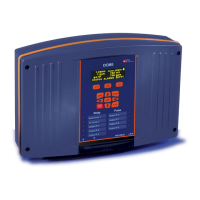
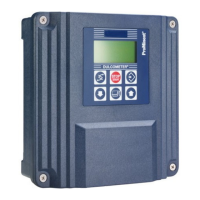
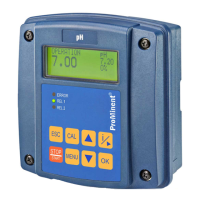
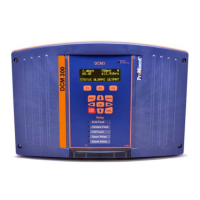
The controller features a clear LED screen that displays real-time measurements, status indicators, and alarm messages. It uses a system of status LEDs (Blue, Red, Red Flash) to provide immediate visual feedback on its operational state: steady Blue indicates normal operation, flashing Red signifies an alarm, and steady Red means an output relay is forced OFF.
A key aspect of its functionality is the ability to manage multiple chemical feeders. Each feeder can be independently configured with its own setpoint and deadband, allowing for fine-tuned control over different chemical additions. The controller also incorporates safety features, such as alarm systems that alert users to out-of-range conditions or system malfunctions. These alarms are typically latching, meaning they must be acknowledged or cleared by the user, ensuring that critical issues are not overlooked.
The DCM3 controller is designed to operate within specific water chemistry ranges for optimal performance and safety. It requires stable water chemistry within 7.2-7.8 pH, 1-5 ppm Free Chlorine, and 80-120 ppm Total Alkalinity for accurate calibration and reliable operation.
The DCM3 controller offers a user-friendly interface for calibration, setpoint adjustment, and alarm management.
The device supports single-point calibration for pH and Free Chlorine sensors.
Users can easily adjust setpoints for various chemical feeders.
The DCM3 controller provides comprehensive alarm management.
The controller allows users to manually control chemical feeders for priming or troubleshooting.
A dedicated START/STOP key provides a quick way to force all chemical feed relays to the OFF position. Pressing this button changes the status LED to a steady RED. Pressing it again resumes normal control, indicated by a steady BLUE status LED.
The DCM3 controller is designed with features that facilitate maintenance and ensure long-term reliability.
 General
| Type | Controller |
|---|---|
| Series | DCM3 |
| Digital Inputs | 2 |
| Protection Class | IP 65 |
| Measured Variables | Chlorine, pH, Conductivity, Temperature |
| Analog Outputs | 2 |
| Power Supply | 24 V DC or 100-240 V AC |
| Display | LCD with backlight |
| Input Voltage | 24 V DC or 100-240 V AC |
| Communication Interface | Optional: Modbus RTU |
| Storage Temperature | -20 °C to +60 °C |




 To Next Page