17
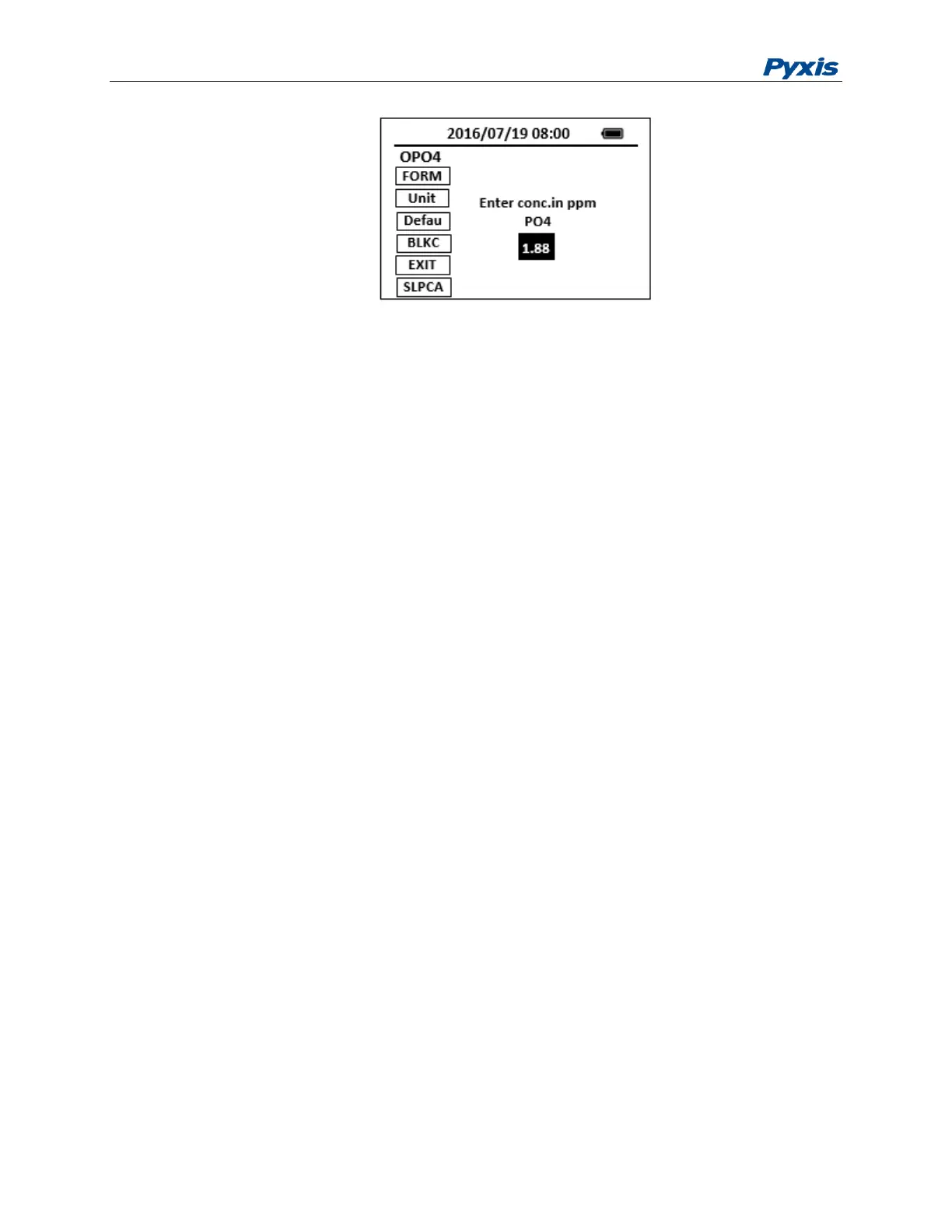
Figure 11. Slope Calibration
For best results, the concentration of the standard solution should be less than the maximum concentration
for the method (table 2) and greater than the half of the maximum concentration. For example, to calibrate
total chlorine, the chlorine concentration in the standard solution should be between 1.1 and 2.2 ppm.
The corresponding calibration parameters will be updated and saved in the memory as the working
calibration parameter set. Note that this set of calibration parameters are not the same as the default set.
You can use Default button to copy the default calibration parameters to the working set.
Reagent Blank Calibration
Some methods have a non-zero intercept value in the calibration equation. For these methods, a proper
non-zero intercept value is pre-loaded in the SP-800 prior to shipping. The following steps are used to carry
out a reagent blank calibration:
1. Follow the normal steps to carry out a measurement on a deionized water sample.
2. Press the CONFG button to launch the method configuration page.
3. Press the reagent blank calibration button BLKC
4. Press the OK key to save when exiting from the configuration page or press other keys to
cancel.
Resume to Default Calibration Parameters
Pressing the Default button will copy the default calibration intercept and slope to the working intercept and
slope, respectively. If the default calibration parameters were created prior to shipping, this button action is
to restore the working calibration parameters to the original factory loaded calibration parameters.
4 Turbidity Measurement
4.1 Operation
Follow the following steps to measure turbidity:
1. Fill the 10 ml sample vial to above the 10 ml mark.
2. Insert the sample vial to the sample vial compartment.
3. Slide the light shield cover to the closed position.
4. Press the TURB on the main page, then press the OK key, The SP-800 will start to measure
the turbidity in the sample.



 To Next Page