User and maintenance manual for stoves with RDS technology
Pag.45
01/02/2016
User and maintenance manual for stoves with RDS technology
Pag.8
11/11/14
6.2 Environment of use
The positioning of the stove is decisive for successful even heating of the room. Before deciding where to place the stove, the following must be
taken into account:
- The stove must be installed on a oor with a sufcient carrying capacity. If the existing building does not meet this requisite, appropriate measures
must be taken (i.e. load distribution plate).
- The combustion air cannot be obtained from a garage or from an area without ventilation or exchange of air, but from a free or external space
- The stove must not be installed in a bedroom, bathroom or shower, or where there is already another heating appliance without an autonomous
air ow (chimney, stove etc.)
- A minimum of 3” inches from the rear of the stove, 3” inches from the side of the stove and 16” inches from the top of the stove must be maintained
from combustible materials.
- A non-combustable Hearth board 6” from front of unit and 6” from the sides must be installed before unit is placed on the oor.
- Installation is better in a large and central room in the house to ensure maximum circulation of the heat;
- Connection to the main supply is recommended using a grounded outlet (if the cable supplied is not long enough to reach the nearest outlet, use
an extension cord with a surge protector);
- The stove must be placed in a position that receives the necessary level of air for appropriate combustion of the pellets (at least 131.23 f
3
/h must
be available), in accordance with installation regulation and local legislations;
- All joints for connector pipe is required to be fastened with at least three screws.
- If vented horizontally joint should be siliconed with hi-temp. silicone and screwed so they are gas tight. (RTU 500 silicone)
- the chimney connector shall not pass through an attic or roof space, closet or similar conceald space, or a oor or ceiling. Where passage through
a wal, or partition of combustible construction is desired, the installationshall conform to CAN/CSA-B365.
The stove must be installed and assembled by qualied personnel.
The room must be:
- Prepared for the environmental functioning conditions
- Prepared with an adequate system of evacuation of smoke
- Have a 120V 60 Hz (EN73-23) electricity mains supply
- Do not connect this unit to a chimney ue serving another appliance
- Use only UL Listed Type L Vent or Pellet Vent 3” in. I.D. venting system to exhaust. Do not install ue damper in the exhaust system of this unit.
- The chimney connector and each other adjoining section must be rmly attached and secured to the stove.
6.3 Mobile Home Requirements
- Outside air is required
- The heater must be secured to the oor using lag bolts.
- The heater must be grounded to the chassis of the mobile home.
- Installation should be in accordance with the manufactured home.
- When outside air is required, system parts, such as vent sections, supports, spark arresters, rodent screens, etc. must be used.
- The space heater is to be connected to a factory built chimney conforming to CAN/ULC-S629.
- It is important to use all the specied components, do not use other components.
- Installation shall maintain an effective vapour barrier at the location where the chimney or other component penetrates to the exterior of the
structure.
-Operating the space heater with open ring doors can cause serious injuries and health damages due to excaping ames or carbon monoxide
generation inside the room.
- Adequate ventilation is required to avoid air starvation and icing which can determine an unhealthy indoor environment.
- Do not overre.
- If the space heater is not correctly installed and operated it can interfere with smoke detectors.
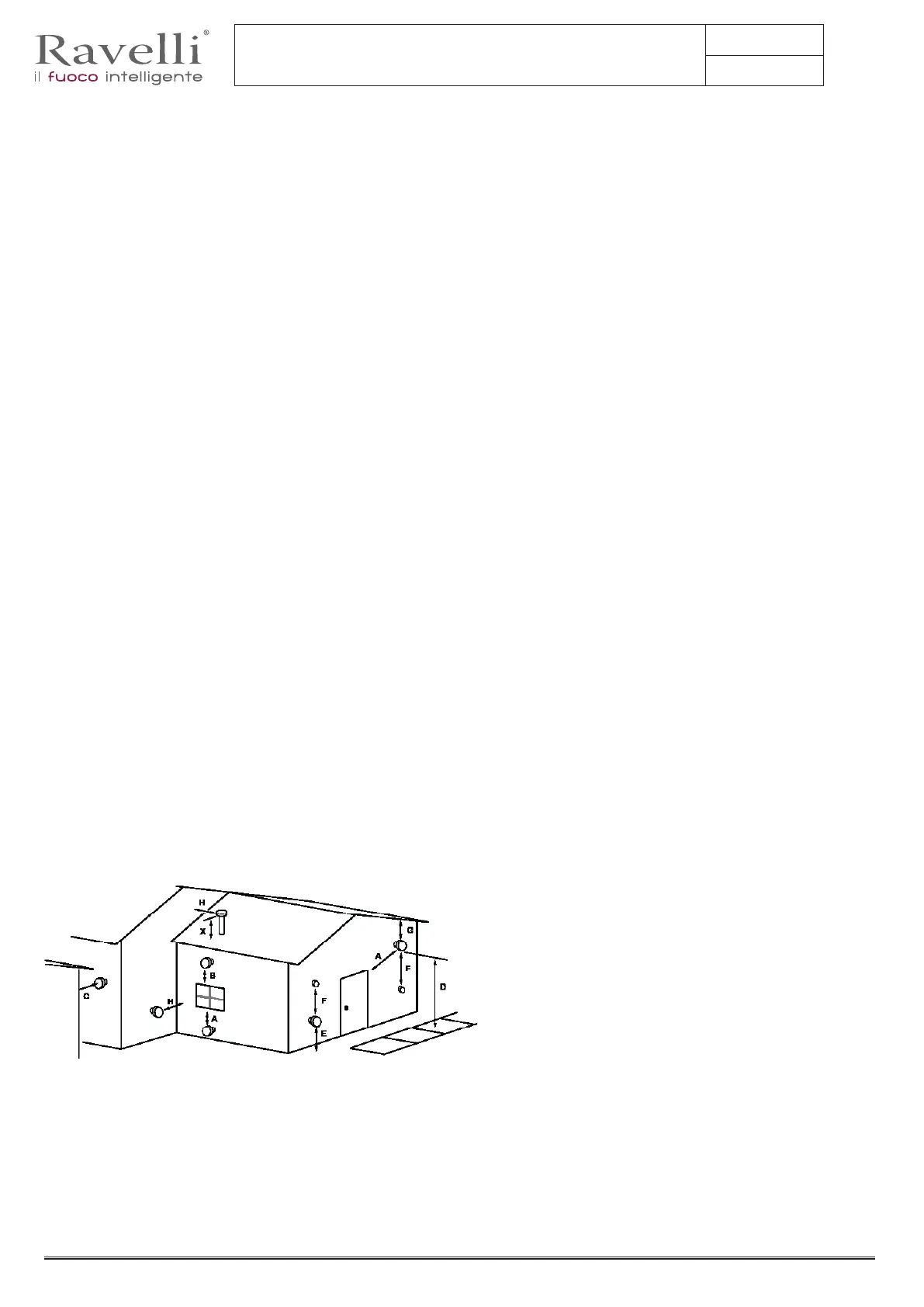
A Minimum 4’ clearance below or beside any door or window that opens
Minimum 1’ clearance below or beside any window that does not open.
B Minimum 1’ clearance above any door or window that opens
C Minimum 2’ clearance from any adjacent building
D Minimum 7’ clearance above any grade when adjacent to public walkways
E Minimum 2’ clearance above any grass, plants, or other combustible materials
F Minimum 3’ clearance from any forced air intake of any other appliance
G Minimum 2’ clearance below eaves or overhangs
H Minimum 1’ clearance horizontally from combustible wall
X Must be a minimum of 2’ above the roof
WARNING: Do not install in bedroom
CAUTION: The structural integrity of the mobile home oor,
ceiling, walls, roof must be maintained.
Refer to HUD Requirements, CFR 3280, Part 24
NOTE: Install vent at clearances specied by the vent
manufactures.
NOTE: Measure clearances to the nearest edge of the exhaust
hood.
NOTE: Vent may not terminate in covered walkway or breezeway.
NOTE: If venting horizontally, check your venting specications for
distance pipe should extrude from building.
6.2 Environnement d'utilisation
Le positionnement du poêle est déterminant pour obtenir un chauage ecace et uniforme de la pièce. Avant de décider où placer le poêle, il convient
de prendre en compte les éléments suivants :
- Le poêle doit être installé sur un sol présentant une capacité de charge susante. Si le bâtiment existant ne satisfait pas à ce prérequis, il convient
de prendre des mesures appropriées (par ex. plaque de répartition de charge).
- L’air de combustion ne peut pas être obtenu à partir d'un garage ou d'une zone sans ventilation ou échange d'air, mais à partir d'un espace libre ou
extérieur
- Le poêle ne doit pas être installé dans une chambre à coucher, une salle de bains ou une douche, où à un endroit où se trouve déjà un autre appareil
de chauage sans un débit d'air autonome (cheminée, poêle etc.)
- Un panneau de foyer non combustible dépassant de 6’’ sur l’avant de l’unité et de 6’’ sur les côtés doit être installé avant de placer l’unité sur le sol.
- L’installation est préférable dans une grande pièce centrale de la maison pour assurer une circulation maximale de la chaleur ;
- Il est recommandé de prévoir le raccordement à l’alimentation secteur à l'aide d'une prise de terre (si le câble fourni n'est pas susamment long pour
atteindre la prise la plus proche, utilisez une rallonge avec parasurtenseur) ;
- Le poêle doit être placé dans une position permettant de recevoir le volume d'air nécessaire pour une combustion appropriée des pellets (il faut
disposer d'au moins 131,23f
3
/h), conformément à la réglementation de l'installation et aux législations locales ;
- Il est nécessaire de xer tous les joints des raccords de tuyaux avec au moins trois vis.
- En cas de ventilation horizontale, le joint doit être siliconé avec du silicone haute température et vissé an d’être étanche aux gaz. (silicone RTU 500)
- Le raccord de cheminée ne doit pas traverser un grenier ou un espace du toit, une armoire ou un espace conné similaire, ou un plancher ou un
plafond. Si l'on souhaite traverser un mur, ou une cloison d'une construction combustible, l’installation doit être conforme à la norme CAN/CSA-B365.
L’installation et l'assemblage du poêle doivent être eectués par un personnel qualié.
La pièce doit être :
- Préparée pour des conditions de fonctionnement environnemental
- Préparée avec un système approprié d'évacuation des fumées
- Équipée d'une alimentation électrique secteur de 120 V - 60 Hz
- Ne pas raccorder cette unité à un conduit de fumée servant pour un autre appareil
- Utilisez uniquement une ventilation de type L homologuée UL ou une ventilation pour pellet 3” po. diamètre intérieur système de ventilation
d'échappement. N’installez pas le registre de tirage dans le système d'échappement de cette unité.
- Le raccord de cheminée et toute autre section attenante doivent être solidement xés et sécurisés sur le poêle.
6.3 Exigences concernant les maisons mobiles
- Un air extérieur est nécessaire
- L'appareil de chauage doit être xé au sol à l'aide de tire-fonds.
- L'appareil de chauage doit être raccordé à la terre au niveau du châssis de la maison mobile.
- L’installation doit être conforme aux instructions du fabricant de la maison.
- Lorsqu’un air extérieur est nécessaire, des pièces système, telles que des sections de ventilation, des supports, des pare-étincelles, des écrans
anti-rongeurs etc. doivent être utilisés.
- L'appareil de chauage doit être raccordé à une cheminée fabriquée en usine conforme à la norme à la norme CAN/ULC-S629.
- Il est important d'utiliser tous les composants spéciés, n’utilisez pas d'autres composants.
- L'installation doit maintenir un pare-vapeur ecace à l’endroit où la cheminée ou un autre composant traverse à l’extérieur de la structure.
- Une utilisation de l’appareil de chauage à feu ouvert, peut causer de graves blessures et des dommages pour la santé en raison de ammes qui
s'échappent ou d'émanations de monoxyde de carbone à l’intérieur de la pièce.
- Une ventilation adéquate est nécessaire pour éviter un manque d'air et une apparition de givre qui signierait un environnement intérieur malsain.
- Ne pas surchauer.
- Si l'appareil de chauage n’est pas correctement installé et exploité, il peut interférer avec les détecteurs de fumée.
A Distance minimale de 4’’ en-dessous ou à côté de toute porte ou fenêtre qui s'ouvre (avec air extérieur, 1’ en-dessous ou à côté)
Distance minimale de 1’’ en-dessous ou à côté de toute fenêtre qui ne s'ouvre pas.
B Distance minimale de 1’’ au-dessus de toute porte ou fenêtre qui s’ouvre.
C Distance minimale de 2’’ par rapport à tout bâtiment adjacent
D Distance minimale de 7’’ au-dessus du sol en cas de proximité avec des voies publiques
E Distance minimale de 2’’ au-dessus du gazon, des plantes ou de tout autre matériau combustible
F Distance minimale de 3’’ par rapport à une admission d'air forcée de tout autre appareil
G Distance minimale de 2’’ au-dessus des avant-toits ou des avancées
H Distance minimale de 1’’ horizontalement par rapport à un mur combustible
X Doit se trouver à une distance minimale de 2’’ au-dessus du toit
AVERTISSEMENT : Ne pas installer dans la chambre
ATTENTION : Il convient de conserver l'intégrité structurelle du sol, du
plafond, du toit de la maison mobile.
Reportez-vous à aux exigences HUD, CFR 3280, Partie 24
REMARQUE : Installez une ventilation aux distances spéciées par le fabricant
de la ventilation.
REMARQUE : Mesurez la distance avec le bord le plus proche de la hotte
d'extraction.
REMARQUE : La ventilation ne doit pas se trouver dans un passage couvert.
REMARQUE : En cas de ventilation horizontale, vériez vos spécications de
ventilation au niveau de la distance car le tuyau devrait ressortir du bâtiment.



 To Next Page