9. Operation & Bandsawing Practice
9.1 Basic bandsawing principles
• The blade cuts on a continuous down stroke.
• Slowly feed the workpiece towards the blade, using only
light pressure whilst letting the blade do the cutting.
• Firmly hold the workpiece and feed it towards the blade
slowly, using the push stick and keeping your hands well
away from the blade.
• For best results the blade must be sharp. Damaged or worn
blades should always be replaced.
• Select the right blade for the job, depending on the
thickness of the wood and the cut to be made. See TABLE
1.
• For straight cutting use the rip fence supplied.
• When cutting shapes, follow the design marked out by
pushing and turning the workpiece evenly. Do not
attempt to turn the workpiece without pushing it, as
this may cause the workpiece to get stuck, or the blade to
bend.
• CAUTION! Particular care should be taken towards
the end of the cut as there will be a sudden decrease in
resistance and care must be taken to stop hands from
being thrown into the blade.
Always ensure that your machine is properly maintained and
clean. Before commencing work on an important project, it
is advisable to familiarise yourself with the operation of the
equipment by practising on low value materials.
9.2 Complicated cutting
Very complicated cuts and small radius curves are the best
accomplished with the aid of pre-drilled holes combined with
a few tangential or radial cuts. This technique will achieve
excellent results without putting undue tension on the blade and
blade guide assembly.
9.3 Reversing the blade out of a cut
If at all possible we advise that reversing out of a cut is avoided.
But in situations such as cutting scrolls it may not be possible
to complete a cut. This requires the blade to be reversed out of
the cut. Care is necessary to minimise damage to the work and
blade. When removing large pieces of material it is advisable to
make the shorter cut last to avoid having to reverse out of the
longer cut. When reversing out of a cut it is advisable to leave
the blade running, but take extreme care not to pull the blade
off the band wheel.
9.4 Blade stall
In circumstances such as cutting deep or wet timber, the work
piece may close up behind the blade causing it to stall. In
this instance the machine should be switched off and isolated
and the material wedged open so the blade can be carefully
reversed out.
9.5 Blade selection (TPI)
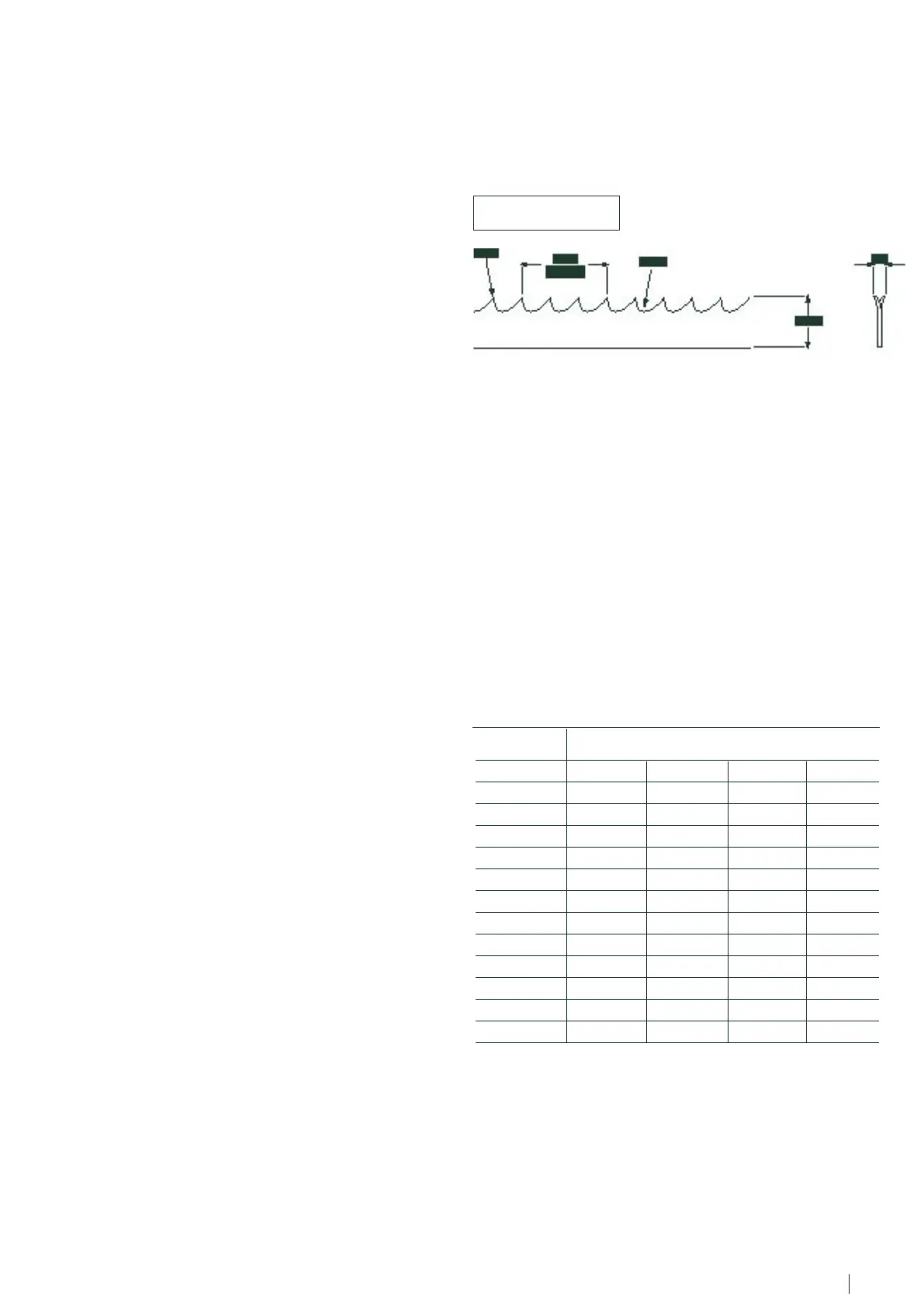
The selection of the best blade configuration (See Fig 9.1) is
necessary for optimum cutting performance.
• Correct blade choice is primarily dependant on two factors:
material thickness and material type.
• Greater TPI should be selected as material thickness
decreases.
• However, if the TPI is too great, the tooth loading will be
insufficient to enable penetration; and cutting. The teeth will
also rapidly lose their sharpness.
• For thicker material a lower TPI should be used otherwise the
gullet will not be sufficient to clear the waste and the blade will
stall or burn the wood.
The accompanying blade selection chart (TABLE 1) gives
guidance on the TPI that should give the best results when
cutting a variety of material types and thickness. TABLE 1
provides recommendations on selecting the correct blade for
a variety of commonly used materials. If in doubt about any
aspects of blade selection contact Customer Services on 0870
770 1777 for assistance.
TABLE 1
Material Material Thickness
<6mm 6-12mm 12-25mm >25mm
Perspex 16 TPI 14 TPI - -
Chipboard - 6 TPI 3-6 TPI 3-4 TPI
Fibre board 16 TPI 14 TPI - -
Hardboard 10 TPI - - -
Plywood 10 TPI 8 TPI 6 TPI 3-4 TPI
Strawboard 14 TPI 10 TPI - -
Cork 14 TPI 6 TPI 3 TPI 3-4 TPI
Leather 14 TPI - - -
Rubber 10 TPI 8 TPI - -
Wood -log - - - 3-4 TPI
Wood -soft 6 TPI 3-6 TPI 3-4 TPI 3-4 TPI
Wood -hard 6 TPI 3-6 TPI 3-4 TPI 3-4 TPI
Wood -wet - - - 3-4 TPI
The table provides a guide to selection only. Exact tooth
configurations are not always available, nor are all blade
configurations covered, but the principles remain the same.
For special applications, custom blades can be supplied please
call Customer Services on 0870 770 1777 and we can advise
you accordingly on your specific needs.
Fig.9.1
TPI = Teeth Per Inch
20 21


 To Next Page