9
5. CL3-CAM & CL4-CAM Specifications
Maximum distance between centres: 36” (194 mm)
Maximum bowl diameter over bed: 12” (305 mm)
Maximum spindle diameter: 9” (229 mm)
Maximum bowl diameter with optional:
CL3/B bowl turning attachment: 30” (762 mm)
Pulley Speeds (smallest to largest diameter): 425, 625, 925, 1360, 2000 rpm
Drive Belt: Poly V
Main Bearing: Phosphor bronze (adjustable)
Spindle Nose: 3/4” x 16 tpi
Motor Power: CL3-CAM: 3/4 hp (550 W)
CL4-CAM: 1 hp (750 W)
Continuous Rating: CL3-CAM: 240 V, 1 Phase, 50 Hz
CL4-CAM: 380/415 V, 3 Phase, 50 Hz (uses 240 V single phase supply)
RPM: 1380min -1
Inverter (CL4-CAM only): 230 V - 50 Hz 750 W. 15 - 100 Hz frequency output range
Inverter enclosure rating (CL4-CAM only): IP55 (dust proof)
Noise Emission: Sound power level < 85dB (A)
Sound pressure level < 85dB (A)
Length: 1625 mm
Depth: 381 mm
Height: 368 mm
Weight: CL3-CAM: 86 kg
CL4-CAM: 90 kg
HEADSTOCK SPINDLE AND TAILSTOCK BARREL BORED TO SUIT NO.1 MORSE TAPER SHANK. SPINDLE FLATTED TO SUIT 9/16" WHITWORTH
WRENCH TO FACILITATE FITTING AND RELEASE OF SPINDLE NOSE ATTACHMENTS SUPPLIED.
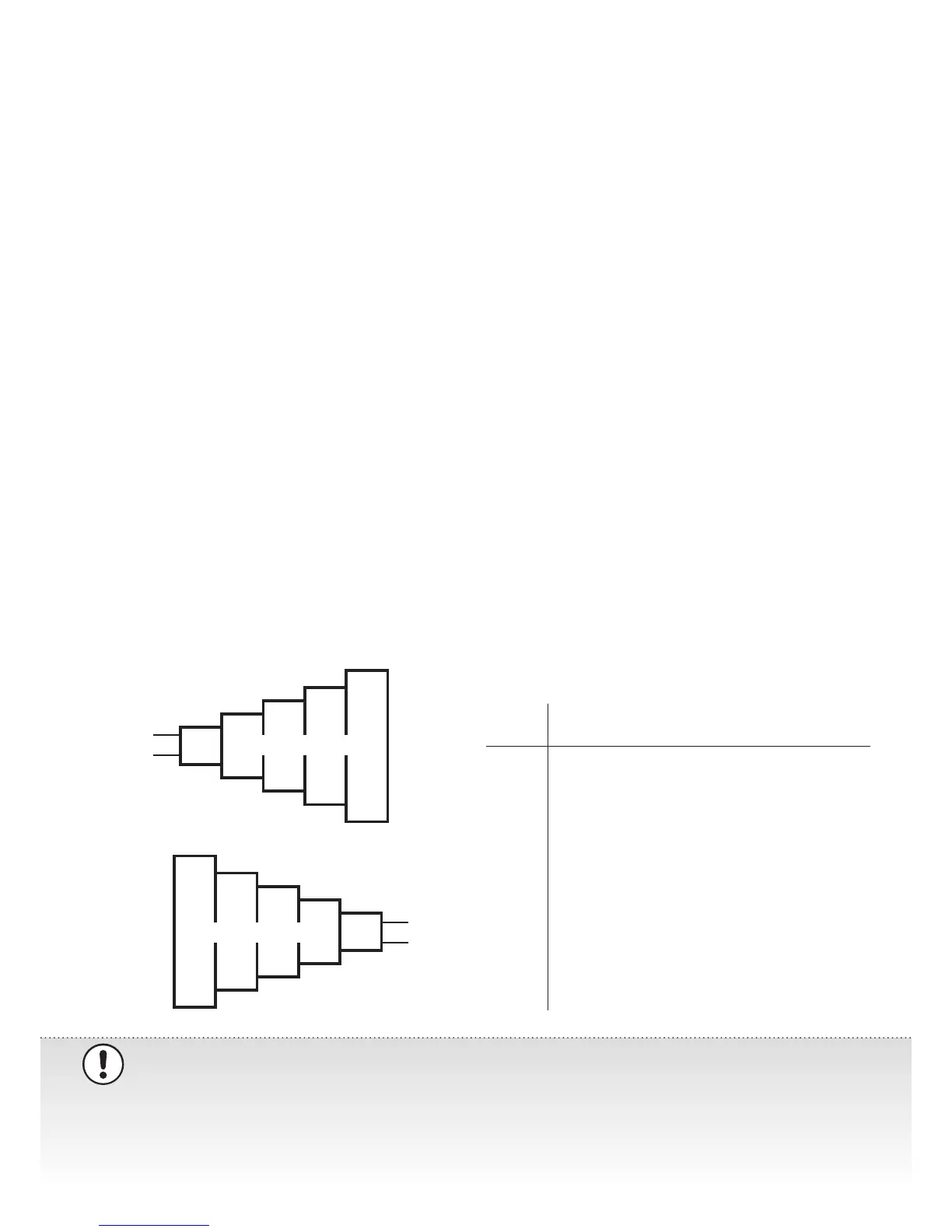
CL3-CAM & CL4-CAM PULLEY SPEED RANGES CL4-CAM PULLEY & VSLK SPEED RANGES
By changing the belt on to each of the five different pulleys the speed can be varied
from 425 to 2000 rpm.
By changing the belt on to each of the five different pulleys and using the VSLK
controls, the speed and torque can be fully varied from 13 to 4648 rpm.
CL3-CAM & CL4-CAM CL4-CAM
Spindle Pulley
425 rpm
625 rpm
925 rpm
1360 rpm
2000 rpm
Motor Pulley
Speed Pulley Steps
Setting 425 625 925 1360 2000
10 1029 1453 2150 3161 4648
9 926 1308 1935 2845 4184
8 823 1162 1720 2529 3718
7 720 1017 1505 2213 3254
6 617 872 1290 1897 2789
5 515 727 1075 1581 2324
4 417 581 860 1264 1859
3 309 436 645 948 1394
2 206 291 430 632 930
1 103 145 215 316 465
0 13 18 27 40 58
KINEMATIC DESIGN
Throughout this manual you will find references to kinematics and the
kinematic design of this product. The principle of kinematics is that three points of
contact provide the most stability. The best example of this is to compare the stability
of a three legged stool and four legged stool. The three legged stool utilises the
kinematic concept and will never rock because it has three points of contact. The four
legged stool however is far more unstable, only a tiny amount of distortion will cause
the stool to become unstable and move. Record Power apply the kinematic design
theory to the CL3-CAM and CL4-CAM lathes, wherever there is a critical piece of the
structure being assembled kinematics are employed giving unsurpassed stability and
rock solid performance. Please take care to follow all instructions when assembling,
making sure that all critical kinematic areas are correctly positioned so that you enjoy
optimum performance.



 To Next Page