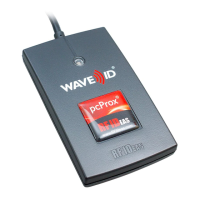
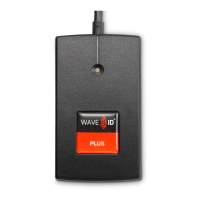
pcProx
®
and AIR ID® Enroll Readers
computer’s USB port. When a proximity token is read,
the active application will receive the entire proximity
token’s data.
The Configuration application allows the user to specify
which data bits from the proximity card are used to create
an ASCII number. Additionally, the user may specify
additional keystrokes to be sent.
The RS-232 Reader
The RS-232 reader has two primary modes of operation.
First it may be set up to operate as a ASCII output
device. In this mode the user’s ID from the proximity
token is read and is sent as a decimal number in ASCII
format. RF IDeas offers software (SoftKBWedge) that
redirects the data into the keyboard’s buffer as if the
user typed in the ID number using the keyboard.
Second, the reader may be set up for operation under the
API (application programmer interface) as defined in the
pcProx SDK. The pcProx reader attaches to the
computer’s serial port. When a proximity token is read,
the active application will receive the entire proximity
token’s data.
The Configuration application allows the user to specify
which data bits from the proximity card are used to create
an ASCII number. Additionally, the user may specify
additional extra RS-232 characters may be sent.
Why is it necessary?
With the proliferation of PC’s, cash machines, security
systems, and electronic locks, users are increasingly
burdened with the requirement of entering identification
information to gain access or show they have accessed
systems.



 To Next Page