Need help?
Do you have a question about the RKI Instruments Eagle Series and is the answer not in the manual?
 General
| Brand | RKI Instruments |
|---|---|
| Model | Eagle Series |
| Category | Security Sensors |
| Language | English |
Read and understand manual before operating. Improper use can lead to serious injury or death.
Details RKI's warranty for gas alarm equipment, covering defects in materials and workmanship for one year.
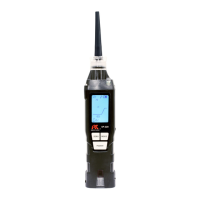
Describes the RKI Eagle as an advanced portable gas detection system with key features and certifications.
Explains the manual's scope, intended use, and organization, covering standard sections and appendices.
Lists physical and environmental specifications for the Eagle, including target gases, dimensions, weight, and power.
Details specifications for standard sensors: range, alarm levels, detection principle, response time, and accuracy.
Describes the Eagle's case, handle, shielding, control panel, and buttons.
Details alarm lights, buzzer, interface port, and sample-drawing system.
Explains the function and connection of combustible gas, oxygen, and toxic gas sensors.
Explains the analog and main PCBs, and the methane elimination and CAL/SETUP switches.
Step-by-step guide to connecting components and powering on the Eagle unit.
Describes continuous monitoring, backlight, beeps, probe use, and monitoring combustible gas.
Instructions on controlling functions via CAL/SETUP switch and safely powering down the unit.
Details visual and audible indicators for first/second gas, STEL, TWA, and over-range alarms.
Explains alarms for low flow, low battery, and sensor failure, including emergency operation.
Covers resetting self-resetting and latching alarms with or without alarm silence options.
Screen for entering user and station identifiers, relevant for data logging.
Details peak readings, elapsed time, TWA/STEL, battery voltage, and date/time screens.
Covers clearing data logger storage and viewing remaining log time.
Procedure to enter setup mode, navigate menus, and return to normal operation.
Details updating channel settings, target gas labels, and alarm point settings for various sensors.
Covers serial number, lunch break, alarm latching/silence, and auto calibration settings.
Options to reset all, alarm points only, or oxygen zero settings to factory defaults.
Lists necessary supplies, equipment, and steps to prepare the Eagle for calibration.
Details the Auto Calibration and Single Calibration methods for sensors.
Specific steps for calibrating individual sensors, including adjusting controls.
Procedure to check the battery voltage and the warning levels.
Instructions for replacing alkaline/Ni-Cd batteries and various sensors.
Lists part numbers and descriptions for standard Eagle replacement parts and accessories.
Part numbers and descriptions for non-standard toxic gas sensors and related items.
Procedure to set the Eagle for methane elimination mode using internal or external switches.
How to monitor gases in Methane Elimination mode and return to standard mode.
Details range, alarms, TWA, and STEL for various non-standard toxic gases.
Describes sensor installation, special hose needs, and calibration procedures.
Lists range, alarm settings, TWA, and STEL specifications for carbon dioxide sensors.
Covers fresh air readings, demand zero, and calibration procedures for CO2 sensors.
Describes multi-channel models and how to display additional gas readings.
How alarms on non-displayed channels are indicated and how to navigate display modes.
Details the specific setup for transformer gas testing, including sensor type and dilution fitting.
Guidance on calibrating the tester and a list of specific parts for this model.
Step-by-step instructions for installing the optional data logger board.
Details specifications, target gases, and sensor configuration for HC sensors.
Procedure for calibrating the HC sensor, including using specific calibration gases.

 To Next Page