Designing Sounds
Temperaments
Temperament Qualities
Equal
In this tuning, each octave is divided into twelve equal
steps. Every interval produces about the same amount
of slight dissonance.
Just Major
This tuning eliminates ambiguities in the fths and
thirds. It is unsuited to playing melodies and cannot be
transposed, but is capable of beautiful sonorities.
Just Minor
There are two types of Just tunings: major and minor.
You can get the same eect with the minor scale as with
the major scale.
Pythagorean
This tuning, devised by the philosopher Pythagoras,
eliminates dissonance in fourths and fths.
Dissonance is produced by third-interval, but melodies
are euphonious.
Kirnberger
This is an improvement of the Meantone and Just
tunings that provides a high degree of freedom of
modulation. Performances are possible in all keys (III).
Meantone
This scale makes some compromises in just intonation,
enabling transposition to other keys.
Werckmeister
This temperament combines the Meantone and
Pythagorean tunings. Performances are possible in all
keys (rst technique, III).
Arabic This tuning is suitable for the music of Arabia.
What is the Duplex Scale?
The Duplex Scale is a system of sympathetically vibrating strings sometimes
included in grand pianos.
These sympathetically vibrating strings are not struck directly with hammers,
but sound by vibrating in sympathy with the vibrations of other strings. By
resonating with the overtones, these strings add richness and brilliance to
the sound. These sympathetic strings are added only to the high register
above approximately C4. Since they do not have a damper (a mechanism that
stops them from sounding), they will continue sounding even after you play
a note and then release it to stop the sound of the string that was actually
struck.
Simulating the Way That Sounds Are
Created on an Organ (Tonewheel Organ )
On the FP-80, you can use the [ORGAN] button to select one of the
“TW-Organ 1–6” tones to play tones that simulate the way in which
sound is produced by an organ.
On a tonewheel organ, you can create original sounds by sliding
nine harmonic bars (drawbars) forward or backward to change their
relative balance. Each bar is assigned a dierent footage, and this
footage determines the pitch of the sound. 8’ is the footage that
forms the basic pitch of the sound; this is the center around which
you create the tone.
By assigning the footage to the TONE buttons, you can simulate the
way in which these harmonic bars are used to create the sound.
What’s the Footage?
“Footage” is a term that began as a measurement of the
length of the pipes in a pipe organ.
The pipes that produce the basic pitch (fundamental) for
each note are considered to be 8 feet in length.
Therefore, a pipe producing a pitch one octave below that of
the reference of 8’ (eight feet) would be 16’; for one octave
above the reference, the pipe would be 4’, and to take the
pitch up yet another octave it would be shortened to 2’.
Selecting the Type of Tonewheel Organ
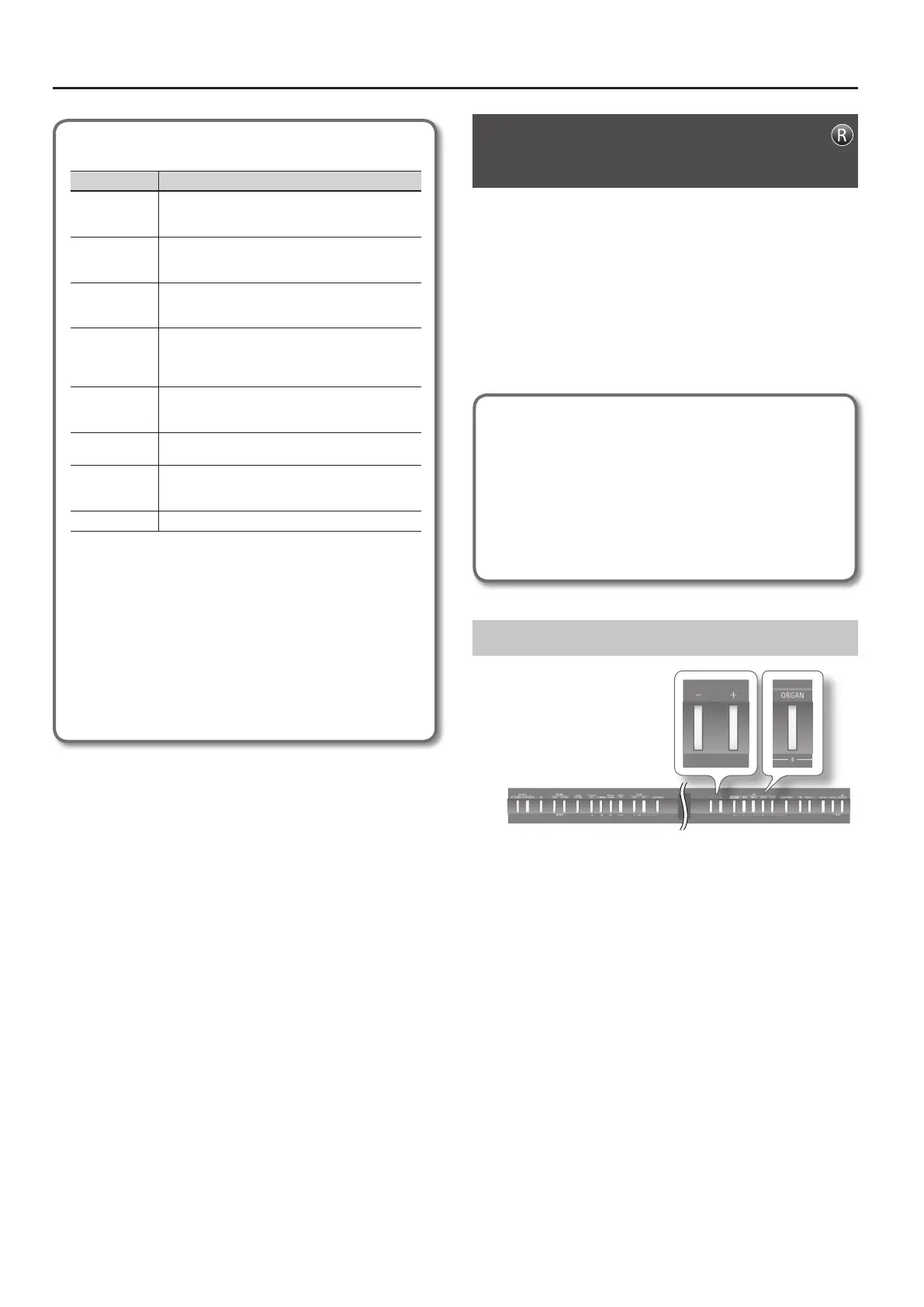
1. Press the [ORGAN] button so it’s lit.
2. Use the [–] [+] buttons to select one of the “TW-Organ
1–6” tones.
32


 To Next Page