4-2 EB 8310-1 EN
Shipment and on-site transport
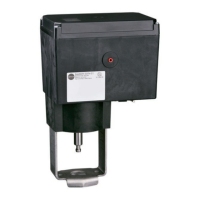
4.3.1 Transporting the actu-
ator
The actuator can be transported using lifting
equipment (e.g. crane or forklift).
Î Leave the actuator in its transport con-
tainer or on the pallet to transport it.
Î Observe the transport instructions.
Transport instructions
− Protect the actuator against external in-
uences(e.g.impact).
− Do not damage the corrosion protection
(paint, surface coatings). Repair any
damage immediately.
− Protect the actuator against moisture and
dirt.
− The permissible transportation tempera-
tureisbetween–20and+65°C.
4.3.2 Lifting the actuator
Due to the low service weight, lifting equip-
ment is not required to lift the actuator (e.g.
to mount it onto a valve). If lifting equipment
(e.g. crane or forklift) is to be used, we have
a gripping device available for the actuator
(see 'Accessories' in the 'Design and princi-
ple of operation' section).
See valve documentation for more informa-
tion on lifting the entire control valve assem-
bly.
4.4 Storing the actuator
Risk of actuator damage due to improper
storage.
Î Observe the storage instructions.
Î Avoid long storage times.
Î Contact SAMSON in case of different
storage conditions or longer storage
times.
We recommend regularly checking the actu-
ator and the prevailing storage conditions
during long storage times.
Storage instructions
− When the valve and actuator are al-
ready assembled, observe the storage
conditions for control valves. See associ-
ated valve documentation.
− Protect the actuator against external in-
uences(e.g.impact).
− Secure the actuator in the stored position
against slipping or tipping over.
− Do not damage the corrosion protection
(paint, surface coatings). Repair any
damage immediately.
− Protect the actuator against moisture and
dirt. Store it at a relative humidity of less
than75%.Indampspaces,preventcon-
densation. If necessary, use a drying
agent or heating.
Note
NOTICE
!
Note


 To Next Page