EB 8310-6 EN 6-3
Start-up
longer be correct. This may apply, for exam-
ple, to the conguration ID or the symbol af-
ter reversal of the direction of action.
Î Immediately renew any nameplates or
labels with incorrect or outdated infor-
mation.
Î Add any new values to the nameplate. If
necessary, contact SAMSON to obtain a
new nameplate.
Risk of actuator damage due to excessively
high or low tightening torques.
Observe the specied torques on tightening
actuator components. Excessively tightened
torques lead to parts wearing out quicker.
Parts that are not tightened far enough may
loosen.
Î Observe the specied tightening torques
(uAB0100).
Risk of actuator damage due to the use of
unsuitable tools.
Î Only use tools approved by SAMSON
(uAB0100).
6.1 Preloading the springs
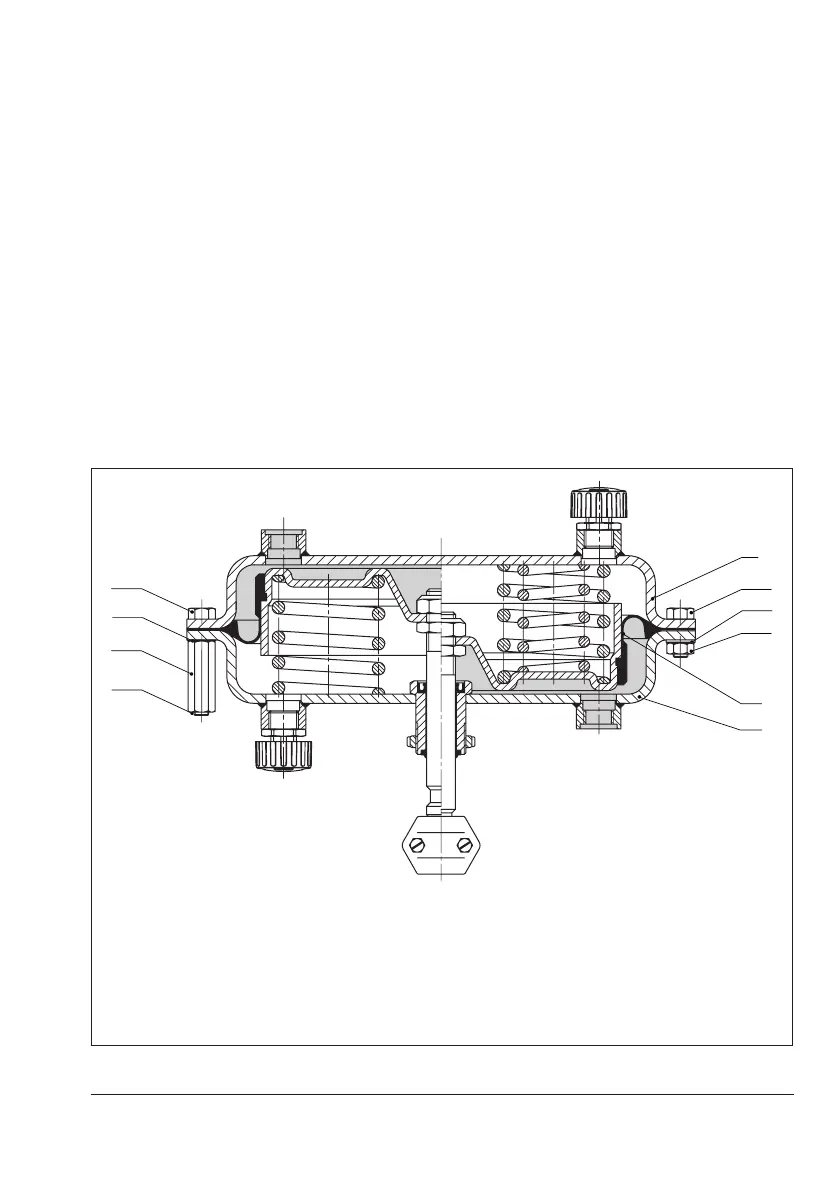
Refer to Fig.6-1
By preloading the springs in the actuator, the
following can be achieved:
− The thrust is increased (only actuators
with "stem extends")
NOTICE
NOTICE
A1 Top diaphragm case
A2 Bottom diaphragm case
A4 Diaphragm
A20 Hex bolt
A21 Hex nut
A22 Hex bolt (preloading)
A23 Hex nut (preloading)
A24 Blanking plug
A25 Shim
A25
A24
A20
A25
A21
A1
A2
A4
Fig.6-1: Actuator with clamping nuts and bolts
5. Screw the short nuts (A21) with shims
(A25) onto the bolts (A20). Observe
tightening torques.
6.1.2 Increasing the actuator
thrust
The thrust can only be increased in actuators
with "stem extends" direction of action. To
achieve this, the springs of the actuators can
be preloaded by up to 12.5% (240cm²) or
by up to 25% (350 and 700cm²) of their
travel or bench range.
Example: Preloading is required for a bench
range of 0.4 to 2bar. 25% of this span is
0.4bar. Therefore, the signal pressure range
is shifted by 0.4bar to 0.8 to 2.4bar. The
new lower signal range value is 0.8bar and
the new upper signal range value 2.4bar.
Î Write the new signal pressure range of
0.8 to 2.4bar on the actuator nameplate
as the operating range with preloaded
springs.



 To Next Page