EasyManua.ls Logo

Schwing FW 18 - User Manual

Default Icon
56 pages
Print Icon
To Next Page IconTo Next Page
Loading...
Service Manual
Remote Control Cable/Radio
553
Radio Control FW 18
Table of Contents
Black-and-white control / proportional control
(as from series 1987)
1. SAFETY AND ACCIDENT PREVENTION
REGULATIONS
2. SHORT INSTRUCTIONS
3. PREFACE
4. EXTRACT FROM THE TERMS OF
WARRANTY
5. MODEL PLATES
6. TECHNICAL DATA
7. SHORT DESCRIPTION
8. CONTROL AND MONITORING EQUIPMENT
9. COMMISSIONING
10. OPERATING THE RADIO CONTROL
11. PUTTING OUT OF OPERATION -
CHANGEOVER
12. SAFETY DEVICES AND TROUBLESHOOTING
13. MAINTENANCE WORKS AND CHECKS,
14. CHANGING AND CHARGING OF BATTERY
1. Safety and Accident
Prevention Regulations
The safety and accident prevention regulations
stipulated in the operating instructions for the
truck-mounted concrete pump are applicable and
binding for the operation with the remote control
too.
To avoid any unintended working movement of
the machine and before changing from one control
system to another:
!SET ALL CONTROL ELEMENTS IN THE
DRIVER’S CAB AND ON THE REMOTE
CONTROL PANEL TO ZERO POSITION.
STOP DRIVING ENGINE.
Only specialists are allowed to repair the radio
controls.
In case of any failure, notify the SCHWING
after-sales service.
Only persons authorized by Messrs.
SCHWING are allowed to open leaded housings.
Unauthorized manipulations may result in
great damages and render all warranty claims void.
See also section 4.1.
ATTENTION! Before welding the machine, make
absolutely sure that the plugs of the connection
cables are detached from sockets 7, 8, and 9 of the
receiver. Protect the socket by means of a sealing
cap. Non-observance would result in damage to
the electronic control system (see also customer
information K 29).
89
7
5
4
Home
PrintPrint
Question and Answer IconNeed help?

Do you have a question about the Schwing FW 18 and is the answer not in the manual?

Overview

This document describes the SCHWING Radio Remote Control FW 18 and FW 20, as well as the FW 24, which are advanced remote control systems for truck-mounted concrete pumps. These systems were first introduced in 1983 and can be retrofitted or fitted at the factory. They offer both black-and-white (pulse) and proportional control options, depending on the machine model.

Function Description

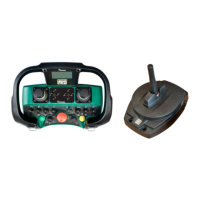
The SCHWING Radio Remote Control system allows for wireless operation of truck-mounted concrete pumps and their placing booms. The system consists of a portable transmitter, a receiver built into the machine, and a charger for the rechargeable transmitter battery.

Transmitter:

The transmitter converts switch operations into unmistakable transmit signals, combined with a special identification code, before sending them. For proportional control, the boom speed is dependent on the control lever's excursion, allowing for almost continuously variable speed. Multiple movements can be made simultaneously by actuating different control levers. An "idle state circuit" optimizes battery utilization by switching off the power supply if no switch is operated for more than 20 seconds, reactivating when a switch is operated. The operating voltage is continuously monitored, and an LED indicates when the battery needs changing. If not changed within approximately 30 minutes, the monitoring circuit blocks the transmitter.

Receiver:

The receiver, mounted in the driver's cabin, is powered by the truck voltage. It detects and monitors the "radio telegram" from the transmitter. If the signal is recognized as correct and complete, it is sent to the machine's pilot control. The transmitter and receiver are precisely tuned to each other, preventing external transmitters from affecting operation. In case of an electronic fault or loss of telegram, initiated functions are stopped. A two-color LED indicates the receiver's status ("FAULT," "READY," "OPERATING"). A storage rack with recharge electronics for one transmitter battery is integrated into the receiver housing.

Safety Features:

The system incorporates several safety features:

  • Only specialists are allowed to repair radio controls.
  • Only authorized personnel can open leaded housings.
  • Unauthorized manipulations void warranty claims.
  • Before welding the machine, connection cables must be detached from the receiver sockets (7, 8, 9) and protected with a sealing cap to prevent damage to the electronic control system.
  • All control elements on the machine and remote control panel must be set to zero position, and the driving engine stopped, before changing control systems to prevent unintended movements.
  • The "EMERGENCY SHUT-OFF" button immediately stops all machine functions.
  • The transmitter range is limited for safety reasons but is sufficient for typical construction site situations. If the transmitter is taken out of broadcast range, all machine functions automatically stop.
  • The receiver checks input signals for correctness and completeness before passing them to the machine control unit.
  • The safety code is individual and non-repeating, preventing other transmitters from interfering.
  • The system automatically switches to the "EMERGENCY SHUT-OFF" state in case of interference.
  • The undervoltage monitor shuts down the transmitter if battery voltage falls below a safety threshold.

Important Technical Specifications (FW 18/20 and FW 24):

Transmitter (FW 18/20 - Proportional Control):

  • Operating Frequency: In the 70 cm band (27.55 inches)
  • RF Output Power: 4 mW
  • Control Channels: 18 black-and-white and 8 proportional
  • Operating Voltage and Power Requirements: 9.6 V DC 70 mA
  • Type of Operation: Portable hand
  • Transmission Range: Approximately 50 m (164.5 feet)
  • Transmission of Control Functions: Digital
  • Battery: Rechargeable nickel-cadmium battery

Receiver (FW 18/20):

  • Operating Frequency: In the 70 cm band (27.55 inches)
  • Telegram Evaluation: By microcomputer
  • Operating Voltage: 11.5 to 14.5 V or 23 to 28 V, 200 mA
  • Relay Outputs: 18
  • Analogous Outputs: 8 in sequence + 6 (for 24 V) or 8 in sequence = 3 (for 12 V)

Transmitter (FW 24 - General):

  • Operating Temperature Range: -10 to +50 C
  • Type of Protection: IP 65
  • Dimensions: 280 x 140 x 135 mm
  • Transmitter-Rechargeable Battery Set: 9.6 V / 1000 mAh
  • Battery Replacement At: < 9.0 V
  • Automatic Transmitter Shut-off At: < 8.7 V
  • Weight: Approximately 3 kg
  • Frequency Range: 430 to 470 MHz, 2 RF channels, switch-selected
  • Transmitter Output Power: Approximately 5 mW
  • Transmitting Range: > 100 m
  • Digital System: CMOS microcontroller, PCM data transmission
  • Transmission Time of Radio Commands:
    • Pulse Control Unit: Approximately 110 msec
    • Proportional Control System: Approximately 155 msec
  • Operating Time with Fully Charged Battery: Approximately 12 hours

Receiver (FW 24 - General):

  • Operating Temperature Range: -10 to +50 C
  • Type of Protection: IP 00 (casing = IP 55)
  • Dimensions: 19" casing, 3HE/8SFE resp. 42 TE
  • Weight: Approximately 2 kg (without casing)
  • Supply Voltage: 20 to 28 V
  • Power Consumption: Max. 0.5 A
  • Frequency Range: 430 to 470 MHz, automatic transmitting frequency scan
  • Sensitivity: 1 uV
  • Digital System: CMOS microcontroller, ECC data telegram decoding
  • Active EMERGENCY SHUT-OFF: By EMERGENCY SHUT-OFF message from transmitter or in case of component failure in EMERGENCY SHUT-OFF circuit
  • Passive EMERGENCY SHUT-OFF: By data message interference of = 1 sec. or missing one EMERGENCY SHUT-OFF channel
  • Control Channel Output Depending on Type of Unit:
    • FW 20 - K28 - V 24: 32 switching + 6 proportional channels
    • FW 20 - K42 - IMP: 20 switching + 1 proportional channel
    • FW 20 - K42 - PROP: 20 switching + 8 proportional channels
    • FW 20 - K42 - SANE: 32 switching + 1 proportional channel

Usage Features

Commissioning:

  1. Set all controls on the machine and transmitter to "0" or "OFF."
  2. Switch off the truck engine when warm and with PTO switched on.
  3. Disconnect the remote control cable from the control panel and replace it with the receiver-control panel cable.
  4. Check all power supply, antenna, and connecting cables to the receiver.
  5. Ensure antennas for transmitter and receiver are mounted.
  6. Switch on "ignition."
  7. Insert a charged battery into the transmitter and a spare battery into the charger, ensuring correct polarity.
  8. Set the selector switch on the machine control panel to "remote control."
  9. Unlock the EMERGENCY SHUT-OFF button on the transmitter by turning it right.
  10. Set the selection switch to "ON." The transmitter's power supply switches on, and the red LED lights up briefly before extinguishing if the battery voltage is correct. The LED then rhythmically flashes, indicating a radio telegram is being transmitted. The receiver switches to "READY," and its two-color LED turns GREEN. If the LED remains RED, there is a fault, possibly due to an external transmitter nearby.

Operating the Radio Control:

  • Always avoid undesired movements by setting the transmitter's power supply switch to "OFF" when the machine is not in use.
  • If the engine is not fitted with an engine ON/OFF switch, start the engine with the "ignition key."
  • To put the transmitter into operation, insert the spring hooks of the upper belts into the carrying frame, place the belts over the shoulders, insert the spring hooks of the lower belts into the carrying frame, and adjust the length of the upper belts.
  • The transmitter automatically sends "address telegrams" without a control command when the power supply is switched on. After 20 seconds of inactivity, the "idle state circuit" switches off the power supply to save battery.
  • Operation by wireless remote control is identical to cable remote control.
  • For uninterrupted operation, always have a charged battery available.
  • The transmitter range is limited to ensure safety but is sufficient for all conceivable construction site situations. Functions stop automatically if the transmitter leaves the broadcast range.
  • The operator must maintain unrestricted visibility of the machine's working area and avoid radio shadows.
  • To prevent unauthorized operation, do not set down the transmitter while it is switched on.
  • Before removing the transmitter, switch off the truck engine, press the EMERGENCY SHUT-OFF button, set the selector switch to "OFF," and lock the transmitter in the driver's cabin.

Putting Out of Operation:

  1. Set all controls on the transmitter to "0" or "OFF" position.
  2. Set the selector switch to "OFF."
  3. Press the EMERGENCY SHUT-OFF button.
  4. Switch off the receiver by means of the toggle switch.
  5. The LED extinguishes.
  6. Switch off the truck engine and remove the "ignition key."
  7. Lock the transmitter in the driver's cabin and secure the machine against unauthorized use.

Changeover to Cable Remote Control:

  1. Put out of operation as described above.
  2. Remove the connecting cable between the receiver and control panel.
  3. Connect the standard remote control cable to the machine control panel.
  4. Perform commissioning as normal for cable remote control.

Maintenance Features

Battery Replacement and Charging:

  • A flashing LED on the transmitter indicates when the rechargeable battery needs replacement.
  • To replace, put the machine out of operation, set all transmitter controls to "0," switch off the transmitter, turn locking screws counter-clockwise by 90 degrees, remove the lid, withdraw the battery, and insert a charged battery with contacts facing forward, observing polarity.
  • The battery charger is permanently connected to the power supply.
  • The ready-for-operation state is indicated by an LED.
  • If the LED shows a red light, the battery is inserted with wrong polarity and must be reinserted correctly.
  • Charging is completed after a maximum of 14 hours. The battery cannot be overcharged.
  • To maintain full charging capacity, completely discharge the battery once a week before recharging. The charger has an automatic discharge function.
  • It is recommended to interrupt the power supply to the charger during long breaks (e.g., weekends).
  • To prevent unnecessary reduction of NiCd battery lifetime, regularly change batteries every 3-4 operating hours BEFORE the voltage monitor indicates a battery change by flashing.

Fuses:

  • The circuit board of both black-and-white and proportional control receivers are equipped with one fuse each (miniature fuses 5 x 20 mm, 3.15 A).
  • To replace, switch off the unit, open lock 1, swing back the cover, open the lid of the mounting rack with a special key, swing back the lid, replace the fuse, and close the mounting rack and cover.

General Maintenance:

  • The control unit is largely maintenance-free, but a check should be carried out every 4 years by SCHWING.
  • Keep steps, platforms, control, and monitoring devices free of dirt, oil, snow, and ice.
  • Regularly read all built-in monitoring instruments and note any unusual reactions (noises, lack of power, etc.).
  • Perform regular maintenance and lubrication of the boom at 1-year intervals and an annual complete check using Schwing America's "Regular Check-Up Concrete Placing Booms" form, SAE-510.
  • All safety devices and provisions must be in place and not tampered with.
  • Only use ORIGINAL SCHWING SPARES.
  • Keep the receiver cover closed to prevent moisture penetration.
  • Keep all parts clean and dry.
  • Close all unused connectors immediately with corresponding caps.
  • Keep the receiver cover closed when the machine is being cleaned.
  • Avoid contact of the equipment with steam jets and aggressive detergents.

Troubleshooting:

  • Both the transmitter and receiver are equipped with LEDs for function checking and fault detection. Green LEDs indicate proper function, while red LEDs indicate faults.
  • Never attempt repairs beyond those recommended in the troubleshooting section.
  • In case of trouble, refer to the fault detection tables provided in the manual.
  • Malfunctions are mainly caused by radio signal interference, leading to an EMERGENCY SHUT-OFF.
  • If the transmitter is out of range or in a radio shadow, machine functions will stop.
  • Low voltage of the transmitter battery is indicated by an LED. If not replaced within 30 minutes, the transmitter shuts off automatically.
  • Message interference from other transmitters may occur, indicated by LEDs TST 1, 2, 3 of the MC 1 module on the receiver. Switching to another transmit frequency (selector switch 6) may resolve this.
  • If the vehicle is retrofitted with a mobile car telephone, ensure a distance of at least two meters between antennas.

Repair:

  • For repairs or regular checks, the receiver must be removed from the vehicle and sent to the factory for repair, complete with the transmitter.
  • For repairs outside Germany, contact your local agent.
  • Ensure the equipment is packed shock-proof for transport.

Schwing FW 18 Specifications

General IconGeneral
BrandSchwing
ModelFW 18
CategoryRemote Control
LanguageEnglish