5 PTC-Firmware
39
5.9.2 GPS position request
As soon as a GPS receiver is connected, the PTC-IIIusb evaluates the incoming data and
saves the actual position with the corresponding (GPS) time.
The PTC-IIIusb accepts messages in formats GPRMC, GPGLL, IIRMC and IIGLL. RMC
has priority over GLL.
The user can call up this position data with the POSition command in the cmd:- menu.
The POSition command is also a remote control command, and available for use via
PACTOR and PR. It can also be called up by users of the PTC-box.
Hostmode programs can use the channel 249 to directly access the NMEA data of a
connected GPS receiver (refer to chapter 10.8 on page 149).
5.10 APRS
1
APRS (Automatic Position Reporting System) was developed 1992 from Bob Bruninga
(WB4APR) as a special operating mode of Packet-Radio, as the name implies, for
automatic transfer of position data.
APRS is mainly used for tracking of mobile objects. For that the actual position is read
out from a GPS receiver (“GPS” operation). But also without GPS receiver connected fix
position data can be transmitted (“FIX” operation). In this case the position needs to be
entered manually.
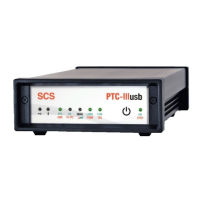
The PTC-IIIusb operates this mode stand alone and without being connected to a PC!
To setup the APRS features the command APRS in the pac:- menu is available (refer to
chapter 9.8.1 on page 121). Also here the parts of the commands written in capital letters
are necessary to enter to invoke the command. The first argument following the APRS
command usually acts as a sub-command and selects a function. The final parameters are
defined with the arguments following this sub-command. If there is no sub-command
given and the numeric parameter follows directly to the APRS command, then this
parameter defines the APRS main mode.
APRS digipeating is not supported directly, but the normal digipeating features can be
used for simple APRS digipeating as well. An universal APRS digipeater can also be
established using a free program like UI-View.
APRS data is always transmitted using the modulation defined with the command Baud
(or %B in hostmode), (refer to chapter 9.8.2 on page 124 and chapter 10.4.27 on page
144).
5.11 Robust HF-Packet
Up till now Packet-Radio over shortwave has been basically a non-starter, has even been
heavily criticized because of the low effective throughput and many repeats due to
missing robustness. AX.25 is for shortwave not an ideal protocol, but with automatic
FRack setting and a small MAXFrame value the protocol should however function much
better on a shortwave channel than has previously been the case generally.
1
APRS is registered Trademark of the APRS Engineering LCC, USA


 To Next Page