
 Need help?
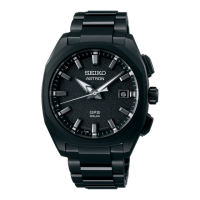
Do you have a question about the Seiko Astron SSJ009J and is the answer not in the manual?
Warning about the dangers of button batteries if swallowed or misused.
Stop wearing the watch if the body/band is corroded or pins protrude.
Keep watch and accessories away from children to prevent accidental swallowing.
Do not remove the secondary battery; replacement requires professional knowledge.
Avoid places with volatile agents, extreme temperatures, strong magnetism, or high humidity.
Stop wearing and consult a specialist for allergic symptoms or skin irritation.
Avoid disassembly, keep away from children, dispose of batteries properly, mind straps.
Do not use for scuba or saturation diving; use watches designed for diving.
Do not turn or pull the crown when the watch is wet to prevent water ingress.
Do not pour running water directly from faucet; use bowl to protect water resistance.
Do not leave moisture, sweat, or dirt on the watch to prevent deterioration of water resistance.
Avoid wearing the watch in baths or saunas to prevent deterioration of water resistance from steam.
Adjusts time to current location using GPS signals with one button operation.
Operates by solar charging; expose dial to light to charge the watch.
Automatically adjusts time based on GPS signals received under open sky.
Explains the US Department of Defense's NAVSTAR GPS satellite system orbiting Earth.
Receives GPS signals to set time and date using atomic clock and location data.
Defines time zones as regions sharing the same standard time, based on UTC.
Explains DST as a system to lengthen daylight by advancing time by 1 hour in summer.
Defines UTC as the universal standard time coordinated internationally for recording time.
Adjusts time zone and shows correct time when region or time zone changes.
Sets correct time for a specific time difference by performing manual time adjustment.
The case back shows the caliber-case number to identify the watch type.
Procedures to set the correct time when the region's time zone has changed.
Identifies the hour, minute, and seconds hands of the watch.
Identifies the crown and buttons (A and B) used for watch operations.
Identifies the date display window on the watch face.
Displays "Y" for successful reception and "N" for failed reception of GPS signals.
Shows the status of the in-flight mode, which prevents interference with aircraft electronics.
Displays the watch's battery charge level (full, middle, low) using the hands.
Provides a list of city time differences from UTC, including DST information.
Explains how to adjust the time difference using the crown rotation direction.
Check the watch's energy level by pushing and releasing Button B.
Indicates whether GPS signal reception is allowed or not based on the charging status.
Expose the watch dial to light to charge the battery for optimal performance.
Provides estimated charging times based on illumination levels and conditions.
Outlines steps for checking GPS signal reception and setting time/date.
Outlines steps for manual time and date setting when GPS reception is not possible.
Outdoors under an open sky with good visibility is ideal for receiving GPS signals.
Areas with limited sky view or obstructions make GPS signal reception difficult.
Indoors, underground, or near interference sources prevent GPS signal reception.
Displays correct current time for the selected time difference in the same time zone.
Identifies current location's time zone and displays correct time for different time zones.
Receives leap second data to compensate for deviations in universal time.
Addresses questions on automatic local time display, DST, and leap seconds.
The seconds hand indicates reception success (Y) or failure (N) for 5 seconds.
If reception is successful (Y), use the watch as it is.
If reception fails (N), move to better GPS signals or manually set the time.
Adjusts the watch to the precise current time for any time zone with one button operation.
Notes on time zone correction near borders and when to manually set time difference.
Go to a place with good GPS signals and press Button B for 3 seconds to start.
Direct watch face upward, wait for reception, and check the result display.
Sets the correct current time for a selected time difference without changing the time zone.
Used after time zone adjustment or when time zone changes, if DST needs manual setting.
Go to a place with good GPS signals and press Button A for 3 seconds to start.
Wait for reception, check the result, and ensure time and date are correct.
Manually sets the time difference when time zone adjustment cannot be performed.
Details how to set time difference using crown for 1-hour and 15-minute increments.
Automatically adjusts time by receiving GPS signals when exposed to sufficient light outdoors.
Stores previous successful manual adjustment time for automatic adjustment in low light.
Set in-flight mode to prevent GPS signal reception from interfering with aircraft electronics.
Turn off in-flight mode when leaving an aircraft to enable GPS signal reception.
Leap seconds compensate for deviations between universal time (UT) and atomic time (TAI).
Automatically receives leap second data from GPS signals when needed.
Leap second data is received during GPS signal reception on June 1st and December 1st.
Displays success (Y) or failure (N) of leap second data reception.
If leap second data reception is successful (Y), use the watch as it is.
If failed (N), move to a location with better GPS signals for re-attempt.
Seconds hand moves at 2 or 5-sec intervals indicating low energy depletion.
Hands stop at 15 or 45-sec positions when Power Save modes 1 or 2 are activated.
Wipe away moisture, sweat, dirt; avoid washing with crown extended.
Turn the crown and press buttons periodically to prevent corrosion.
Information on watch performance, caliber/case number, and water resistant ratings.
Magnetism can cause temporary time gain, loss, or stoppage; watch has automatic adjustment.
Keep the watch more than 5 cm away from magnetic products to prevent magnetization.
Care instructions for metallic, leather, polyurethane, and silicone bands to prevent damage.
Adjust band for clearance and be aware of potential skin irritation or allergies.
Instructions on how to open and close the easy adjust type clasp.
Details how to lengthen the band by up to 5mm using the clasp's adjuster.
Instructions for wearing and taking off the watch using the three-fold clasp.
Details how to adjust band length by pulling and reinserting pins in adjustment holes.
Instructions for wearing and removing the watch with the pointed tip diving type clasp.
Details how to adjust band length by moving pins in adjustment holes on the diving type clasp.
Lumibrite absorbs light energy and emits it in the dark for visibility.
Provides brightness levels (lux) and corresponding light emission durations for Lumibrite.
Uses a special secondary battery that does not require periodic replacement.
Features overcharge prevention; avoid intense light sources during charging to prevent overheating.
Contact retailer/service center for repair/overhaul; present guarantee certificate.
Replacement parts warranted for 7 years; substitutes may be used if originals unavailable.
Recommends periodic inspection and cleaning (overhaul) every 3-4 years for optimal performance.
Addresses issues with not starting or receiving GPS signals, including low energy and in-flight mode.
Provides instructions for manually setting the time when GPS signals are unavailable.
Step-by-step guide to manually set the watch's time using the crown and buttons.
Addresses time inaccuracies after successful reception due to time difference or DST settings.
Explains misalignment of preliminary hand positions due to external factors like impact or magnetism.
Guides on adjusting the standard positions of the date and hour/minute hands.
Detailed steps for manually aligning the hour, minute, and seconds hands to their correct positions.
Seconds hand moves at 2 or 5-sec intervals indicating low energy depletion.
Hands stop at 15 or 45-sec positions when Power Save modes 1 or 2 are activated.
Hands advance rapidly and return to current time; this is normal automatic correction.
Low charging status prevents GPS reception; charge the watch to "middle" or "full".
In-flight mode blocks GPS signals; reset the mode after relocation from aircraft.
If GPS signals cannot be received, move to a location with better signal reception.
Inaccurate time/date post-reception may require resetting the time difference.
Hand misalignment or incorrect preliminary positions can cause time/date inaccuracies.
Automatic time adjustment fails due to insufficient energy or unmet environmental conditions.
Automatic reception requires light exposure and good GPS signal conditions.
Incorrect seconds hand position may indicate misalignment; use automatic adjustment.
A 1-hour time gain/loss may occur if the time difference setting is incorrect.
Charging issues due to weak light or insufficient charging time for the solar battery.
Incorrect date after reception may be due to misalignment of the preliminary date position.
Crown/buttons inoperable due to low power or during date adjustment.
If lost mid-operation, follow steps to restart after date stops or crown is reset.
Persistent blur may indicate water ingress from gasket; consult retailer.
Receives GPS signals to adjust time, identify time zone, and display correct time.
Identifies current location's time zone and displays correct time for different zones.
Receives GPS signals to display correct time for the set time difference.
Determines optimal timing for GPS signal reception and automatically adjusts time.
Enables changing of the time difference and setting DST (daylight saving time).
Converts light to electrical energy to charge the battery using the solar cell.
Roughly displays the charged energy and the watch's ability to receive GPS signals.
Activates Power Save mode to reduce energy consumption when watch is left without light.
Basic watch functions include hour, minute, seconds hands, and date display.
The crystal oscillator frequency is 32,768 Hz (Hertz).
Monthly loss/gain rate is ±15 seconds under normal temperature range without GPS signal.
Operational temperature range is between -10°C and +60°C (14°F and 140°F).
The driving system uses a step motor for hands and date.
The power source is a secondary battery, 1 piece.
Duration of operation is about 6 months on a full charge (without power save).
Supports time zone adjustment, manual time adjustment, and automatic time adjustment.
Contains an IC with oscillator, frequency divider, and driving circuit (C-MOSIC, 4 pieces).
 General
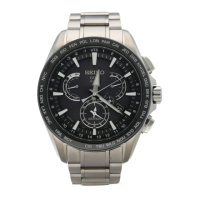
| Brand | Seiko |
|---|---|
| Case Material | Titanium |
| Band Material | Titanium |
| Case Diameter | 42.7 mm |
| Water Resistance | 10 bar (100 meters) |
| Dial Color | Black |
| Crystal | Sapphire crystal |
| Clasp Type | Three-fold clasp with push button release |
| Movement | Solar |
| Features | World Time |
| Functions | Date, Time |
| Model | Astron SSJ009J |




 To Next Page