12
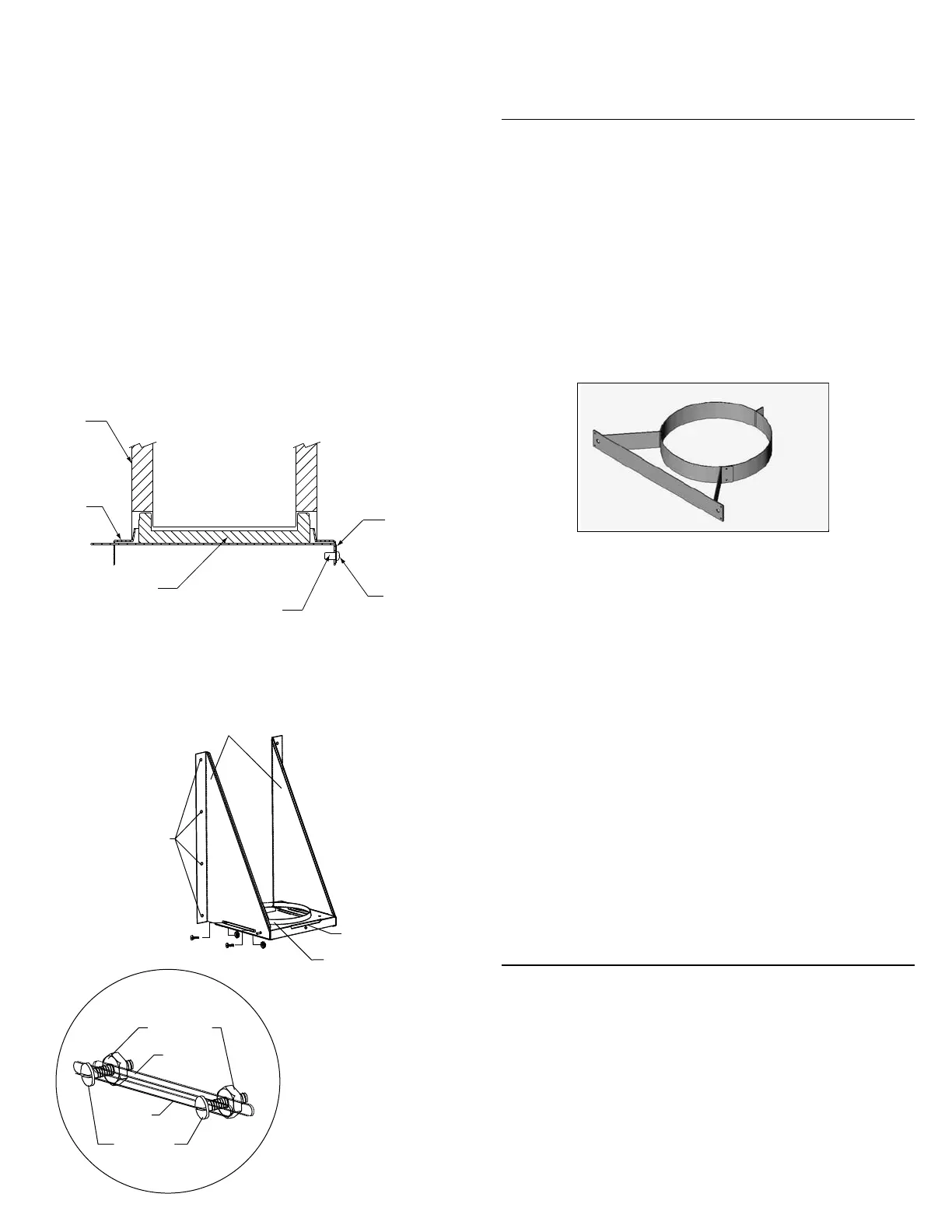
WARNING: The Insulated Tee Cap must be installed and
secured in place. Failure to install could cause fire, injury or death.
Insulated
Chimney
Sections
Support
Plate
Insulated Tee Cap
Nutsert
Screw to
Secure Tee
Cap Bracket
Tee Cap
Bracket
15. Insert the Insulated Tee Cap into the bottom of the Support Plate
opening and secure by sliding the Tee Cap Bracket into both slots
located at the front and rear of the Support Plate. Make sure the Tee
Cap Bracket is beneath the Tee Cap and the other end is exiting
through the slot at the back of the Support Plate. Secure in place by
threading the securing screw into the nutsert located on the front of
the Support Plate (Figures 16, 17 and 18).
FIGURE 18 - Securing of Insulated Tee Cap
14. Use a non-hardening high-temperature sealant (500
°
F) to seal
around the horizontal Chimney Length where it enters through the
exterior of the Wall Thimble or the concrete wall.
Nuts
Slot on
Support
Bracket
Support Brackets
Pre-Punched
Holes of
Support Bracket
Support Plate
w/ Flange Up
Slot for Tee Cap
Bracket
Slot on
Support
Plate
Bolts
FIG. 20- SLOT AREAS
WITH BOLTS (#8 x 3/4")
AND NUTS ASSEMBLY
OF SUPPORT BRACK-
ETS AND SUPPORT
PLATE
FIG. 19- FRONT VIEW
OF WALL SUPPORT
ASSEMBLY WITH
BRACKETS
MOUNTED ABOVE
THE SUPPORT PLATE
- ONLY IN A NON-
COMBUSTIBLE WALL
APPLICATION
17. For lateral stability of the chimney above the Wall Support ( either
AWS or WS), a Wall Band must be installed along an outside wall.
Install the first Wall Band midway up the first Chimney Length above
the Insulated Tee and any additional Wall Band to be installed at 8
foot intervals above this point. Secure the Wall Band bracket to the
wall using 2 6d (2") spiral nails or #8 x 2" wood screws through the
pre-drilled holes (see Figure 21). For concrete or brick veneer walls,
use suitable masonry fasteners or other anchoring systems.
18. Fasten securely the Wall Band around the chimney with the
supplied nut and bolt. Check for clearances and plumb as you fasten
the Wall Bands to the wall. Use a level against the chimney sections
at each support stage to keep the assembly plumb.
19. If the chimney penetrates an eave or overhang (soffit) cut an
opening with 2" clearance all around. To find the exact spot where
the chimney will pass through the eaves, drop a plumb line from the
underside of the eaves to the outer edge of the leveled chimney.
Mark 5 or 6 points to give an outline of the hole. Remember that
the hole will need 2" clearance to the chimney surface. Install an
Attic Insulation Shield if space permits on the under side of the
overhang. If it is not possible, the overhang area can be enclosed
and a Rafter Radiation Shield installed at the roof level and a
Finishing Plate on the underside of the soffit. If the Attic is open
to the overhang, close off the access with suitable building mate-
rials ensuring that a 2" air space clearance is maintained. From
above, install the Roof Flashing and Storm Collar by following the
Roof Flashing section in these instructions. If the overhang is not
deep enough to allow the chimney to be fully installed within the
overhang, it will be necessary to cut into it. Ensure that a 2"air
space clearance all around the chimney is respected. Framing and
flashing the sides of the opening will be required. Install a Wall
Band at this level.
NOTE: Interior chimneys installed with a Wall Support must use an
Attic Insulation Shield (AIS) when extending through floor/ceiling
joist and into attic space.
Wall Band
Figure 21
NOTE: If ground clearance does not permit the installation of the Wall
Support with the Support Bracket facing down, it is permissible to
invert these brackets, if in a non-combustilbe wall application.
Inverting the brackets (brackets mounted on the wall above the
support plate) can be accomplished by rotating the Support Plate so
that the threaded stud faces toward the front and securing each side
with (2) #8 x 3/4" bolts (not supplied) through the oblong slots of the
support side brackets and the support plate as per Figures 19 and 20.
Secure with nuts. In this position, the range of adjustability is limited
to 5” from the wall. Install the Insulated Tee Cap as per step 15.
To complete a proper Cathedral Ceiling Support installation, the
following parts may required:
- Cathedral Ceiling Support (CCS): To support chimney with a sloped
ceiling
- Stove Pipe Adaptor (ASE): Transition from the chimney to flue pipe.
- Universal Shielding Insulation (JUSI): To reduce cold air infiltration
into the dwelling when installed in conjunction with the Cathedral
Ceiling Support.
- Roof Flashing Assembly: Required when the chimney penetrates
a roof.
- Suitable length(s) of chimney: The chimney diameter should be sized
to suit the appliance.
- Rain Cap: To prevent rain and/or debris from entering into the
chimney. Standard or Deluxe model.
CATHEDRAL CEILING SUPPORT (CCS)
16. Chimney Lengths above the Insulated Tee are simply stacked
on and locked with a 1/8 clockwise turn.
Wall Band (WB)



 To Next Page
 Loading...