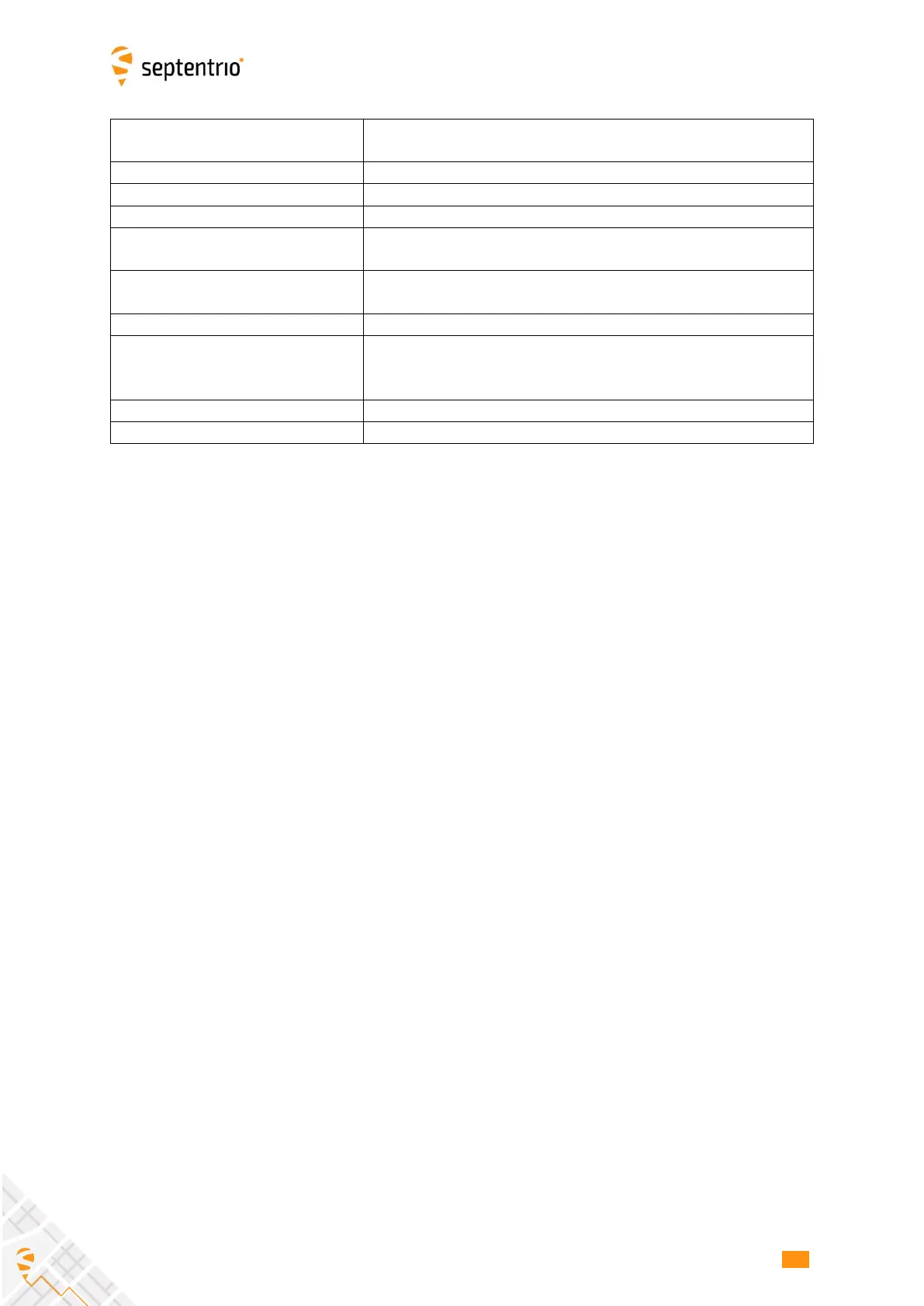
4.5 dB typ. on passive antenna
10 dB typ. with 15 dB pre-amplification
20 dB typ. with 30 dB pre-amplification
1
The net gain is the total pre-amplification of the distribution network in front of the receiver. Typically, this
equals antenna active LNA gain minus coax losses in the applicable GNSS bands.
2.4.2 System Noise Figure and C/N0
The system noise figure, in dB, can be calculated as:
NFsys = 10*log
10
(10
NFant/10
+ (10
NFrx/10
-1)/10
Gpreamp/10
)
where
• NFant is the antenna LNA noise figure, in dB;
• NFrx is the receiver noise figure, in dB. See table above;
• Gpreamp is the net gain in front of the receiver, in dB.
For example, with a 2.5-dB antenna LNA noise figure, 30-dB antenna LNA gain and 15-dB
cable loss, Gpreamp = 30dB-15dB = 15dB and NRrx is 10dB (see table in section 2.4.1). In
this case, the system noise figure is:
NFsys = 10.log
10
(10
2.5/10
+ (10
10/10
-1)/10
15/10
) = 3.14 dB.
The C/N0, in dB-Hz, of a GNSS signal received at a power P can be computed by:
C/N0 = P - 10.log
10
(Tant + 290*(10
NFsys/10
-1)) + 228.6 dB
where
• P is the received GNSS signal power including the gain of the antenna passive
radiating element, in dBW (e.g. -155dBW)
• Tant is the antenna noise temperature, in Kelvin. Typically Tant = 130K for an open-
sky antenna.
• 228.6 is -10*log10(k
B
) with k
B
=1.38e-23 J/K the Boltzmann constant.


 To Next Page