www.servware.com
800•768•5953
Service, Installation & Care Manual
17
04. KNOWING THE EQUIPMENT
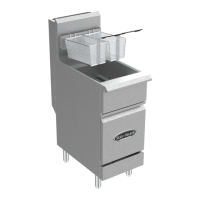
The Fryer Gas Cabinet has been designed and manufactured to offer the user the best in
the market for cafeteria, restaurant and kitchen equipment in general.
The equipment was developed to obtain a more uniform cooking process in the food. For
this, the tank acts as an intermediary between the heat source (re) and the food, and it is
through its caloric capacity that the equipment guarantees the best avor in the food.
The fryer is designed only for the use of oil or vegetable fat in the cooking process with
the food. Water may only be used for cleaning equipment.
The tank assembly is developed with innovative design, prizing for the functionality and
efciency of heat distribution.
The gas distribution and are assembly is assembled and tested with rigorous quality
processes to ensure the safety and efciency of cast iron burners.
The fryer has a thermopile that has two functions, the rst being to ensure that the pilot
ame remains in operation so that in a heat demand the main burner will be lit. The
second function is to provide safety to the operator in order to detect the existence of a
ame for safety purposes by closing the possible gas ow to a burner.
This should be lit only once a day, and so should stay on throughout the workday as
consumption is very low.
In addition, 6" (152 mm) swivel castors can be purchased separately for the equipment.
• Available in 40 lb (16 l), 50 lb (20 l) and 75 lb (30 l) sizes.
• Tank - stainless steel providing durability for a high production output.
• 1 1/4'' Full port drain valve for fast draining.
• Cabinet - Stainless steel front, door and sides.
• Millivolt Thermostat, 200 ° F – 400 ° F (93.3 °C – 204.4°C).
• High-Temperature safety limit switch.
• Thermo-Safety pilot with built-in regulator.
• Separate Manual gas shut offs, for front servicing.
• Heavy-duty cast iron burners.
• Tubes constructed of heavy gauge metal.
• Heavy gauge deector system providing a quicker recovery time.
4.1 Main Features


 To Next Page